

9-1 H2 : → *; C2H4 : → *
123
Inspection of Eqn. (6) for 2 (MO)
shows that it corresponds to the HeitlerLondon function obtained when the + of Eqn. (2) is replaced by a – ; this is a
result that we have obtained previously in section 3-5. We may also obtain
3 (MO)
(≡
(ionic)) from
(HL)
by exciting an electron from one atomic
orbital into the other and changing the sign of the linear combination. (The sign
change is necessary in order to satisfy the spectroscopic rule that an “even” →
“odd” excitation is allowed, whereas both “even” → “even” and “odd” → “odd”
excitations are forbidden. The “even” and “odd” characters of
(HL)
and
(ionic)
refer to the behaviour of the wave-functions with respect to inversion
through the centre of symmetry of the molecule. Thus
(HL)
and
(ionic)
are symmetric (even) and
(HL)
and
(ionic)
are antisymmetric (odd).)
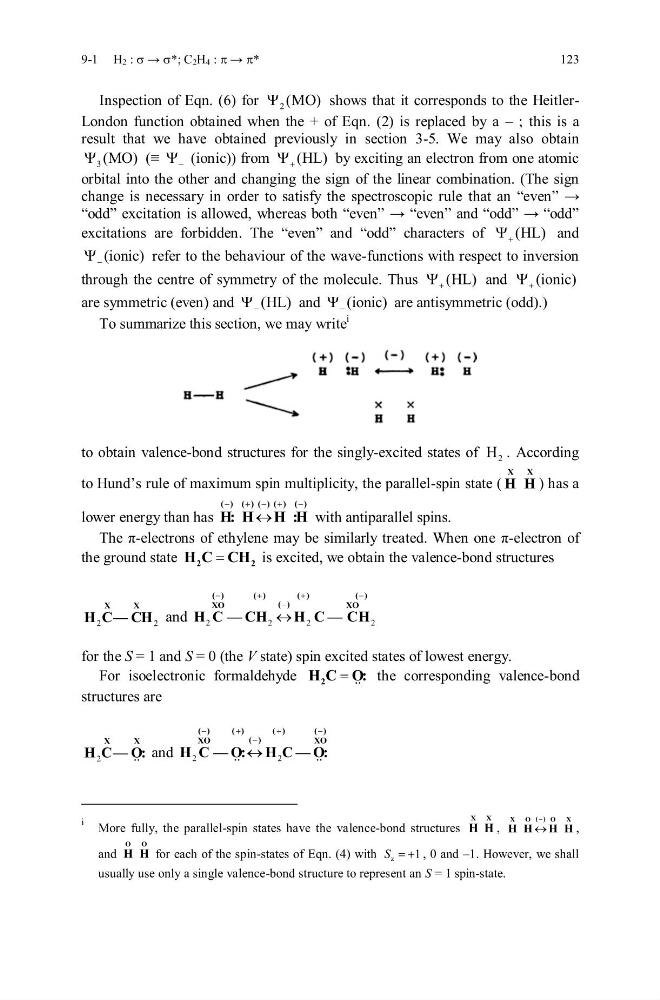
To summarize this section, we may write
i
to obtain valence-bond structures for the singly-excited states of 2
H . According
to Hund’s rule of maximum spin multiplicity, the parallel-spin state (
X
X
H H ) has a
lower energy than has
( ) ( ) ( ) ( ) ( )
H: H H :H with antiparallel spins.
The π-electrons of ethylene may be similarly treated. When one π-electron of
the ground state 2
2
H C CH
is excited, we obtain the valence-bond structures
2
2
X
X
H C— CH and 2
2
2
2
( )
( )
( )
( )
( )
XO
XO
H C — CH
H C — CH
for the S = 1 and S = 0 (the V state) spin excited states of lowest energy.
For isoelectronic formaldehyde
2
H C O:
the corresponding valence-bond
structures are
2
X
X
H C— O:
and 2
2
( )
( )
( )
( )
( )
XO
XO
H C — O: H C — O:
i More fully, the parallel-spin states have the valence-bond structures
X X
H H ,
( )
X
O
O
X
H H H H
,
and
O
O
H H for each of the spin-states of Eqn. (4) with z
1
S
, 0 and –1. However, we shall
usually use only a single valence-bond structure to represent an S = 1 spin-state.
123
Inspection of Eqn. (6) for 2 (MO)
shows that it corresponds to the HeitlerLondon function obtained when the + of Eqn. (2) is replaced by a – ; this is a
result that we have obtained previously in section 3-5. We may also obtain
3 (MO)
(≡
(ionic)) from
(HL)
by exciting an electron from one atomic
orbital into the other and changing the sign of the linear combination. (The sign
change is necessary in order to satisfy the spectroscopic rule that an “even” →
“odd” excitation is allowed, whereas both “even” → “even” and “odd” → “odd”
excitations are forbidden. The “even” and “odd” characters of
(HL)
and
(ionic)
refer to the behaviour of the wave-functions with respect to inversion
through the centre of symmetry of the molecule. Thus
(HL)
and
(ionic)
are symmetric (even) and
(HL)
and
(ionic)
are antisymmetric (odd).)
To summarize this section, we may write
i
to obtain valence-bond structures for the singly-excited states of 2
H . According
to Hund’s rule of maximum spin multiplicity, the parallel-spin state (
X
X
H H ) has a
lower energy than has
( ) ( ) ( ) ( ) ( )
H: H H :H with antiparallel spins.
The π-electrons of ethylene may be similarly treated. When one π-electron of
the ground state 2
2
H C CH
is excited, we obtain the valence-bond structures
2
2
X
X
H C— CH and 2
2
2
2
( )
( )
( )
( )
( )
XO
XO
H C — CH
H C — CH
for the S = 1 and S = 0 (the V state) spin excited states of lowest energy.
For isoelectronic formaldehyde
2
H C O:
the corresponding valence-bond
structures are
2
X
X
H C— O:
and 2
2
( )
( )
( )
( )
( )
XO
XO
H C — O: H C — O:
i More fully, the parallel-spin states have the valence-bond structures
X X
H H ,
( )
X
O
O
X
H H H H
,
and
O
O
H H for each of the spin-states of Eqn. (4) with z
1
S
, 0 and –1. However, we shall
usually use only a single valence-bond structure to represent an S = 1 spin-state.