

122
Chapter 9 Excited States
wave-functions of Eqs. (4) and (5), which have respectively parallel and antiparallel spins for the two electrons. (In Eqs. (4) and (5) the S and z
S spin quantum
numbers have the following values:
2 (MO) :
1
S
, z 1
S , 0 and –1;
3
z
(MO) :
0
S S
.)
1
2
2
(1) (2)
(MO) { (1) * (2) – * (1) (2)} { (1) (2) (1) (2)} / 2
(1) (2)
(4)
1
2
3 (MO) { (1) * (2)
* (1) (2)} { (1) (2) – (1) (2)} / 2
(5)
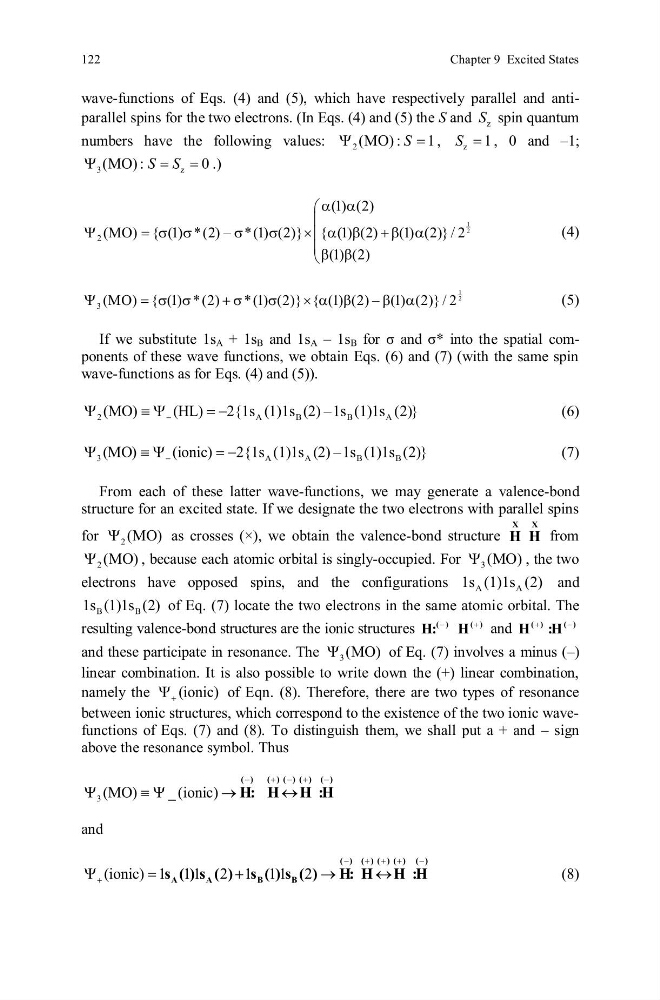
If we substitute 1s A + 1s B and 1s A – 1s B for σ and σ* into the spatial components of these wave functions, we obtain Eqs. (6) and (7) (with the same spin
wave-functions as for Eqs. (4) and (5)).
2
A
B
B
A
(MO)
(HL)
2{1s (1)1s (2) –1s (1)1s (2)}
(6)
3
A
A
B
B
(MO)
(ionic)
2{1s (1)1s (2) –1s (1)1s (2)}
(7)
From each of these latter wave-functions, we may generate a valence-bond
structure for an excited state. If we designate the two electrons with parallel spins
for 2 (MO)
as crosses (×), we obtain the valence-bond structure
X
X
H H from
2 (MO)
, because each atomic orbital is singly-occupied. For 3 (MO)
, the two
electrons have opposed spins, and the configurations
A
A
1s (1)1s (2) and
B
B
1s (1)1s (2) of Eq. (7) locate the two electrons in the same atomic orbital. The
resulting valence-bond structures are the ionic structures
( )
( )
H: H and
( )
( )
H :H
and these participate in resonance. The 3 (MO)
of Eq. (7) involves a minus (–)
linear combination. It is also possible to write down the (+) linear combination,
namely the
(ionic)
of Eqn. (8). Therefore, there are two types of resonance
between ionic structures, which correspond to the existence of the two ionic wavefunctions of Eqs. (7) and (8). To distinguish them, we shall put a + and – sign
above the resonance symbol. Thus
3 (MO)
(ionic)
( )
( ) ( ) ( ) ( )
_
H: H H :H
and
(ionic) 1 1 1 2 1 1 1 2
( ) ( ) ( ) ( ) ( )
A
A
B
B
s ( ) s ( ) s ( ) s ( ) H: H H :H
(8)
Chapter 9 Excited States
wave-functions of Eqs. (4) and (5), which have respectively parallel and antiparallel spins for the two electrons. (In Eqs. (4) and (5) the S and z
S spin quantum
numbers have the following values:
2 (MO) :
1
S
, z 1
S , 0 and –1;
3
z
(MO) :
0
S S
.)
1
2
2
(1) (2)
(MO) { (1) * (2) – * (1) (2)} { (1) (2) (1) (2)} / 2
(1) (2)
(4)
1
2
3 (MO) { (1) * (2)
* (1) (2)} { (1) (2) – (1) (2)} / 2
(5)
If we substitute 1s A + 1s B and 1s A – 1s B for σ and σ* into the spatial components of these wave functions, we obtain Eqs. (6) and (7) (with the same spin
wave-functions as for Eqs. (4) and (5)).
2
A
B
B
A
(MO)
(HL)
2{1s (1)1s (2) –1s (1)1s (2)}
(6)
3
A
A
B
B
(MO)
(ionic)
2{1s (1)1s (2) –1s (1)1s (2)}
(7)
From each of these latter wave-functions, we may generate a valence-bond
structure for an excited state. If we designate the two electrons with parallel spins
for 2 (MO)
as crosses (×), we obtain the valence-bond structure
X
X
H H from
2 (MO)
, because each atomic orbital is singly-occupied. For 3 (MO)
, the two
electrons have opposed spins, and the configurations
A
A
1s (1)1s (2) and
B
B
1s (1)1s (2) of Eq. (7) locate the two electrons in the same atomic orbital. The
resulting valence-bond structures are the ionic structures
( )
( )
H: H and
( )
( )
H :H
and these participate in resonance. The 3 (MO)
of Eq. (7) involves a minus (–)
linear combination. It is also possible to write down the (+) linear combination,
namely the
(ionic)
of Eqn. (8). Therefore, there are two types of resonance
between ionic structures, which correspond to the existence of the two ionic wavefunctions of Eqs. (7) and (8). To distinguish them, we shall put a + and – sign
above the resonance symbol. Thus
3 (MO)
(ionic)
( )
( ) ( ) ( ) ( )
_
H: H H :H
and
(ionic) 1 1 1 2 1 1 1 2
( ) ( ) ( ) ( ) ( )
A
A
B
B
s ( ) s ( ) s ( ) s ( ) H: H H :H
(8)