

Chapter 9 Excited States
It is frequently considered that valence-bond theory is not easily adapted to provide qualitative descriptions of molecular excited states. No doubt this is often
true. However, for some simple systems, there exists an elementary valence-bond
counterpart for each molecular orbital description of the excited state. To demonstrate this point, we shall give consideration here to a few types of electronic
excitations.
9-1 H 2 : → *; C 2 H 4 : → *
For the H 2 ground-state, the covalent bond for the valence-bond structure H — H
involves a pair of shared electrons with opposite spins. In Section 3-3, we have
discussed the simplest wave-functions that can be associated with the electron-pair
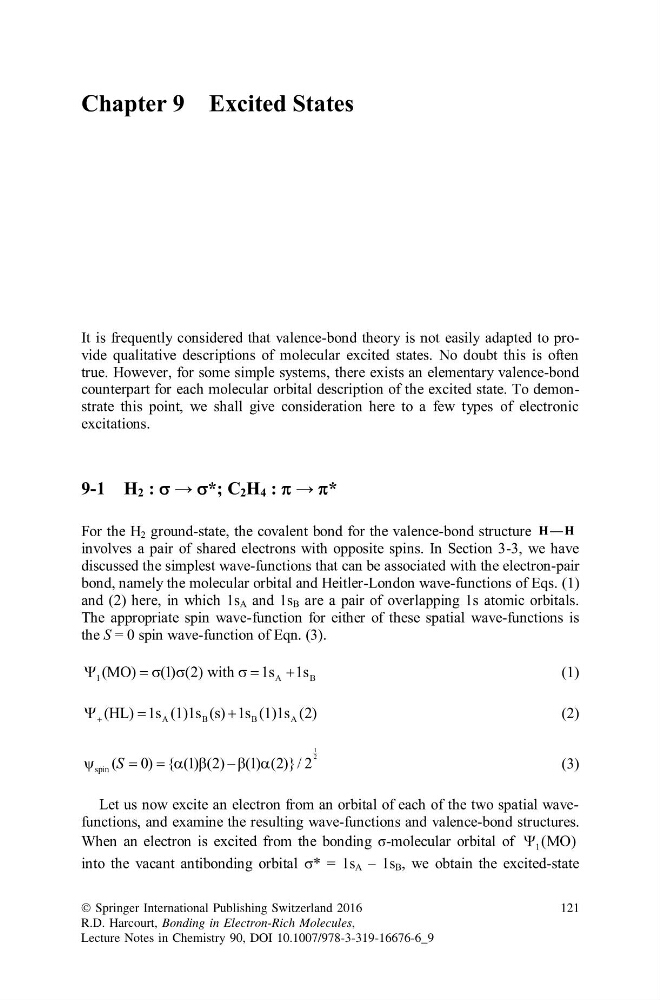
bond, namely the molecular orbital and Heitler-London wave-functions of Eqs. (1)
and (2) here, in which 1s A and 1s B are a pair of overlapping 1s atomic orbitals.
The appropriate spin wave-function for either of these spatial wave-functions is
the S = 0 spin wave-function of Eqn. (3).
1
A
B
(MO)
(1) (2) with
1s 1s
(1)
A
B
B
A
(HL) 1s (1)1s (s) 1s (1)1s (2)
(2)
1
2
spin (
0) { (1) (2) – (1) (2)} / 2
S
(3)
Let us now excite an electron from an orbital of each of the two spatial wavefunctions, and examine the resulting wave-functions and valence-bond structures.
When an electron is excited from the bonding σ-molecular orbital of 1 (MO)
into the vacant antibonding orbital * = 1s A – 1s B , we obtain the excited-state
Ó Springer International Publishing Switzerland 2016
R.D. Harcourt, Bonding in Electron-Rich Molecules,
Lecture Notes in Chemistry 90, DOI 10.1007/978-3-319-16676-6_9
121
It is frequently considered that valence-bond theory is not easily adapted to provide qualitative descriptions of molecular excited states. No doubt this is often
true. However, for some simple systems, there exists an elementary valence-bond
counterpart for each molecular orbital description of the excited state. To demonstrate this point, we shall give consideration here to a few types of electronic
excitations.
9-1 H 2 : → *; C 2 H 4 : → *
For the H 2 ground-state, the covalent bond for the valence-bond structure H — H
involves a pair of shared electrons with opposite spins. In Section 3-3, we have
discussed the simplest wave-functions that can be associated with the electron-pair
bond, namely the molecular orbital and Heitler-London wave-functions of Eqs. (1)
and (2) here, in which 1s A and 1s B are a pair of overlapping 1s atomic orbitals.
The appropriate spin wave-function for either of these spatial wave-functions is
the S = 0 spin wave-function of Eqn. (3).
1
A
B
(MO)
(1) (2) with
1s 1s
(1)
A
B
B
A
(HL) 1s (1)1s (s) 1s (1)1s (2)
(2)
1
2
spin (
0) { (1) (2) – (1) (2)} / 2
S
(3)
Let us now excite an electron from an orbital of each of the two spatial wavefunctions, and examine the resulting wave-functions and valence-bond structures.
When an electron is excited from the bonding σ-molecular orbital of 1 (MO)
into the vacant antibonding orbital * = 1s A – 1s B , we obtain the excited-state
Ó Springer International Publishing Switzerland 2016
R.D. Harcourt, Bonding in Electron-Rich Molecules,
Lecture Notes in Chemistry 90, DOI 10.1007/978-3-319-16676-6_9
121