

Addendum Chapter 8
119
here. Of course the covalent structures of types (8) and (11) in Section 13-3,
together with their ionic partners, participate in resonance with structures (9), (10)
and their ionic partners. Altogether there are ten S = 0 spin structures. A similar
type of covalent-ionic resonance scheme is also appropriate for the six S = 1 spin
structures, and their contributions to the magnetic exchange parameter will modify
Eqn. (1) here. With ψ ab = a + kb and ψ dc = d + kc, the simplest expression
32(c,d)
for J is then given by Eqn. (9),
J = –2[(β bc ) 2 /{(bb|bb) – (bb|cc)} – k 2 J CuO (β bc + β ad ) 2 /{(aa|bb) – (aa|cc)} 2
+ k 4 (β ad ) 2 /{(aa|aa) – (aa|dd)}]/(k 2 + 1) 2
(9)
in which the (ii|jj) are 2-electron repulsion integrals when the electrons occupy the
i and j AOs.
In Eqn. (9), k is the “superexchange” parameter, which measures the extent of
delocalisation of electrons from the oxygen AOs (a and d) into the copper AOs
(b and c). The (µµ|νν) are (two-electron) Coulomb repulsion integrals which
involve a pair of AOs.
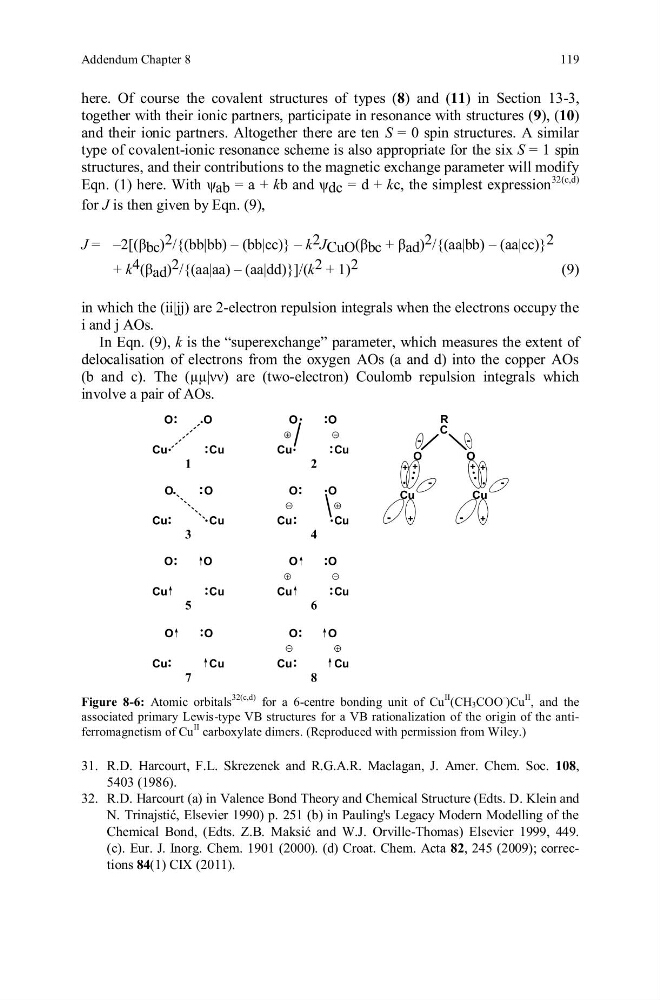
Figure 8-6: Atomic orbitals
32(c,d) for a 6-centre bonding unit of Cu
II (CH3COO
- )Cu
II , and the
associated primary Lewis-type VB structures for a VB rationalization of the origin of the antiferromagnetism of Cu
II carboxylate dimers. (Reproduced with permission from Wiley.)
31. R.D. Harcourt, F.L. Skrezenek and R.G.A.R. Maclagan, J. Amer. Chem. Soc. 108,
5403 (1986).
32. R.D. Harcourt (a) in Valence Bond Theory and Chemical Structure (Edts. D. Klein and
N. Trinajstić, Elsevier 1990) p. 251 (b) in Pauling's Legacy Modern Modelling of the
Chemical Bond, (Edts. Z.B. Maksić and W.J. Orville-Thomas) Elsevier 1999, 449.
(c). Eur. J. Inorg. Chem. 1901 (2000). (d) Croat. Chem. Acta 82, 245 (2009); corrections 84(1) CIX (2011).
O
O
Cu
Cu
O
O
Cu
Cu
O
O
Cu
Cu
O
O
Cu
Cu
O
O
Cu
Cu
O
O
Cu
Cu
O
O
Cu
Cu
Cu
O
+
-
+
+
-
Cu
O
+
-
+ +
-
C
-
-
R
1
O
O
Cu
Cu
2
3
4
5
6
7
8
119
here. Of course the covalent structures of types (8) and (11) in Section 13-3,
together with their ionic partners, participate in resonance with structures (9), (10)
and their ionic partners. Altogether there are ten S = 0 spin structures. A similar
type of covalent-ionic resonance scheme is also appropriate for the six S = 1 spin
structures, and their contributions to the magnetic exchange parameter will modify
Eqn. (1) here. With ψ ab = a + kb and ψ dc = d + kc, the simplest expression
32(c,d)
for J is then given by Eqn. (9),
J = –2[(β bc ) 2 /{(bb|bb) – (bb|cc)} – k 2 J CuO (β bc + β ad ) 2 /{(aa|bb) – (aa|cc)} 2
+ k 4 (β ad ) 2 /{(aa|aa) – (aa|dd)}]/(k 2 + 1) 2
(9)
in which the (ii|jj) are 2-electron repulsion integrals when the electrons occupy the
i and j AOs.
In Eqn. (9), k is the “superexchange” parameter, which measures the extent of
delocalisation of electrons from the oxygen AOs (a and d) into the copper AOs
(b and c). The (µµ|νν) are (two-electron) Coulomb repulsion integrals which
involve a pair of AOs.
Figure 8-6: Atomic orbitals
32(c,d) for a 6-centre bonding unit of Cu
II (CH3COO
- )Cu
II , and the
associated primary Lewis-type VB structures for a VB rationalization of the origin of the antiferromagnetism of Cu
II carboxylate dimers. (Reproduced with permission from Wiley.)
31. R.D. Harcourt, F.L. Skrezenek and R.G.A.R. Maclagan, J. Amer. Chem. Soc. 108,
5403 (1986).
32. R.D. Harcourt (a) in Valence Bond Theory and Chemical Structure (Edts. D. Klein and
N. Trinajstić, Elsevier 1990) p. 251 (b) in Pauling's Legacy Modern Modelling of the
Chemical Bond, (Edts. Z.B. Maksić and W.J. Orville-Thomas) Elsevier 1999, 449.
(c). Eur. J. Inorg. Chem. 1901 (2000). (d) Croat. Chem. Acta 82, 245 (2009); corrections 84(1) CIX (2011).
O
O
Cu
Cu
O
O
Cu
Cu
O
O
Cu
Cu
O
O
Cu
Cu
O
O
Cu
Cu
O
O
Cu
Cu
O
O
Cu
Cu
Cu
O
+
-
+
+
-
Cu
O
+
-
+ +
-
C
-
-
R
1
O
O
Cu
Cu
2
3
4
5
6
7
8