

118
Chapter 8 Some Cu(II) Binuclear Transition-Metal Complexes
22 J. Kanamori, J. Phys. Chem. Solids, 10, 87 (1959).
23 J.B. Goodenough, Magnetism and the Chemical Bond, (Interscience 1963) p. 1654.
24 R.L. Martin in “New Pathways in Inorganic Chemistry”, (E.A.V. Ebsworth, A.G. Maddock and A.G. Sharpe (eds.), C.U.P., 1968), p. 175.
25 A.P. Ginsberg, Inorg. Chim. Acta Revs., 5, 45 (1971).
26 A.T. Casey, Aust. J. Chem., 25, 2311 (1972).
27 W.E. Hatfield in “Extended Interactions between Metal Ions in Transition Metal Complexes”, L.V. Interrante, (ed.), A.C.S. Symposium, Series No. 5, p. 116, 1974).
28 D.J. Hodgson, Progress in Inorg. Chem. 19, 173 (1976).
29 R.D. Harcourt and F. Skrezenek, in preparation.
30 C.G. Barraclough and R.W. Brookes, J. Chem. Soc. Faraday II, 70, 1364 (1974).
Addendum Chapter 8
The covalent-ionic resonance valence bond theory for the origin of the
antiferromagnetism of the Cu
II carboxylate dimers described in Sections 8-1(c) is
appropriate when nearest-neighbour Cu-O overlap integrals are omitted. When
these integrals are included
31,32 , the theory has been modified
32(c,d) as follows. We
restrict our attention to the origin of the antiferromagnetism for one Cu
II
(RCOO -
)Cu
II component of the dimer.
The primary type of [CuO)(CuO) ↔ (CuO) - (CuO) + ↔ (CuO) + (CuO) - ]
covalent-ionic resonance involves the S = 0 and S = 1 spin VB structures of Fig. 822
31,32
. These structures arise from the delocalization of one oxygen lone-pair
electron of Figure 8-2 into a singly-occupied copper AO. Because the overlap
between the singly-occupied non-adjacent AOs is small, the covalent structures
are essentially degenerate, i.e.
3
E cov ≈
1 E cov = E cov .
Each of the S = 0 spin ionic structures involves a nearest-neighbour Cu–O
electron-pair bond. It has been deduced
32(c,d) that the resulting expression for the
magnetic exchange parameter is given approximately by Eqn. (8),
J = (β ad + β bc )
2
J CuO /(
1 E ion – E cov )
2
(8)
in which β ad and β bc are O–O and Cu–Cu overlap-dependent resonance integrals,
and J CuO = ½{
1
E(Cu–O) –
3 E(Cu–O)} is the (negative) exchange integral for the
nearest-neighbour Cu–O electron-pair bond that is present in each of the S = 0
spin ionic structures.
The S = 0 spin covalent valence-bond structures 1 and 3 of Fig. 8-6 correspond
to the valence-bond structures (9) and (10) in Section 13-3, in which A and D are
oxygen atoms and B and C are copper atoms. The ionic structures 2 and 4 of Fig.
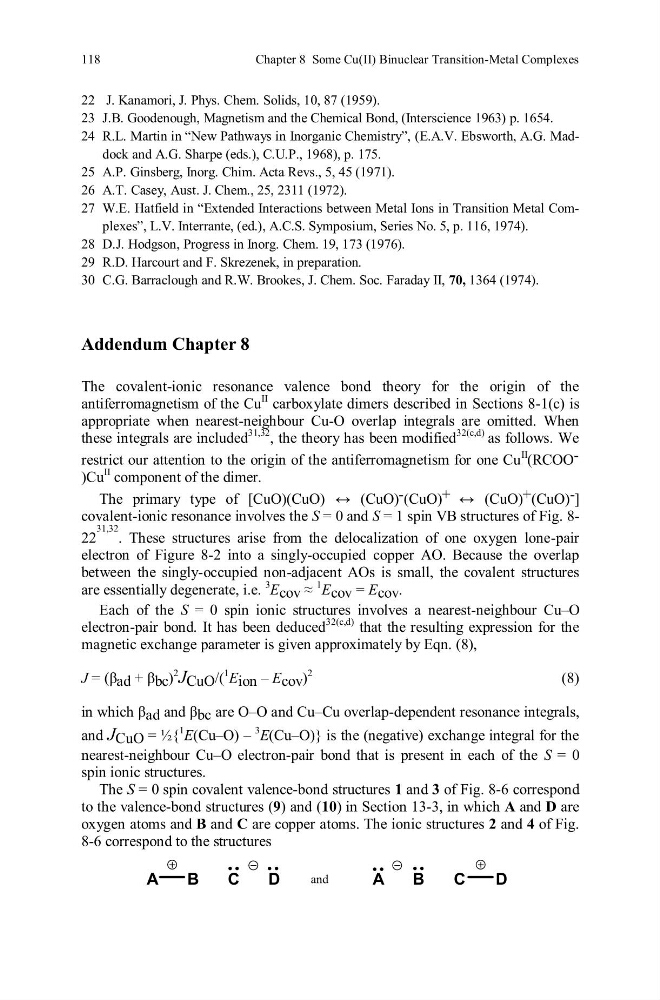
8-6 correspond to the structures
C
D
A
B
and
C
D
A
B
Chapter 8 Some Cu(II) Binuclear Transition-Metal Complexes
22 J. Kanamori, J. Phys. Chem. Solids, 10, 87 (1959).
23 J.B. Goodenough, Magnetism and the Chemical Bond, (Interscience 1963) p. 1654.
24 R.L. Martin in “New Pathways in Inorganic Chemistry”, (E.A.V. Ebsworth, A.G. Maddock and A.G. Sharpe (eds.), C.U.P., 1968), p. 175.
25 A.P. Ginsberg, Inorg. Chim. Acta Revs., 5, 45 (1971).
26 A.T. Casey, Aust. J. Chem., 25, 2311 (1972).
27 W.E. Hatfield in “Extended Interactions between Metal Ions in Transition Metal Complexes”, L.V. Interrante, (ed.), A.C.S. Symposium, Series No. 5, p. 116, 1974).
28 D.J. Hodgson, Progress in Inorg. Chem. 19, 173 (1976).
29 R.D. Harcourt and F. Skrezenek, in preparation.
30 C.G. Barraclough and R.W. Brookes, J. Chem. Soc. Faraday II, 70, 1364 (1974).
Addendum Chapter 8
The covalent-ionic resonance valence bond theory for the origin of the
antiferromagnetism of the Cu
II carboxylate dimers described in Sections 8-1(c) is
appropriate when nearest-neighbour Cu-O overlap integrals are omitted. When
these integrals are included
31,32 , the theory has been modified
32(c,d) as follows. We
restrict our attention to the origin of the antiferromagnetism for one Cu
II
(RCOO -
)Cu
II component of the dimer.
The primary type of [CuO)(CuO) ↔ (CuO) - (CuO) + ↔ (CuO) + (CuO) - ]
covalent-ionic resonance involves the S = 0 and S = 1 spin VB structures of Fig. 822
31,32
. These structures arise from the delocalization of one oxygen lone-pair
electron of Figure 8-2 into a singly-occupied copper AO. Because the overlap
between the singly-occupied non-adjacent AOs is small, the covalent structures
are essentially degenerate, i.e.
3
E cov ≈
1 E cov = E cov .
Each of the S = 0 spin ionic structures involves a nearest-neighbour Cu–O
electron-pair bond. It has been deduced
32(c,d) that the resulting expression for the
magnetic exchange parameter is given approximately by Eqn. (8),
J = (β ad + β bc )
2
J CuO /(
1 E ion – E cov )
2
(8)
in which β ad and β bc are O–O and Cu–Cu overlap-dependent resonance integrals,
and J CuO = ½{
1
E(Cu–O) –
3 E(Cu–O)} is the (negative) exchange integral for the
nearest-neighbour Cu–O electron-pair bond that is present in each of the S = 0
spin ionic structures.
The S = 0 spin covalent valence-bond structures 1 and 3 of Fig. 8-6 correspond
to the valence-bond structures (9) and (10) in Section 13-3, in which A and D are
oxygen atoms and B and C are copper atoms. The ionic structures 2 and 4 of Fig.
8-6 correspond to the structures
C
D
A
B
and
C
D
A
B