

8-2 Cu(II)-X-Cu(II) Linkages
113
8-2 Cu(II)-X-Cu(II) Linkages
The 4-electron 3-centre bonding for linear triatomic M-X-M linkages has received
much attention since it was first described by Kramers
11
. For this type of linkage,
each M is a paramagnetic cation with a singly-occupied orbital that overlaps
with a doubly-occupied orbital of a closed-shell anion X (cf. Figure 2-4 for
2
2
2
Ni O Ni
). The paramagnetic cations are too widely separated for their orbitals to overlap significantly, and the phenomenon of superexchange (Section 8-1),
i.e. the delocalization of electrons from the doubly occupied ligand orbital into the
singly occupied cation orbitals, has been invoked to account for the observed
antiferromagnetism of solids such as NiO and
3
KNiF with linear M-X-M
linkages.
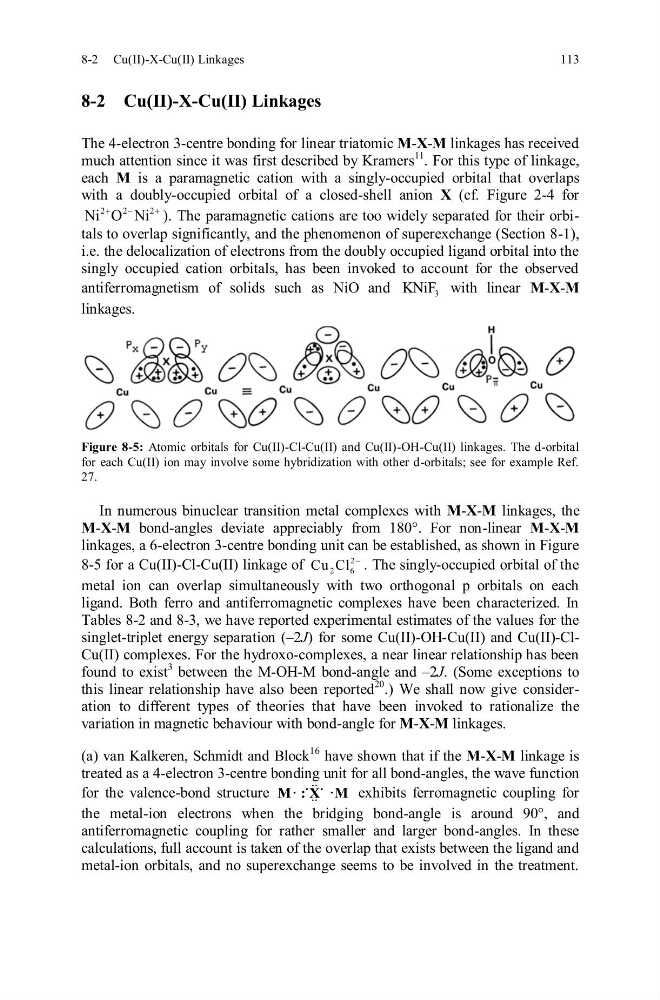
Figure 8-5: Atomic orbitals for Cu(II)-Cl-Cu(II) and Cu(II)-OH-Cu(II) linkages. The d-orbital
for each Cu(II) ion may involve some hybridization with other d-orbitals; see for example Ref.
27.
In numerous binuclear transition metal complexes with M-X-M linkages, the
M-X-M bond-angles deviate appreciably from 180°. For non-linear M-X-M
linkages, a 6-electron 3-centre bonding unit can be established, as shown in Figure
8-5 for a Cu(II)-Cl-Cu(II) linkage of
2
2
6
Cu Cl
. The singly-occupied orbital of the
metal ion can overlap simultaneously with two orthogonal p orbitals on each
ligand. Both ferro and antiferromagnetic complexes have been characterized. In
Tables 8-2 and 8-3, we have reported experimental estimates of the values for the
singlet-triplet energy separation (–2J) for some Cu(II)-OH-Cu(II) and Cu(II)-ClCu(II) complexes. For the hydroxo-complexes, a near linear relationship has been
found to exist
3 between the M-OH-M bond-angle and –2J. (Some exceptions to
this linear relationship have also been reported
20 .) We shall now give consideration to different types of theories that have been invoked to rationalize the
variation in magnetic behaviour with bond-angle for M-X-M linkages.
(a) van Kalkeren, Schmidt and Block
16 have shown that if the M-X-M linkage is
treated as a 4-electron 3-centre bonding unit for all bond-angles, the wave function
for the valence-bond structure
M· : X ·M exhibits ferromagnetic coupling for
the metal-ion electrons when the bridging bond-angle is around 90°, and
antiferromagnetic coupling for rather smaller and larger bond-angles. In these
calculations, full account is taken of the overlap that exists between the ligand and
metal-ion orbitals, and no superexchange seems to be involved in the treatment.
113
8-2 Cu(II)-X-Cu(II) Linkages
The 4-electron 3-centre bonding for linear triatomic M-X-M linkages has received
much attention since it was first described by Kramers
11
. For this type of linkage,
each M is a paramagnetic cation with a singly-occupied orbital that overlaps
with a doubly-occupied orbital of a closed-shell anion X (cf. Figure 2-4 for
2
2
2
Ni O Ni
). The paramagnetic cations are too widely separated for their orbitals to overlap significantly, and the phenomenon of superexchange (Section 8-1),
i.e. the delocalization of electrons from the doubly occupied ligand orbital into the
singly occupied cation orbitals, has been invoked to account for the observed
antiferromagnetism of solids such as NiO and
3
KNiF with linear M-X-M
linkages.
Figure 8-5: Atomic orbitals for Cu(II)-Cl-Cu(II) and Cu(II)-OH-Cu(II) linkages. The d-orbital
for each Cu(II) ion may involve some hybridization with other d-orbitals; see for example Ref.
27.
In numerous binuclear transition metal complexes with M-X-M linkages, the
M-X-M bond-angles deviate appreciably from 180°. For non-linear M-X-M
linkages, a 6-electron 3-centre bonding unit can be established, as shown in Figure
8-5 for a Cu(II)-Cl-Cu(II) linkage of
2
2
6
Cu Cl
. The singly-occupied orbital of the
metal ion can overlap simultaneously with two orthogonal p orbitals on each
ligand. Both ferro and antiferromagnetic complexes have been characterized. In
Tables 8-2 and 8-3, we have reported experimental estimates of the values for the
singlet-triplet energy separation (–2J) for some Cu(II)-OH-Cu(II) and Cu(II)-ClCu(II) complexes. For the hydroxo-complexes, a near linear relationship has been
found to exist
3 between the M-OH-M bond-angle and –2J. (Some exceptions to
this linear relationship have also been reported
20 .) We shall now give consideration to different types of theories that have been invoked to rationalize the
variation in magnetic behaviour with bond-angle for M-X-M linkages.
(a) van Kalkeren, Schmidt and Block
16 have shown that if the M-X-M linkage is
treated as a 4-electron 3-centre bonding unit for all bond-angles, the wave function
for the valence-bond structure
M· : X ·M exhibits ferromagnetic coupling for
the metal-ion electrons when the bridging bond-angle is around 90°, and
antiferromagnetic coupling for rather smaller and larger bond-angles. In these
calculations, full account is taken of the overlap that exists between the ligand and
metal-ion orbitals, and no superexchange seems to be involved in the treatment.