

114
Chapter 8 Some Cu(II) Binuclear Transition-Metal Complexes
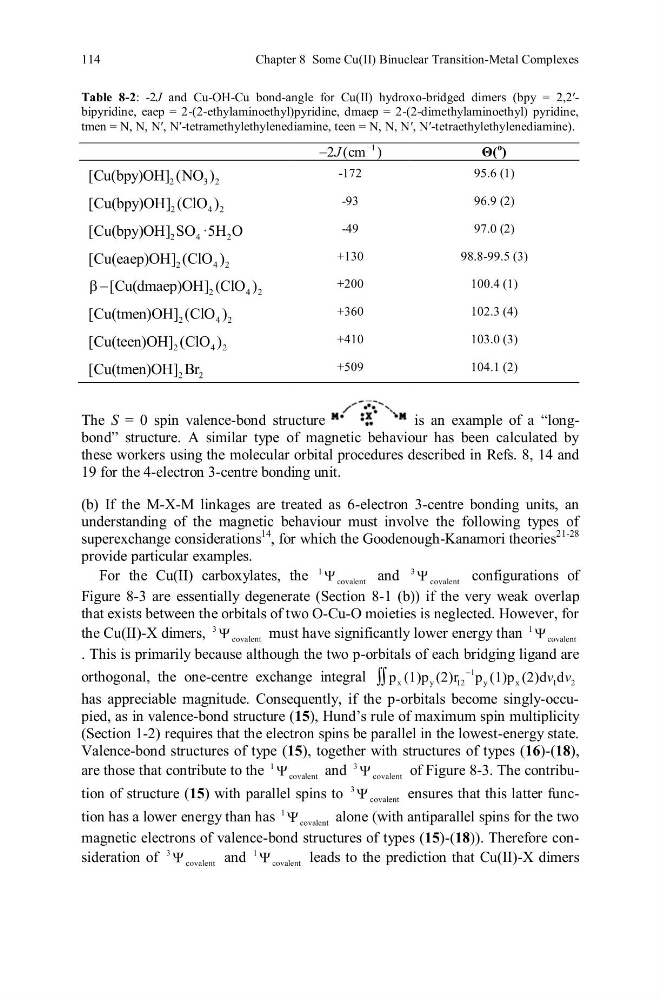
Table 8-2: -2J and Cu-OH-Cu bond-angle for Cu(II) hydroxo-bridged dimers (bpy = 2,2′bipyridine, eaep = 2-(2-ethylaminoethyl)pyridine, dmaep = 2-(2-dimethylaminoethyl) pyridine,
tmen = N, N, N′, N′-tetramethylethylenediamine, teen = N, N, N′, N′-tetraethylethylenediamine).
1
2 (cm )
J
Θ(
o
)
2
3 2
[Cu(bpy)OH] (NO )
-172
95.6 (1)
2
4 2
[Cu(bpy)OH] (ClO )
-93
96.9 (2)
2
4
2
[Cu(bpy)OH] SO ·5H O
-49
97.0 (2)
2
4 2
[Cu(eaep)OH] (ClO )
+130
98.8-99.5 (3)
2
4 2
[Cu(dmaep)OH] (ClO )
+200
100.4 (1)
2
4 2
[Cu(tmen)OH] (ClO )
+360
102.3 (4)
2
4 2
[Cu(teen)OH] (ClO )
+410
103.0 (3)
2
2
[Cu(tmen)OH] Br
+509
104.1 (2)
The S = 0 spin valence-bond structure
is an example of a “longbond” structure. A similar type of magnetic behaviour has been calculated by
these workers using the molecular orbital procedures described in Refs. 8, 14 and
19 for the 4-electron 3-centre bonding unit.
(b) If the M-X-M linkages are treated as 6-electron 3-centre bonding units, an
understanding of the magnetic behaviour must involve the following types of
superexchange considerations
14
, for which the Goodenough-Kanamori theories
21-28
provide particular examples.
For the Cu(II) carboxylates, the
1
covalent
and
3
covalent
configurations of
Figure 8-3 are essentially degenerate (Section 8-1 (b)) if the very weak overlap
that exists between the orbitals of two O-Cu-O moieties is neglected. However, for
the Cu(II)-X dimers,
3
covalent
must have significantly lower energy than
1
covalent
. This is primarily because although the two p-orbitals of each bridging ligand are
orthogonal, the one-centre exchange integral
1
x
y
12
y
x
1
2
p (1)p (2)r p (1)p (2)d d
v v
∬
has appreciable magnitude. Consequently, if the p-orbitals become singly-occupied, as in valence-bond structure (15), Hund’s rule of maximum spin multiplicity
(Section 1-2) requires that the electron spins be parallel in the lowest-energy state.
Valence-bond structures of type (15), together with structures of types (16)-(18),
are those that contribute to the
1
covalent
and
3
covalent
of Figure 8-3. The contribution of structure (15) with parallel spins to
3
covalent
ensures that this latter function has a lower energy than has
1
covalent
alone (with antiparallel spins for the two
magnetic electrons of valence-bond structures of types (15)-(18)). Therefore consideration of
3
covalent
and
1
covalent
leads to the prediction that Cu(II)-X dimers
Chapter 8 Some Cu(II) Binuclear Transition-Metal Complexes
Table 8-2: -2J and Cu-OH-Cu bond-angle for Cu(II) hydroxo-bridged dimers (bpy = 2,2′bipyridine, eaep = 2-(2-ethylaminoethyl)pyridine, dmaep = 2-(2-dimethylaminoethyl) pyridine,
tmen = N, N, N′, N′-tetramethylethylenediamine, teen = N, N, N′, N′-tetraethylethylenediamine).
1
2 (cm )
J
Θ(
o
)
2
3 2
[Cu(bpy)OH] (NO )
-172
95.6 (1)
2
4 2
[Cu(bpy)OH] (ClO )
-93
96.9 (2)
2
4
2
[Cu(bpy)OH] SO ·5H O
-49
97.0 (2)
2
4 2
[Cu(eaep)OH] (ClO )
+130
98.8-99.5 (3)
2
4 2
[Cu(dmaep)OH] (ClO )
+200
100.4 (1)
2
4 2
[Cu(tmen)OH] (ClO )
+360
102.3 (4)
2
4 2
[Cu(teen)OH] (ClO )
+410
103.0 (3)
2
2
[Cu(tmen)OH] Br
+509
104.1 (2)
The S = 0 spin valence-bond structure
is an example of a “longbond” structure. A similar type of magnetic behaviour has been calculated by
these workers using the molecular orbital procedures described in Refs. 8, 14 and
19 for the 4-electron 3-centre bonding unit.
(b) If the M-X-M linkages are treated as 6-electron 3-centre bonding units, an
understanding of the magnetic behaviour must involve the following types of
superexchange considerations
14
, for which the Goodenough-Kanamori theories
21-28
provide particular examples.
For the Cu(II) carboxylates, the
1
covalent
and
3
covalent
configurations of
Figure 8-3 are essentially degenerate (Section 8-1 (b)) if the very weak overlap
that exists between the orbitals of two O-Cu-O moieties is neglected. However, for
the Cu(II)-X dimers,
3
covalent
must have significantly lower energy than
1
covalent
. This is primarily because although the two p-orbitals of each bridging ligand are
orthogonal, the one-centre exchange integral
1
x
y
12
y
x
1
2
p (1)p (2)r p (1)p (2)d d
v v
∬
has appreciable magnitude. Consequently, if the p-orbitals become singly-occupied, as in valence-bond structure (15), Hund’s rule of maximum spin multiplicity
(Section 1-2) requires that the electron spins be parallel in the lowest-energy state.
Valence-bond structures of type (15), together with structures of types (16)-(18),
are those that contribute to the
1
covalent
and
3
covalent
of Figure 8-3. The contribution of structure (15) with parallel spins to
3
covalent
ensures that this latter function has a lower energy than has
1
covalent
alone (with antiparallel spins for the two
magnetic electrons of valence-bond structures of types (15)-(18)). Therefore consideration of
3
covalent
and
1
covalent
leads to the prediction that Cu(II)-X dimers