

112
Chapter 8 Some Cu(II) Binuclear Transition-Metal Complexes
the normalizing constants, and assuming that the i
and
i
are normalized, we
obtain
1
1
2
2
1
1
1
1
2
1
(
) / 2 ,
( – ) / 2
1
1
2
2
2
2
3
2
4
2
(
) / 2 ,
( – ) / 2
(2)
1
1
2
2
3
3
5
3
6
3
(
) / 2 ,
( – ) / 2
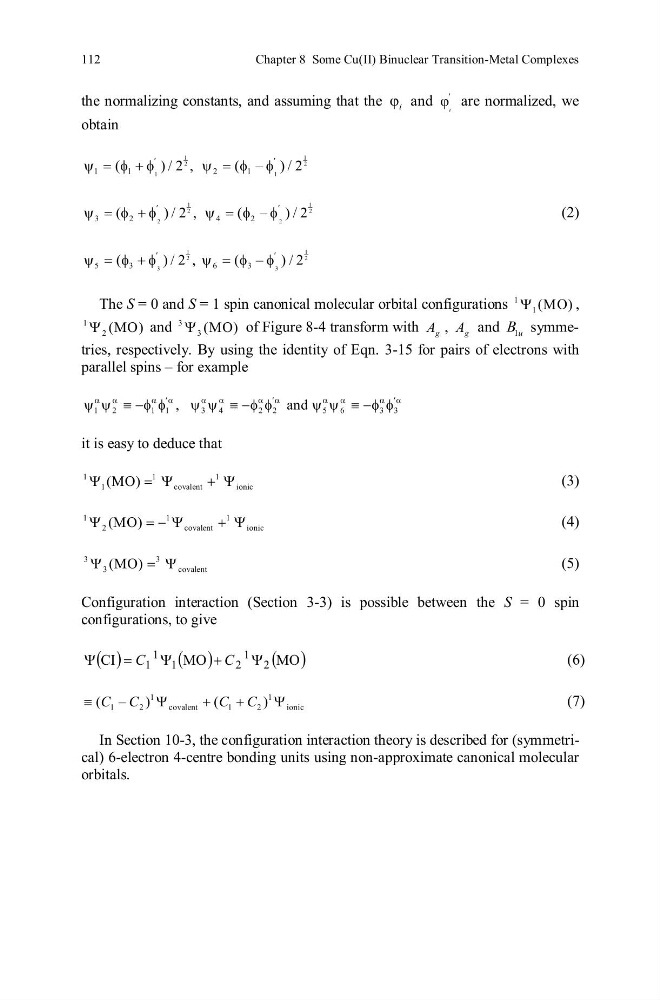
The S = 0 and S = 1 spin canonical molecular orbital configurations
1
1 (MO)
,
1
2 (MO)
and
3
3 (MO)
of Figure 8-4 transform with g
A , g
A and 1u
B symmetries, respectively. By using the identity of Eqn. 3-15 for pairs of electrons with
parallel spins – for example
1
2
1 1
3
4
2 2
5
6
3 3
,
and
it is easy to deduce that
1
1
1
1
covalent
ionic
(MO)
(3)
1
1
1
2
covalent
ionic
(MO)
(4)
3
3
3
covalent
(MO)
(5)
Configuration interaction (Section 3-3) is possible between the S = 0 spin
configurations, to give
MO
MO
CI
2
1
2
1
1
1
C
C
(6)
1
1
1
2
covalent
1
2
ionic
( – )
(
)
C C
C C
(7)
In Section 10-3, the configuration interaction theory is described for (symmetrical) 6-electron 4-centre bonding units using non-approximate canonical molecular
orbitals.
Chapter 8 Some Cu(II) Binuclear Transition-Metal Complexes
the normalizing constants, and assuming that the i
and
i
are normalized, we
obtain
1
1
2
2
1
1
1
1
2
1
(
) / 2 ,
( – ) / 2
1
1
2
2
2
2
3
2
4
2
(
) / 2 ,
( – ) / 2
(2)
1
1
2
2
3
3
5
3
6
3
(
) / 2 ,
( – ) / 2
The S = 0 and S = 1 spin canonical molecular orbital configurations
1
1 (MO)
,
1
2 (MO)
and
3
3 (MO)
of Figure 8-4 transform with g
A , g
A and 1u
B symmetries, respectively. By using the identity of Eqn. 3-15 for pairs of electrons with
parallel spins – for example
1
2
1 1
3
4
2 2
5
6
3 3
,
and
it is easy to deduce that
1
1
1
1
covalent
ionic
(MO)
(3)
1
1
1
2
covalent
ionic
(MO)
(4)
3
3
3
covalent
(MO)
(5)
Configuration interaction (Section 3-3) is possible between the S = 0 spin
configurations, to give
MO
MO
CI
2
1
2
1
1
1
C
C
(6)
1
1
1
2
covalent
1
2
ionic
( – )
(
)
C C
C C
(7)
In Section 10-3, the configuration interaction theory is described for (symmetrical) 6-electron 4-centre bonding units using non-approximate canonical molecular
orbitals.