

8-1 Cu(II) Carboxylate Dimers
111
At this level of approximation, the S = 1 spin state involves no ionic
components. Small S = 1 spin ionic contributions do enter through consideration
of excited configurations, but any additional stabilization of
3
covalent
through
interaction with them will be of less importance than is that which arises for the S
= 0 spin state through interaction of
1
covalent
with
1
ionic
. The calculations of
Ref. 7 provide a further illustration of this point.
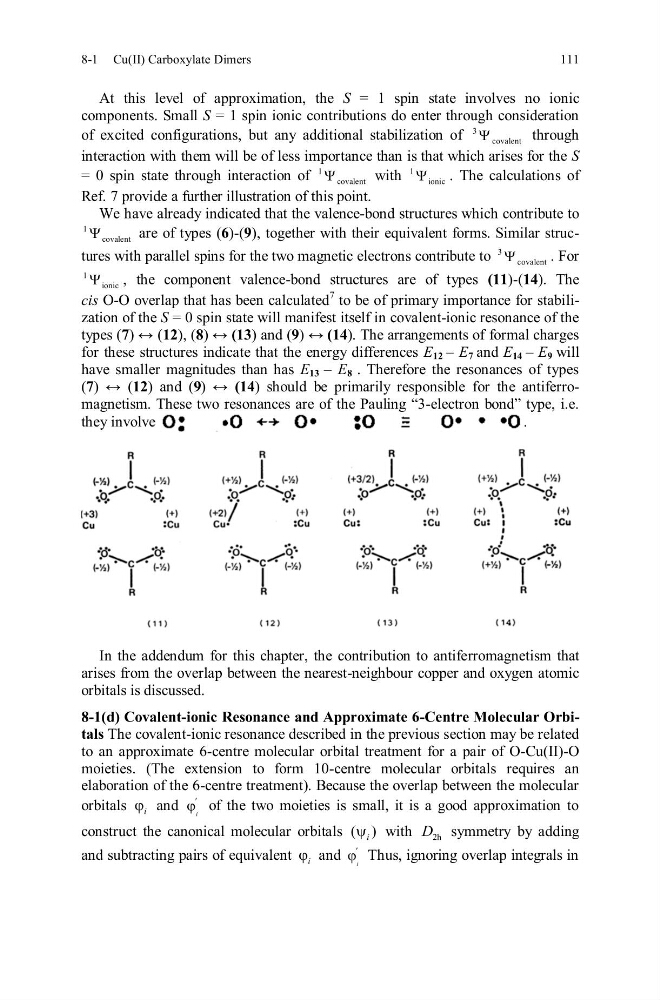
We have already indicated that the valence-bond structures which contribute to
1
covalent
are of types (6)-(9), together with their equivalent forms. Similar structures with parallel spins for the two magnetic electrons contribute to
3
covalent
. For
1
ionic
, the component valence-bond structures are of types (11)-(14). The
cis O-O overlap that has been calculated
7 to be of primary importance for stabilization of the S = 0 spin state will manifest itself in covalent-ionic resonance of the
types (7) ↔ (12), (8) ↔ (13) and (9) ↔ (14). The arrangements of formal charges
for these structures indicate that the energy differences E 12 – E 7 and E 14 – E 9 will
have smaller magnitudes than has E 13 – E 8 . Therefore the resonances of types
(7) ↔ (12) and (9) ↔ (14) should be primarily responsible for the antiferromagnetism. These two resonances are of the Pauling “3-electron bond” type, i.e.
they involve
.
In the addendum for this chapter, the contribution to antiferromagnetism that
arises from the overlap between the nearest-neighbour copper and oxygen atomic
orbitals is discussed.
8-1(d) Covalent-ionic Resonance and Approximate 6-Centre Molecular Orbitals The covalent-ionic resonance described in the previous section may be related
to an approximate 6-centre molecular orbital treatment for a pair of O-Cu(II)-O
moieties. (The extension to form 10-centre molecular orbitals requires an
elaboration of the 6-centre treatment). Because the overlap between the molecular
orbitals i
and
i
of the two moieties is small, it is a good approximation to
construct the canonical molecular orbitals ( )
i
with 2h
D symmetry by adding
and subtracting pairs of equivalent i
and
i
Thus, ignoring overlap integrals in
111
At this level of approximation, the S = 1 spin state involves no ionic
components. Small S = 1 spin ionic contributions do enter through consideration
of excited configurations, but any additional stabilization of
3
covalent
through
interaction with them will be of less importance than is that which arises for the S
= 0 spin state through interaction of
1
covalent
with
1
ionic
. The calculations of
Ref. 7 provide a further illustration of this point.
We have already indicated that the valence-bond structures which contribute to
1
covalent
are of types (6)-(9), together with their equivalent forms. Similar structures with parallel spins for the two magnetic electrons contribute to
3
covalent
. For
1
ionic
, the component valence-bond structures are of types (11)-(14). The
cis O-O overlap that has been calculated
7 to be of primary importance for stabilization of the S = 0 spin state will manifest itself in covalent-ionic resonance of the
types (7) ↔ (12), (8) ↔ (13) and (9) ↔ (14). The arrangements of formal charges
for these structures indicate that the energy differences E 12 – E 7 and E 14 – E 9 will
have smaller magnitudes than has E 13 – E 8 . Therefore the resonances of types
(7) ↔ (12) and (9) ↔ (14) should be primarily responsible for the antiferromagnetism. These two resonances are of the Pauling “3-electron bond” type, i.e.
they involve
.
In the addendum for this chapter, the contribution to antiferromagnetism that
arises from the overlap between the nearest-neighbour copper and oxygen atomic
orbitals is discussed.
8-1(d) Covalent-ionic Resonance and Approximate 6-Centre Molecular Orbitals The covalent-ionic resonance described in the previous section may be related
to an approximate 6-centre molecular orbital treatment for a pair of O-Cu(II)-O
moieties. (The extension to form 10-centre molecular orbitals requires an
elaboration of the 6-centre treatment). Because the overlap between the molecular
orbitals i
and
i
of the two moieties is small, it is a good approximation to
construct the canonical molecular orbitals ( )
i
with 2h
D symmetry by adding
and subtracting pairs of equivalent i
and
i
Thus, ignoring overlap integrals in