

110
Chapter 8 Some Cu(II) Binuclear Transition-Metal Complexes
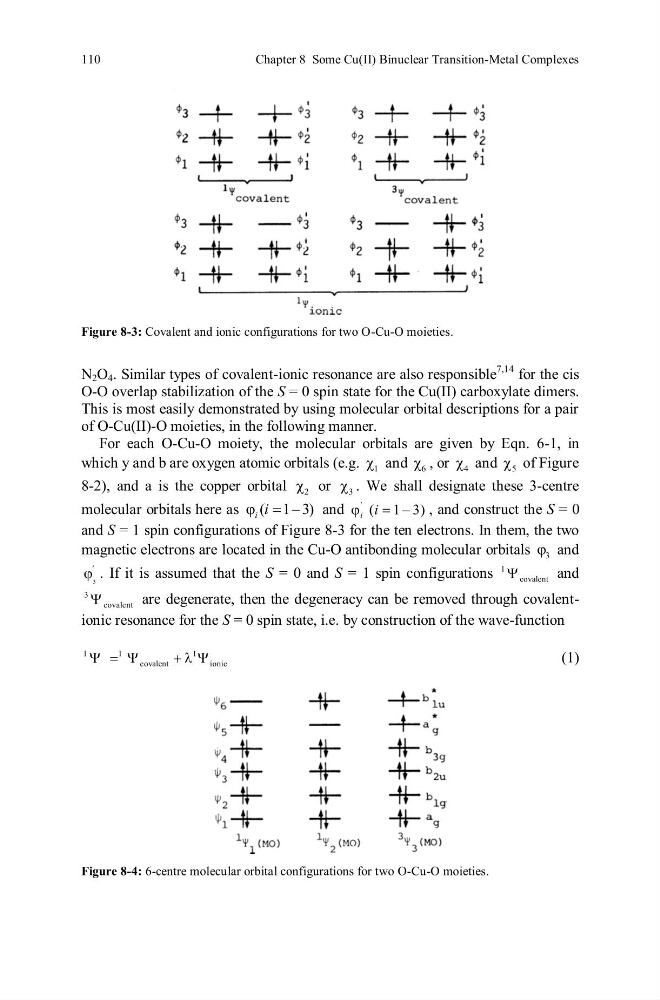
Figure 8-3: Covalent and ionic configurations for two O-Cu-O moieties.
N 2 O 4 . Similar types of covalent-ionic resonance are also responsible
7,14 for the cis
O-O overlap stabilization of the S = 0 spin state for the Cu(II) carboxylate dimers.
This is most easily demonstrated by using molecular orbital descriptions for a pair
of O-Cu(II)-O moieties, in the following manner.
For each O-Cu-O moiety, the molecular orbitals are given by Eqn. 6-1, in
which y and b are oxygen atomic orbitals (e.g. 1
and 6
, or 4
and 5
of Figure
8-2), and a is the copper orbital 2
or 3
. We shall designate these 3-centre
molecular orbitals here as ( 1 – 3)
i i
and
( 1 – 3)
i i
, and construct the S = 0
and S = 1 spin configurations of Figure 8-3 for the ten electrons. In them, the two
magnetic electrons are located in the Cu-O antibonding molecular orbitals 3
and
3
. If it is assumed that the S = 0 and S = 1 spin configurations
1
covalent
and
3
covalent
are degenerate, then the degeneracy can be removed through covalentionic resonance for the S = 0 spin state, i.e. by construction of the wave-function
1
1
1
covalent
ionic
(1)
Figure 8-4: 6-centre molecular orbital configurations for two O-Cu-O moieties.
Chapter 8 Some Cu(II) Binuclear Transition-Metal Complexes
Figure 8-3: Covalent and ionic configurations for two O-Cu-O moieties.
N 2 O 4 . Similar types of covalent-ionic resonance are also responsible
7,14 for the cis
O-O overlap stabilization of the S = 0 spin state for the Cu(II) carboxylate dimers.
This is most easily demonstrated by using molecular orbital descriptions for a pair
of O-Cu(II)-O moieties, in the following manner.
For each O-Cu-O moiety, the molecular orbitals are given by Eqn. 6-1, in
which y and b are oxygen atomic orbitals (e.g. 1
and 6
, or 4
and 5
of Figure
8-2), and a is the copper orbital 2
or 3
. We shall designate these 3-centre
molecular orbitals here as ( 1 – 3)
i i
and
( 1 – 3)
i i
, and construct the S = 0
and S = 1 spin configurations of Figure 8-3 for the ten electrons. In them, the two
magnetic electrons are located in the Cu-O antibonding molecular orbitals 3
and
3
. If it is assumed that the S = 0 and S = 1 spin configurations
1
covalent
and
3
covalent
are degenerate, then the degeneracy can be removed through covalentionic resonance for the S = 0 spin state, i.e. by construction of the wave-function
1
1
1
covalent
ionic
(1)
Figure 8-4: 6-centre molecular orbital configurations for two O-Cu-O moieties.