

8-1 Cu(II) Carboxylate Dimers
109
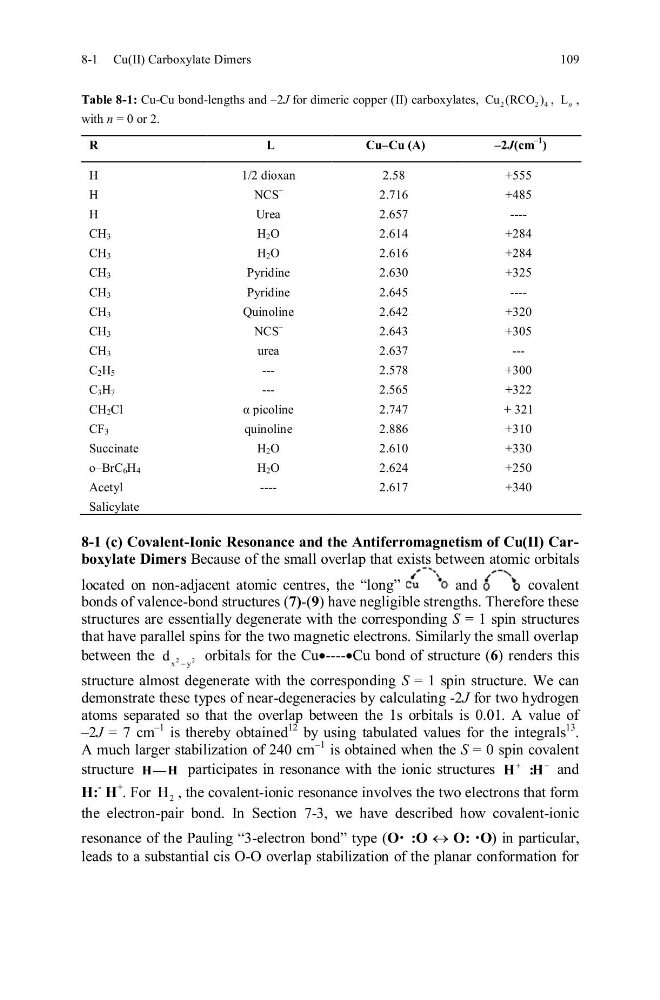
Table 8-1: Cu-Cu bond-lengths and –2J for dimeric copper (II) carboxylates,
2
2 4
Cu (RCO ) , L n ,
with n = 0 or 2.
R
L
Cu–Cu (A)
–2J(cm
–1 )
H
1/2 dioxan
2.58
+555
H
NCS
–
2.716
+485
H
Urea
2.657
---CH3
H2O
2.614
+284
CH3
H2O
2.616
+284
CH3
Pyridine
2.630
+325
CH3
Pyridine
2.645
---CH3
Quinoline
2.642
+320
CH3
NCS
–
2.643
+305
CH3
urea
2.637
--C2H5
--2.578
+300
C3H7
--2.565
+322
CH2Cl
α picoline
2.747
+ 321
CF3
quinoline
2.886
+310
Succinate
H2O
2.610
+330
o–BrC6H4
H2O
2.624
+250
Acetyl
---2.617
+340
Salicylate
8-1 (c) Covalent-Ionic Resonance and the Antiferromagnetism of Cu(II) Carboxylate Dimers Because of the small overlap that exists between atomic orbitals
located on non-adjacent atomic centres, the “long”
and
covalent
bonds of valence-bond structures (7)-(9) have negligible strengths. Therefore these
structures are essentially degenerate with the corresponding S = 1 spin structures
that have parallel spins for the two magnetic electrons. Similarly the small overlap
between the 2 2
x y
d orbitals for the Cu----Cu bond of structure (6) renders this
structure almost degenerate with the corresponding S = 1 spin structure. We can
demonstrate these types of near-degeneracies by calculating -2J for two hydrogen
atoms separated so that the overlap between the 1s orbitals is 0.01. A value of
–2J = 7 cm
–1 is thereby obtained
12 by using tabulated values for the integrals
13
.
A much larger stabilization of 240 cm
–1 is obtained when the S = 0 spin covalent
structure H — H participates in resonance with the ionic structures
H :H and
H:
- H
+
. For 2
H , the covalent-ionic resonance involves the two electrons that form
the electron-pair bond. In Section 7-3, we have described how covalent-ionic
resonance of the Pauling “3-electron bond” type (O :O O: O) in particular,
leads to a substantial cis O-O overlap stabilization of the planar conformation for
109
Table 8-1: Cu-Cu bond-lengths and –2J for dimeric copper (II) carboxylates,
2
2 4
Cu (RCO ) , L n ,
with n = 0 or 2.
R
L
Cu–Cu (A)
–2J(cm
–1 )
H
1/2 dioxan
2.58
+555
H
NCS
–
2.716
+485
H
Urea
2.657
---CH3
H2O
2.614
+284
CH3
H2O
2.616
+284
CH3
Pyridine
2.630
+325
CH3
Pyridine
2.645
---CH3
Quinoline
2.642
+320
CH3
NCS
–
2.643
+305
CH3
urea
2.637
--C2H5
--2.578
+300
C3H7
--2.565
+322
CH2Cl
α picoline
2.747
+ 321
CF3
quinoline
2.886
+310
Succinate
H2O
2.610
+330
o–BrC6H4
H2O
2.624
+250
Acetyl
---2.617
+340
Salicylate
8-1 (c) Covalent-Ionic Resonance and the Antiferromagnetism of Cu(II) Carboxylate Dimers Because of the small overlap that exists between atomic orbitals
located on non-adjacent atomic centres, the “long”
and
covalent
bonds of valence-bond structures (7)-(9) have negligible strengths. Therefore these
structures are essentially degenerate with the corresponding S = 1 spin structures
that have parallel spins for the two magnetic electrons. Similarly the small overlap
between the 2 2
x y
d orbitals for the Cu----Cu bond of structure (6) renders this
structure almost degenerate with the corresponding S = 1 spin structure. We can
demonstrate these types of near-degeneracies by calculating -2J for two hydrogen
atoms separated so that the overlap between the 1s orbitals is 0.01. A value of
–2J = 7 cm
–1 is thereby obtained
12 by using tabulated values for the integrals
13
.
A much larger stabilization of 240 cm
–1 is obtained when the S = 0 spin covalent
structure H — H participates in resonance with the ionic structures
H :H and
H:
- H
+
. For 2
H , the covalent-ionic resonance involves the two electrons that form
the electron-pair bond. In Section 7-3, we have described how covalent-ionic
resonance of the Pauling “3-electron bond” type (O :O O: O) in particular,
leads to a substantial cis O-O overlap stabilization of the planar conformation for