

108
Chapter 8 Some Cu(II) Binuclear Transition-Metal Complexes
pairing of the two delocalized magnetic electrons to generate an S = 0 spin-state
with antiparallel (↑↓) spins for the two electrons is weak. Little energy is required
to uncouple their spins to generate an S = 1 spin excited state with parallel (↑↑)
spins for these electrons. Measurements of the temperature-dependent magnetic
susceptibilities for a large number of Cu(II) carboxylate dimers
2, 9 indicate that for
each of these complexes an S = 1 spin excited state lies only ∾ 100-500 cm
–1
(1-6 kJ mol
–1
) above the S = 0 spin ground-state
ii
. In Table 8-1, we have reported
energy separations (via –2J ≡ E(S = 1) – E(S = 0)) for a selection of these
compounds. By contrast, the much larger overlap which exists between the
nitrogen atomic orbitals that form the N-N σ-bond of N 2 O 4 helps to generate a
relatively stronger spin-coupling for the unpaired-electrons of the two NO 2 moieties. The dissociation energy of 57 kJ mol
-1 for N 2 O 4 (Section 7-1) reflects the
stronger coupling relative to what occurs for the Cu(II) carboxylate dimers.
In Table 8-1, the lack of correlation that exists between the Cu-Cu bond-lengths
and the energy separation between the S = 0 and S = 1 spin states suggests that the
Cu-Cu δ bonding is not the primary antiferromagnetic interaction that occurs
between the odd-electrons of the O-Cu(II)-O moieties. If it were, then a lengthening of the Cu-Cu bond would decrease the energy separation, because the overlap
between the
2
2
x y
3d orbitals would be smaller. It may also be noted that in Cu(II)
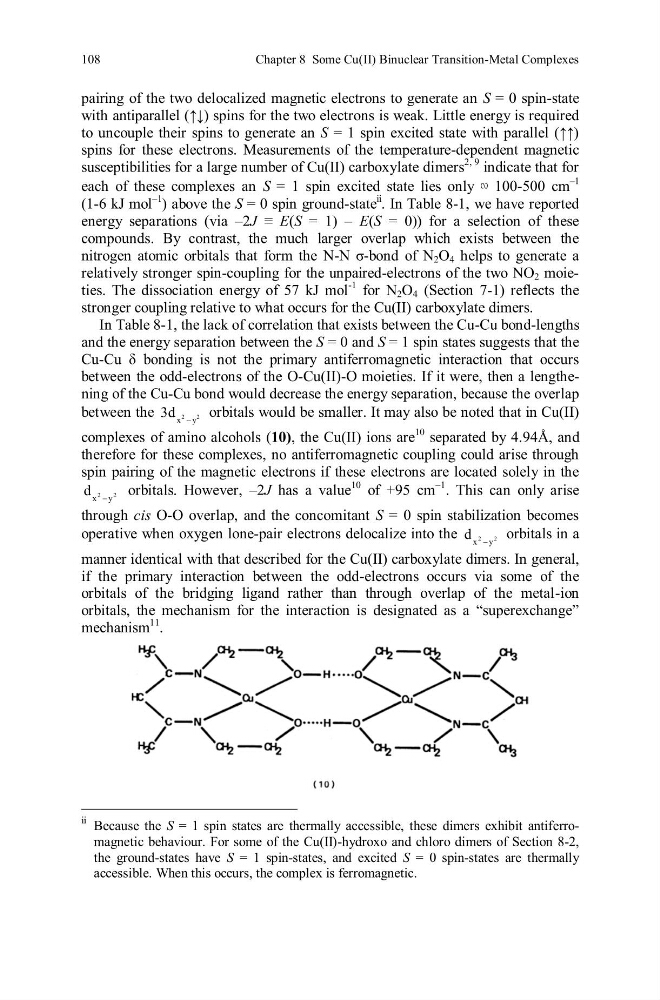
complexes of amino alcohols (10), the Cu(II) ions are
10 separated by 4.94Å, and
therefore for these complexes, no antiferromagnetic coupling could arise through
spin pairing of the magnetic electrons if these electrons are located solely in the
2
2
x y
d orbitals. However, –2J has a value
10 of +95 cm
–1 . This can only arise
through cis O-O overlap, and the concomitant S = 0 spin stabilization becomes
operative when oxygen lone-pair electrons delocalize into the 2 2
x y
d orbitals in a
manner identical with that described for the Cu(II) carboxylate dimers. In general,
if the primary interaction between the odd-electrons occurs via some of the
orbitals of the bridging ligand rather than through overlap of the metal-ion
orbitals, the mechanism for the interaction is designated as a “superexchange”
mechanism
11
.
ii Because the S = 1 spin states are thermally accessible, these dimers exhibit antiferromagnetic behaviour. For some of the Cu(II)-hydroxo and chloro dimers of Section 8-2,
the ground-states have S = 1 spin-states, and excited S = 0 spin-states are thermally
accessible. When this occurs, the complex is ferromagnetic.
Chapter 8 Some Cu(II) Binuclear Transition-Metal Complexes
pairing of the two delocalized magnetic electrons to generate an S = 0 spin-state
with antiparallel (↑↓) spins for the two electrons is weak. Little energy is required
to uncouple their spins to generate an S = 1 spin excited state with parallel (↑↑)
spins for these electrons. Measurements of the temperature-dependent magnetic
susceptibilities for a large number of Cu(II) carboxylate dimers
2, 9 indicate that for
each of these complexes an S = 1 spin excited state lies only ∾ 100-500 cm
–1
(1-6 kJ mol
–1
) above the S = 0 spin ground-state
ii
. In Table 8-1, we have reported
energy separations (via –2J ≡ E(S = 1) – E(S = 0)) for a selection of these
compounds. By contrast, the much larger overlap which exists between the
nitrogen atomic orbitals that form the N-N σ-bond of N 2 O 4 helps to generate a
relatively stronger spin-coupling for the unpaired-electrons of the two NO 2 moieties. The dissociation energy of 57 kJ mol
-1 for N 2 O 4 (Section 7-1) reflects the
stronger coupling relative to what occurs for the Cu(II) carboxylate dimers.
In Table 8-1, the lack of correlation that exists between the Cu-Cu bond-lengths
and the energy separation between the S = 0 and S = 1 spin states suggests that the
Cu-Cu δ bonding is not the primary antiferromagnetic interaction that occurs
between the odd-electrons of the O-Cu(II)-O moieties. If it were, then a lengthening of the Cu-Cu bond would decrease the energy separation, because the overlap
between the
2
2
x y
3d orbitals would be smaller. It may also be noted that in Cu(II)
complexes of amino alcohols (10), the Cu(II) ions are
10 separated by 4.94Å, and
therefore for these complexes, no antiferromagnetic coupling could arise through
spin pairing of the magnetic electrons if these electrons are located solely in the
2
2
x y
d orbitals. However, –2J has a value
10 of +95 cm
–1 . This can only arise
through cis O-O overlap, and the concomitant S = 0 spin stabilization becomes
operative when oxygen lone-pair electrons delocalize into the 2 2
x y
d orbitals in a
manner identical with that described for the Cu(II) carboxylate dimers. In general,
if the primary interaction between the odd-electrons occurs via some of the
orbitals of the bridging ligand rather than through overlap of the metal-ion
orbitals, the mechanism for the interaction is designated as a “superexchange”
mechanism
11
.
ii Because the S = 1 spin states are thermally accessible, these dimers exhibit antiferromagnetic behaviour. For some of the Cu(II)-hydroxo and chloro dimers of Section 8-2,
the ground-states have S = 1 spin-states, and excited S = 0 spin-states are thermally
accessible. When this occurs, the complex is ferromagnetic.