

8-1 Cu(II) Carboxylate Dimers
107
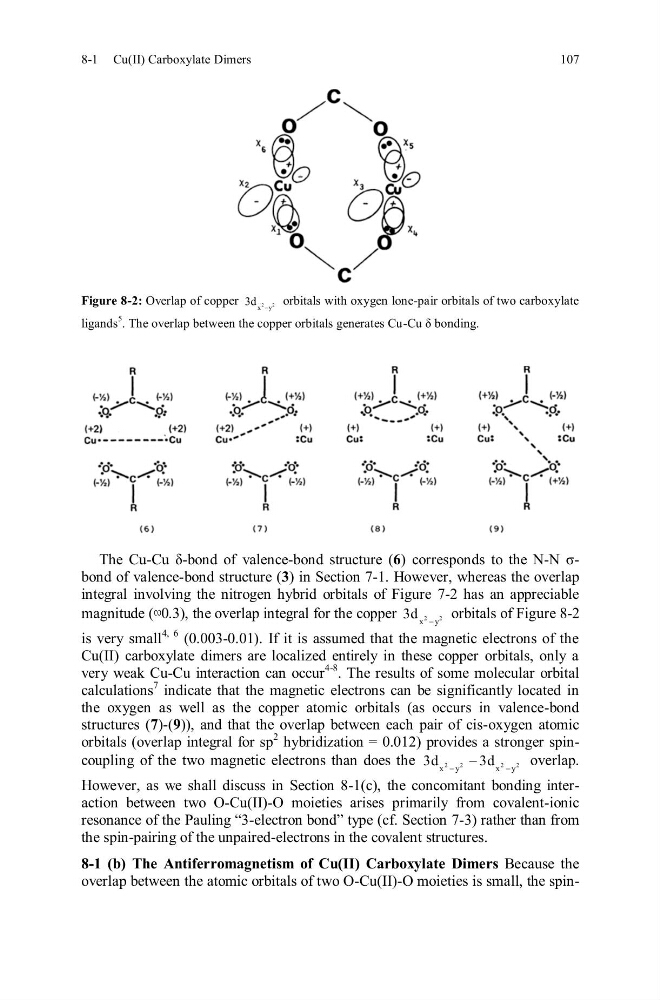
Figure 8-2: Overlap of copper
2
2
x y
3d orbitals with oxygen lone-pair orbitals of two carboxylate
ligands
5
. The overlap between the copper orbitals generates Cu-Cu δ bonding.
The Cu-Cu δ-bond of valence-bond structure (6) corresponds to the N-N σbond of valence-bond structure (3) in Section 7-1. However, whereas the overlap
integral involving the nitrogen hybrid orbitals of Figure 7-2 has an appreciable
magnitude (∾0.3), the overlap integral for the copper
2
2
x y
3d orbitals of Figure 8-2
is very small
4, 6 (0.003-0.01). If it is assumed that the magnetic electrons of the
Cu(II) carboxylate dimers are localized entirely in these copper orbitals, only a
very weak Cu-Cu interaction can occur
4-8 . The results of some molecular orbital
calculations
7 indicate that the magnetic electrons can be significantly located in
the oxygen as well as the copper atomic orbitals (as occurs in valence-bond
structures (7)-(9)), and that the overlap between each pair of cis-oxygen atomic
orbitals (overlap integral for sp
2 hybridization = 0.012) provides a stronger spincoupling of the two magnetic electrons than does the
2
2
2
2
x y
x y
3d
– 3d
overlap.
However, as we shall discuss in Section 8-1(c), the concomitant bonding interaction between two O-Cu(II)-O moieties arises primarily from covalent-ionic
resonance of the Pauling “3-electron bond” type (cf. Section 7-3) rather than from
the spin-pairing of the unpaired-electrons in the covalent structures.
8-1 (b) The Antiferromagnetism of Cu(II) Carboxylate Dimers Because the
overlap between the atomic orbitals of two O-Cu(II)-O moieties is small, the spin-
107
Figure 8-2: Overlap of copper
2
2
x y
3d orbitals with oxygen lone-pair orbitals of two carboxylate
ligands
5
. The overlap between the copper orbitals generates Cu-Cu δ bonding.
The Cu-Cu δ-bond of valence-bond structure (6) corresponds to the N-N σbond of valence-bond structure (3) in Section 7-1. However, whereas the overlap
integral involving the nitrogen hybrid orbitals of Figure 7-2 has an appreciable
magnitude (∾0.3), the overlap integral for the copper
2
2
x y
3d orbitals of Figure 8-2
is very small
4, 6 (0.003-0.01). If it is assumed that the magnetic electrons of the
Cu(II) carboxylate dimers are localized entirely in these copper orbitals, only a
very weak Cu-Cu interaction can occur
4-8 . The results of some molecular orbital
calculations
7 indicate that the magnetic electrons can be significantly located in
the oxygen as well as the copper atomic orbitals (as occurs in valence-bond
structures (7)-(9)), and that the overlap between each pair of cis-oxygen atomic
orbitals (overlap integral for sp
2 hybridization = 0.012) provides a stronger spincoupling of the two magnetic electrons than does the
2
2
2
2
x y
x y
3d
– 3d
overlap.
However, as we shall discuss in Section 8-1(c), the concomitant bonding interaction between two O-Cu(II)-O moieties arises primarily from covalent-ionic
resonance of the Pauling “3-electron bond” type (cf. Section 7-3) rather than from
the spin-pairing of the unpaired-electrons in the covalent structures.
8-1 (b) The Antiferromagnetism of Cu(II) Carboxylate Dimers Because the
overlap between the atomic orbitals of two O-Cu(II)-O moieties is small, the spin-