

106
Chapter 8 Some Cu(II) Binuclear Transition-Metal Complexes
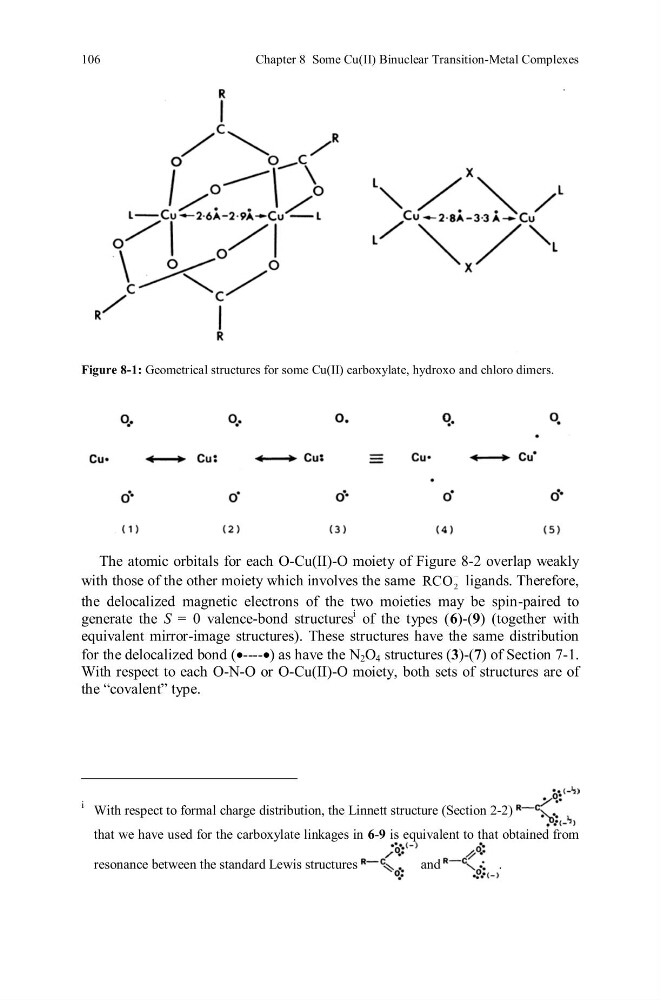
Figure 8-1: Geometrical structures for some Cu(II) carboxylate, hydroxo and chloro dimers.
The atomic orbitals for each O-Cu(II)-O moiety of Figure 8-2 overlap weakly
with those of the other moiety which involves the same
2
RCO
ligands. Therefore,
the delocalized magnetic electrons of the two moieties may be spin-paired to
generate the S = 0 valence-bond structures
i of the types (6)-(9) (together with
equivalent mirror-image structures). These structures have the same distribution
for the delocalized bond (----) as have the N 2 O 4 structures (3)-(7) of Section 7-1.
With respect to each O-N-O or O-Cu(II)-O moiety, both sets of structures are of
the “covalent” type.
i With respect to formal charge distribution, the Linnett structure (Section 2-2)
that we have used for the carboxylate linkages in 6-9 is equivalent to that obtained from
resonance between the standard Lewis structures
and
.
Chapter 8 Some Cu(II) Binuclear Transition-Metal Complexes
Figure 8-1: Geometrical structures for some Cu(II) carboxylate, hydroxo and chloro dimers.
The atomic orbitals for each O-Cu(II)-O moiety of Figure 8-2 overlap weakly
with those of the other moiety which involves the same
2
RCO
ligands. Therefore,
the delocalized magnetic electrons of the two moieties may be spin-paired to
generate the S = 0 valence-bond structures
i of the types (6)-(9) (together with
equivalent mirror-image structures). These structures have the same distribution
for the delocalized bond (----) as have the N 2 O 4 structures (3)-(7) of Section 7-1.
With respect to each O-N-O or O-Cu(II)-O moiety, both sets of structures are of
the “covalent” type.
i With respect to formal charge distribution, the Linnett structure (Section 2-2)
that we have used for the carboxylate linkages in 6-9 is equivalent to that obtained from
resonance between the standard Lewis structures
and
.