

98
Chapter 7 Some Dimers of Triatomic Radicals with 17 and 19 Valence-Shell Electrons
will then result, and so the S-S bond will be lengthened substantially relative to
the single-bond length
12a
.
A Lewis-type valence-bond explanation
27 for the existence of a long S-S bond
in
2
2
4
S O
is the following. On dimerization of the
2
SO
valence-bond structures
(24) and (26) of Section 6-3 (with a sulphur atom replacing the central oxygen
atoms of these structures), we obtain the Lewis structures (19)-(22). The nature of
the formal charge distributions - particularly that of structure (22) - implies that
the “long- bond” structures (20)-(22) with no S-S bonds should have appreciable
weights. One consequence is that the S-S bond-number for
2
2
4
S O
must be rather
less than unity, and the S-S bond is therefore substantially longer than a single
bond.
In structure (22), the sulphur orbitals that form the S-S σ-bond of structure (19)
are both doubly-occupied. As is the case for N 2 O 4 (Section 7-1), the resulting nonbonded repulsions must contribute to some of the lengthening of the S-S bond.
7-5 B 2 Y 4 (Y = F, Cl or Br), N 2 F 4 and P 2 F 4
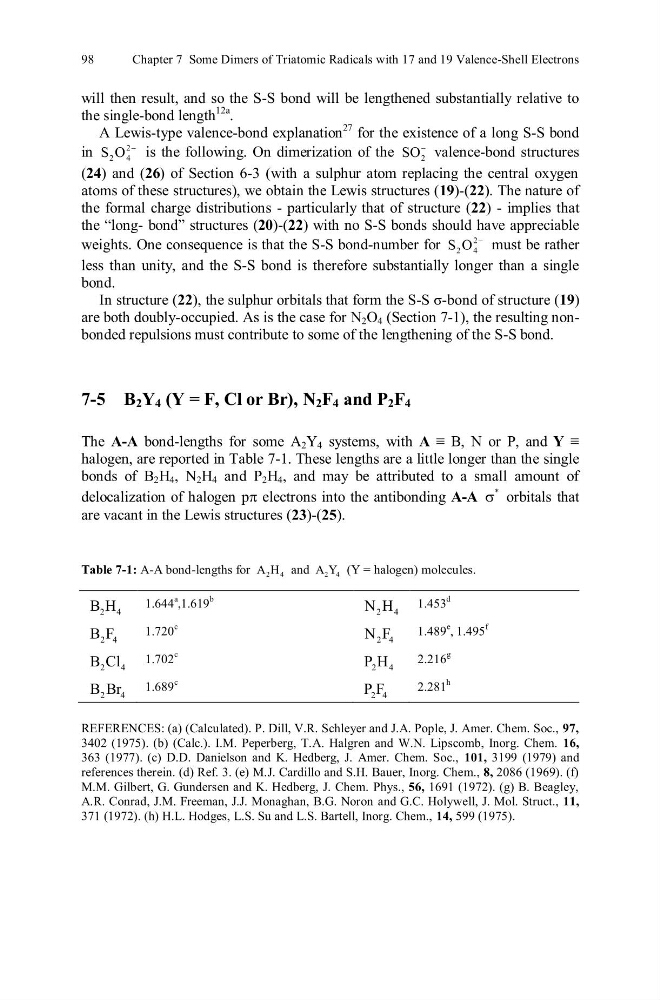
The A-A bond-lengths for some A 2 Y 4 systems, with A ≡ B, N or P, and Y ≡
halogen, are reported in Table 7-1. These lengths are a little longer than the single
bonds of B 2 H 4 , N 2 H 4 and P 2 H 4 , and may be attributed to a small amount of
delocalization of halogen p electrons into the antibonding A-A
*
orbitals that
are vacant in the Lewis structures (23)-(25).
Table 7-1: A-A bond-lengths for 2 4
A H and 2 4
A Y (Y = halogen) molecules.
2 4
B H
1.644
a
,1.619
b
2 4
N H
1.453
d
2 4
B F
1.720
c
2 4
N F
1.489
e
, 1.495
f
2
4
B Cl
1.702
c
2 4
P H
2.216
g
2
4
B Br
1.689
c
2 4
P F
2.281
h
REFERENCES: (a) (Calculated). P. Dill, V.R. Schleyer and J.A. Pople, J. Amer. Chem. Soc., 97,
3402 (1975). (b) (Calc.). I.M. Peperberg, T.A. Halgren and W.N. Lipscomb, Inorg. Chem. 16,
363 (1977). (c) D.D. Danielson and K. Hedberg, J. Amer. Chem. Soc., 101, 3199 (1979) and
references therein. (d) Ref. 3. (e) M.J. Cardillo and S.H. Bauer, Inorg. Chem., 8, 2086 (1969). (f)
M.M. Gilbert, G. Gundersen and K. Hedberg, J. Chem. Phys., 56, 1691 (1972). (g) B. Beagley,
A.R. Conrad, J.M. Freeman, J.J. Monaghan, B.G. Noron and G.C. Holywell, J. Mol. Struct., 11,
371 (1972). (h) H.L. Hodges, L.S. Su and L.S. Bartell, Inorg. Chem., 14, 599 (1975).
Chapter 7 Some Dimers of Triatomic Radicals with 17 and 19 Valence-Shell Electrons
will then result, and so the S-S bond will be lengthened substantially relative to
the single-bond length
12a
.
A Lewis-type valence-bond explanation
27 for the existence of a long S-S bond
in
2
2
4
S O
is the following. On dimerization of the
2
SO
valence-bond structures
(24) and (26) of Section 6-3 (with a sulphur atom replacing the central oxygen
atoms of these structures), we obtain the Lewis structures (19)-(22). The nature of
the formal charge distributions - particularly that of structure (22) - implies that
the “long- bond” structures (20)-(22) with no S-S bonds should have appreciable
weights. One consequence is that the S-S bond-number for
2
2
4
S O
must be rather
less than unity, and the S-S bond is therefore substantially longer than a single
bond.
In structure (22), the sulphur orbitals that form the S-S σ-bond of structure (19)
are both doubly-occupied. As is the case for N 2 O 4 (Section 7-1), the resulting nonbonded repulsions must contribute to some of the lengthening of the S-S bond.
7-5 B 2 Y 4 (Y = F, Cl or Br), N 2 F 4 and P 2 F 4
The A-A bond-lengths for some A 2 Y 4 systems, with A ≡ B, N or P, and Y ≡
halogen, are reported in Table 7-1. These lengths are a little longer than the single
bonds of B 2 H 4 , N 2 H 4 and P 2 H 4 , and may be attributed to a small amount of
delocalization of halogen p electrons into the antibonding A-A
*
orbitals that
are vacant in the Lewis structures (23)-(25).
Table 7-1: A-A bond-lengths for 2 4
A H and 2 4
A Y (Y = halogen) molecules.
2 4
B H
1.644
a
,1.619
b
2 4
N H
1.453
d
2 4
B F
1.720
c
2 4
N F
1.489
e
, 1.495
f
2
4
B Cl
1.702
c
2 4
P H
2.216
g
2
4
B Br
1.689
c
2 4
P F
2.281
h
REFERENCES: (a) (Calculated). P. Dill, V.R. Schleyer and J.A. Pople, J. Amer. Chem. Soc., 97,
3402 (1975). (b) (Calc.). I.M. Peperberg, T.A. Halgren and W.N. Lipscomb, Inorg. Chem. 16,
363 (1977). (c) D.D. Danielson and K. Hedberg, J. Amer. Chem. Soc., 101, 3199 (1979) and
references therein. (d) Ref. 3. (e) M.J. Cardillo and S.H. Bauer, Inorg. Chem., 8, 2086 (1969). (f)
M.M. Gilbert, G. Gundersen and K. Hedberg, J. Chem. Phys., 56, 1691 (1972). (g) B. Beagley,
A.R. Conrad, J.M. Freeman, J.J. Monaghan, B.G. Noron and G.C. Holywell, J. Mol. Struct., 11,
371 (1972). (h) H.L. Hodges, L.S. Su and L.S. Bartell, Inorg. Chem., 14, 599 (1975).