

7-4
C2O4
2– and S2O4
2– Anions
97
The reduction in the extent of delocalization of oxygen -electrons generates a
smaller cis O-O overlap stabilization for
2
2 4
C O
than for 2 4
N O . Non-planar as
well as planar
2
2 4
C O
conformers have been reported
23 .
A Lewis-type valence-bond explanation for the difference in N-N and C-C
bond-lengths can also be provided. When
2
CO
monomers with the valence-bond
structures (13) and (15) of Section 6-2 dimerize, the Lewis structures of types
(15)-(18) are obtained. These structures are equivalent to structures (3)-(6) for
2 4
N O . For
2
2 4
C O
, the formal charge arrangements for structures (16)-(18) are no
better than are those for the standard Lewis structure (15). Therefore, the “longbond” structures (16)-(18), each with no C-C bond, would be expected to make a
smaller contribution to the ground-state resonance than do the corresponding
structures (4)-(6) for 2 4
N O . Consequently, the standard Lewis structure (15) with
a C-C electron-pair σ-bond has a larger weight than has structure (3) (with an N-N
σ-bond for 2 4
N O ), thereby generating a larger C-C bond-number for
2
2 4
C O
.
The dithionite anion
2
2
4
S O
is non-planar
24, 25
. Its S-S bond-length of 2.39 Å
24, 25
is 0.33 Å longer than the S-S single-bond of 2 2
H S
26
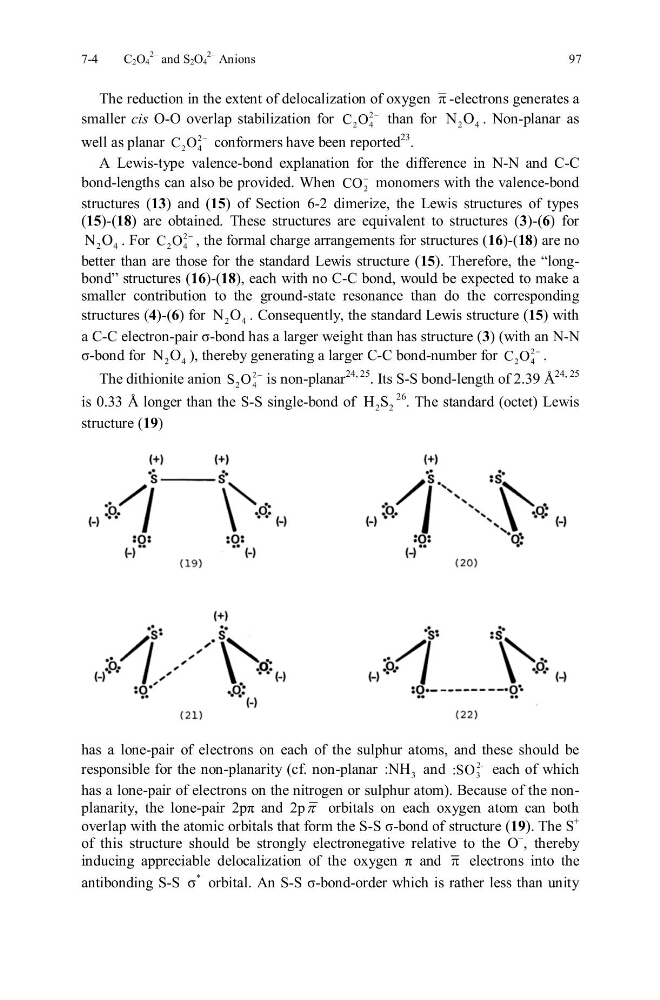
. The standard (octet) Lewis
structure (19)
has a lone-pair of electrons on each of the sulphur atoms, and these should be
responsible for the non-planarity (cf. non-planar
3
:NH and
23
:SO each of which
has a lone-pair of electrons on the nitrogen or sulphur atom). Because of the nonplanarity, the lone-pair 2pπ and 2p orbitals on each oxygen atom can both
overlap with the atomic orbitals that form the S-S σ-bond of structure (19). The S
+
of this structure should be strongly electronegative relative to the O
– , thereby
inducing appreciable delocalization of the oxygen π and electrons into the
antibonding S-S
*
σ orbital. An S-S σ-bond-order which is rather less than unity
C2O4
2– and S2O4
2– Anions
97
The reduction in the extent of delocalization of oxygen -electrons generates a
smaller cis O-O overlap stabilization for
2
2 4
C O
than for 2 4
N O . Non-planar as
well as planar
2
2 4
C O
conformers have been reported
23 .
A Lewis-type valence-bond explanation for the difference in N-N and C-C
bond-lengths can also be provided. When
2
CO
monomers with the valence-bond
structures (13) and (15) of Section 6-2 dimerize, the Lewis structures of types
(15)-(18) are obtained. These structures are equivalent to structures (3)-(6) for
2 4
N O . For
2
2 4
C O
, the formal charge arrangements for structures (16)-(18) are no
better than are those for the standard Lewis structure (15). Therefore, the “longbond” structures (16)-(18), each with no C-C bond, would be expected to make a
smaller contribution to the ground-state resonance than do the corresponding
structures (4)-(6) for 2 4
N O . Consequently, the standard Lewis structure (15) with
a C-C electron-pair σ-bond has a larger weight than has structure (3) (with an N-N
σ-bond for 2 4
N O ), thereby generating a larger C-C bond-number for
2
2 4
C O
.
The dithionite anion
2
2
4
S O
is non-planar
24, 25
. Its S-S bond-length of 2.39 Å
24, 25
is 0.33 Å longer than the S-S single-bond of 2 2
H S
26
. The standard (octet) Lewis
structure (19)
has a lone-pair of electrons on each of the sulphur atoms, and these should be
responsible for the non-planarity (cf. non-planar
3
:NH and
23
:SO each of which
has a lone-pair of electrons on the nitrogen or sulphur atom). Because of the nonplanarity, the lone-pair 2pπ and 2p orbitals on each oxygen atom can both
overlap with the atomic orbitals that form the S-S σ-bond of structure (19). The S
+
of this structure should be strongly electronegative relative to the O
– , thereby
inducing appreciable delocalization of the oxygen π and electrons into the
antibonding S-S
*
σ orbital. An S-S σ-bond-order which is rather less than unity