

96
Chapter 7 Some Dimers of Triatomic Radicals with 17 and 19 Valence-Shell Electrons
(4) ↔ (10) and (5) ↔ (11) resonances. Simple electrostatic considerations show
why this is the case; due to the distribution of formal charges in structures (4) and
(10) (or (5) and (11)), the energy difference between a pair of these structures is
much smaller than it is between structures (7) and (14). Therefore a more effective
linear combination of the wave-functions for structures (4) and (10) may be
formed. Similar electrostatic considerations indicate why the (4) ↔ (10) resonance
generates a larger stabilization than does the (6) ↔ (8) ↔ (9) resonance.
Further theory for covalent-ionic resonance and Pauling “3-electron bonds” for
6-electron 4-centre bonding is described in Chapter 24.
7-4 C 2 O 4
2–
and S 2 O 4
2–
Anions
The oxalate anion dimer of
2
CO
(i.e.
2
2 4
C O
) is isoelectronic with N 2 O 4 . Its C-C
bond-length of 1.57 Å (average)
23 is only a little longer than the C-C single-bond
length of 1.54 Å for C 2 H 6 . In contrast, the N-N bond of N 2 O 4 is 0.33 Å longer than
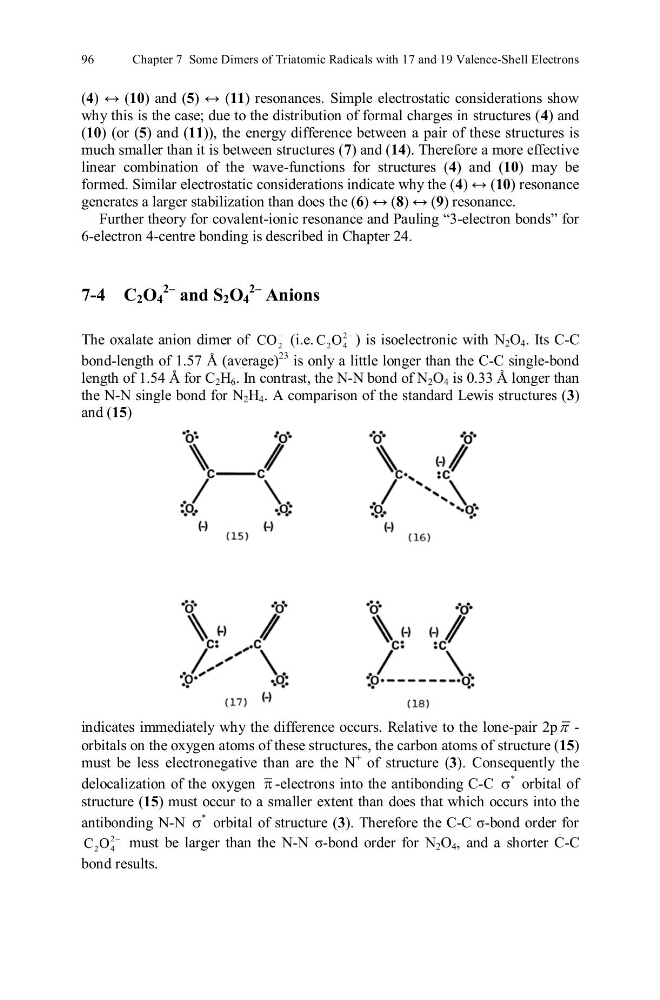
the N-N single bond for N 2 H 4 . A comparison of the standard Lewis structures (3)
and (15)
indicates immediately why the difference occurs. Relative to the lone-pair 2p -
orbitals on the oxygen atoms of these structures, the carbon atoms of structure (15)
must be less electronegative than are the N
+ of structure (3). Consequently the
delocalization of the oxygen -electrons into the antibonding C-C
*
orbital of
structure (15) must occur to a smaller extent than does that which occurs into the
antibonding N-N
*
orbital of structure (3). Therefore the C-C σ-bond order for
2
2 4
C O
must be larger than the N-N σ-bond order for N 2 O 4 , and a shorter C-C
bond results.
Chapter 7 Some Dimers of Triatomic Radicals with 17 and 19 Valence-Shell Electrons
(4) ↔ (10) and (5) ↔ (11) resonances. Simple electrostatic considerations show
why this is the case; due to the distribution of formal charges in structures (4) and
(10) (or (5) and (11)), the energy difference between a pair of these structures is
much smaller than it is between structures (7) and (14). Therefore a more effective
linear combination of the wave-functions for structures (4) and (10) may be
formed. Similar electrostatic considerations indicate why the (4) ↔ (10) resonance
generates a larger stabilization than does the (6) ↔ (8) ↔ (9) resonance.
Further theory for covalent-ionic resonance and Pauling “3-electron bonds” for
6-electron 4-centre bonding is described in Chapter 24.
7-4 C 2 O 4
2–
and S 2 O 4
2–
Anions
The oxalate anion dimer of
2
CO
(i.e.
2
2 4
C O
) is isoelectronic with N 2 O 4 . Its C-C
bond-length of 1.57 Å (average)
23 is only a little longer than the C-C single-bond
length of 1.54 Å for C 2 H 6 . In contrast, the N-N bond of N 2 O 4 is 0.33 Å longer than
the N-N single bond for N 2 H 4 . A comparison of the standard Lewis structures (3)
and (15)
indicates immediately why the difference occurs. Relative to the lone-pair 2p -
orbitals on the oxygen atoms of these structures, the carbon atoms of structure (15)
must be less electronegative than are the N
+ of structure (3). Consequently the
delocalization of the oxygen -electrons into the antibonding C-C
*
orbital of
structure (15) must occur to a smaller extent than does that which occurs into the
antibonding N-N
*
orbital of structure (3). Therefore the C-C σ-bond order for
2
2 4
C O
must be larger than the N-N σ-bond order for N 2 O 4 , and a shorter C-C
bond results.