

7-3
The Planarity of N2O4, Covalent-Ionic Resonance
95
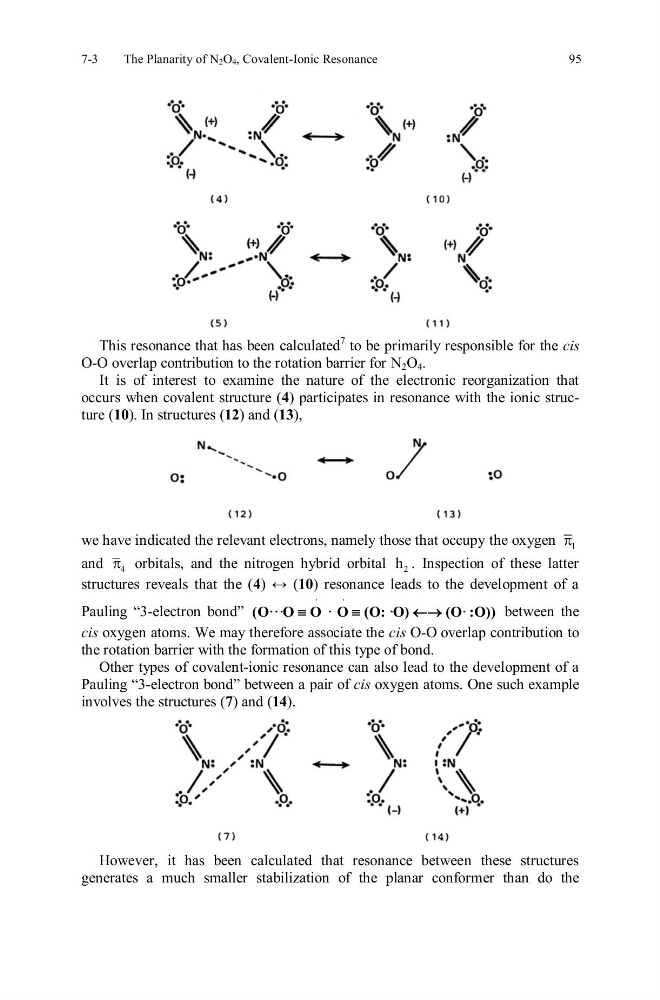
This resonance that has been calculated
7 to be primarily responsible for the cis
O-O overlap contribution to the rotation barrier for N 2 O 4 .
It is of interest to examine the nature of the electronic reorganization that
occurs when covalent structure (4) participates in resonance with the ionic structure (10). In structures (12) and (13),
we have indicated the relevant electrons, namely those that occupy the oxygen 1
and 4
orbitals, and the nitrogen hybrid orbital 2
h . Inspection of these latter
structures reveals that the (4) ↔ (10) resonance leads to the development of a
Pauling “3-electron bond”
·
·
(O···O O · O (O: ·O)
(O· :O))
between the
cis oxygen atoms. We may therefore associate the cis O-O overlap contribution to
the rotation barrier with the formation of this type of bond.
Other types of covalent-ionic resonance can also lead to the development of a
Pauling “3-electron bond” between a pair of cis oxygen atoms. One such example
involves the structures (7) and (14).
However, it has been calculated that resonance between these structures
generates a much smaller stabilization of the planar conformer than do the
The Planarity of N2O4, Covalent-Ionic Resonance
95
This resonance that has been calculated
7 to be primarily responsible for the cis
O-O overlap contribution to the rotation barrier for N 2 O 4 .
It is of interest to examine the nature of the electronic reorganization that
occurs when covalent structure (4) participates in resonance with the ionic structure (10). In structures (12) and (13),
we have indicated the relevant electrons, namely those that occupy the oxygen 1
and 4
orbitals, and the nitrogen hybrid orbital 2
h . Inspection of these latter
structures reveals that the (4) ↔ (10) resonance leads to the development of a
Pauling “3-electron bond”
·
·
(O···O O · O (O: ·O)
(O· :O))
between the
cis oxygen atoms. We may therefore associate the cis O-O overlap contribution to
the rotation barrier with the formation of this type of bond.
Other types of covalent-ionic resonance can also lead to the development of a
Pauling “3-electron bond” between a pair of cis oxygen atoms. One such example
involves the structures (7) and (14).
However, it has been calculated that resonance between these structures
generates a much smaller stabilization of the planar conformer than do the