

94
Chapter 7 Some Dimers of Triatomic Radicals with 17 and 19 Valence-Shell Electrons
7-3 The Planarity of N 2 O 4 , Covalent-Ionic Resonance
and cis O-O Pauling “3-Electron Bonds”
The planarity of 2 4
N O is concomitant with a barrier to rotation
1, 20 around the NN bond of 8-12 kJ mol
-1 . The origin of this barrier was initially associated with
weak π-bonding across the N-N bond
21 . However, the results of molecular orbital
calculations
14, 15, 22 now indicate that the overlap between σ-orbitals on pairs of cis
oxygen atoms provides the primary contribution to this barrier. For these
calculations, the oxygen orbitals were oriented parallel to the N-N bond axis. For
the valence-bond structures (3)-(7), the corresponding oxygen orbitals are the
2p -orbitals of Figure 7-2. The overlap integral between a pair of cis 2p -
orbitals (for example 1
and 4
, or 5
and 6
) is 0.01
7a
. Using valence-bond
theory, we shall now give consideration to how this overlap can generate a
contribution to the rotation barrier via covalent-ionic resonance. Fuller numerical
details are provided in Refs. 7a and 7c.
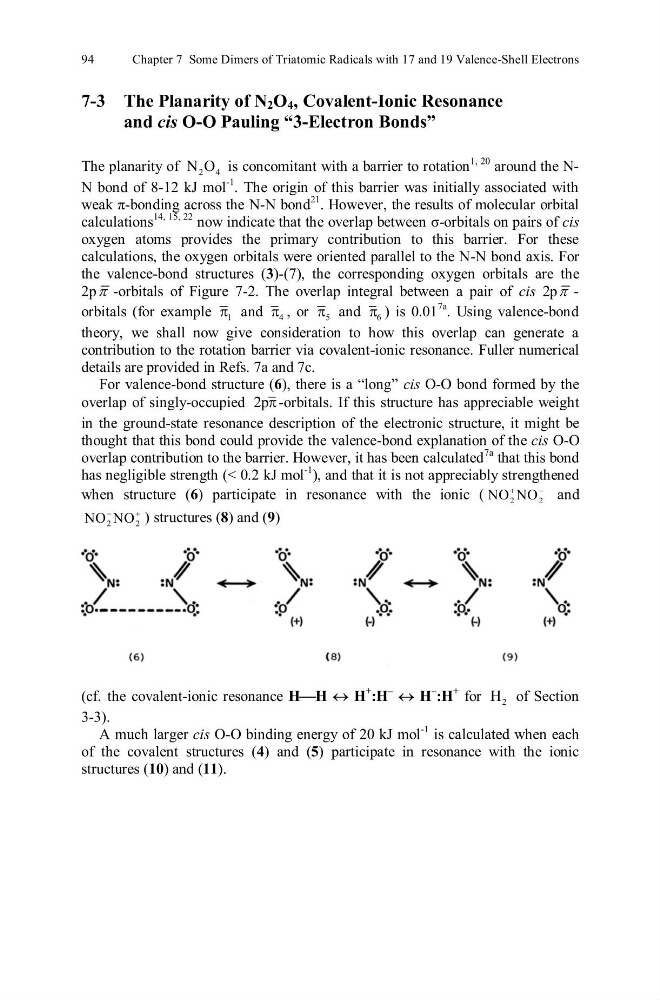
For valence-bond structure (6), there is a “long” cis O-O bond formed by the
overlap of singly-occupied 2p -orbitals. If this structure has appreciable weight
in the ground-state resonance description of the electronic structure, it might be
thought that this bond could provide the valence-bond explanation of the cis O-O
overlap contribution to the barrier. However, it has been calculated
7a that this bond
has negligible strength (< 0.2 kJ mol
-1 ), and that it is not appreciably strengthened
when structure (6) participate in resonance with the ionic (
2
2
NO NO
and
2
2
NO NO
) structures (8) and (9)
(cf. the covalent-ionic resonance HH H
+
:H
–
H
– :H
+ for 2
H of Section
3-3).
A much larger cis O-O binding energy of 20 kJ mol
-1 is calculated when each
of the covalent structures (4) and (5) participate in resonance with the ionic
structures (10) and (11).
Chapter 7 Some Dimers of Triatomic Radicals with 17 and 19 Valence-Shell Electrons
7-3 The Planarity of N 2 O 4 , Covalent-Ionic Resonance
and cis O-O Pauling “3-Electron Bonds”
The planarity of 2 4
N O is concomitant with a barrier to rotation
1, 20 around the NN bond of 8-12 kJ mol
-1 . The origin of this barrier was initially associated with
weak π-bonding across the N-N bond
21 . However, the results of molecular orbital
calculations
14, 15, 22 now indicate that the overlap between σ-orbitals on pairs of cis
oxygen atoms provides the primary contribution to this barrier. For these
calculations, the oxygen orbitals were oriented parallel to the N-N bond axis. For
the valence-bond structures (3)-(7), the corresponding oxygen orbitals are the
2p -orbitals of Figure 7-2. The overlap integral between a pair of cis 2p -
orbitals (for example 1
and 4
, or 5
and 6
) is 0.01
7a
. Using valence-bond
theory, we shall now give consideration to how this overlap can generate a
contribution to the rotation barrier via covalent-ionic resonance. Fuller numerical
details are provided in Refs. 7a and 7c.
For valence-bond structure (6), there is a “long” cis O-O bond formed by the
overlap of singly-occupied 2p -orbitals. If this structure has appreciable weight
in the ground-state resonance description of the electronic structure, it might be
thought that this bond could provide the valence-bond explanation of the cis O-O
overlap contribution to the barrier. However, it has been calculated
7a that this bond
has negligible strength (< 0.2 kJ mol
-1 ), and that it is not appreciably strengthened
when structure (6) participate in resonance with the ionic (
2
2
NO NO
and
2
2
NO NO
) structures (8) and (9)
(cf. the covalent-ionic resonance HH H
+
:H
–
H
– :H
+ for 2
H of Section
3-3).
A much larger cis O-O binding energy of 20 kJ mol
-1 is calculated when each
of the covalent structures (4) and (5) participate in resonance with the ionic
structures (10) and (11).