

7-2 The Long Weak N-N Bond of N2O4: Molecular Orbital Theory
93
1
1
2
2
2
1
2
1
1
1
{(a b) / (1
) } {( a b) / (1
) }
(a) (b)
k
k
k
k
(9)
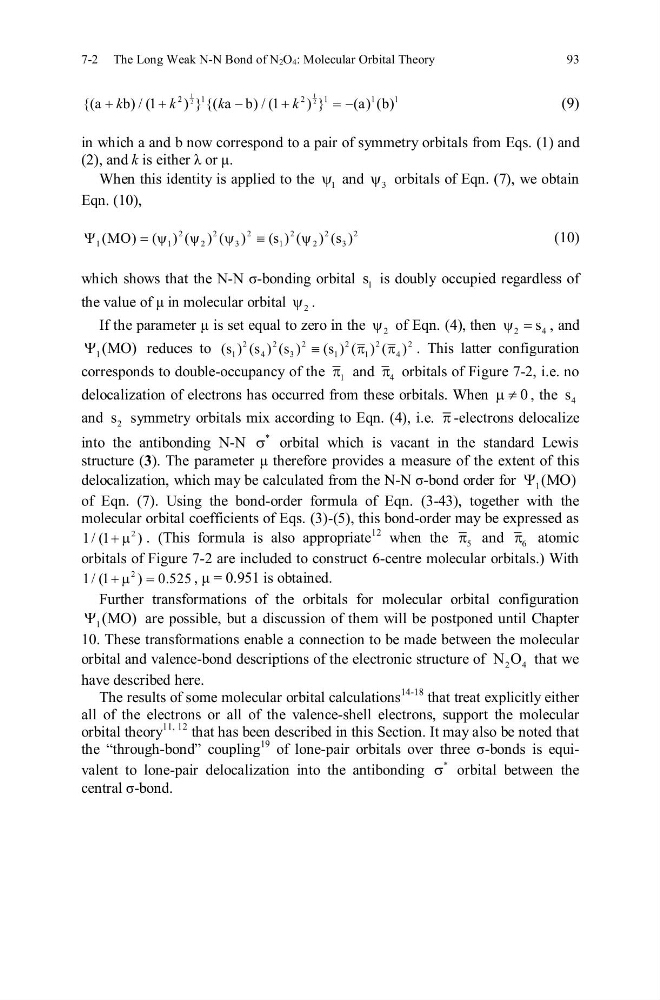
in which a and b now correspond to a pair of symmetry orbitals from Eqs. (1) and
(2), and k is either λ or μ.
When this identity is applied to the 1
and 3
orbitals of Eqn. (7), we obtain
Eqn. (10),
2
2
2
2
2
2
1
1
2
3
1
2
3
(MO) ( ) ( ) ( )
(s ) ( ) (s )
(10)
which shows that the N-N σ-bonding orbital 1
s is doubly occupied regardless of
the value of μ in molecular orbital 2
.
If the parameter μ is set equal to zero in the 2
of Eqn. (4), then 2
4
s
, and
1 (MO)
reduces to
2
2
2
2
2
2
1
4
3
1
1
4
(s ) (s ) (s )
(s ) ( ) ( )
. This latter configuration
corresponds to double-occupancy of the 1
and 4
orbitals of Figure 7-2, i.e. no
delocalization of electrons has occurred from these orbitals. When
0
, the 4
s
and 2
s symmetry orbitals mix according to Eqn. (4), i.e. -electrons delocalize
into the antibonding N-N
*
orbital which is vacant in the standard Lewis
structure (3). The parameter μ therefore provides a measure of the extent of this
delocalization, which may be calculated from the N-N σ-bond order for 1 (MO)
of Eqn. (7). Using the bond-order formula of Eqn. (3-43), together with the
molecular orbital coefficients of Eqs. (3)-(5), this bond-order may be expressed as
2
1 / (1
)
. (This formula is also appropriate
12 when the 5
and 6
atomic
orbitals of Figure 7-2 are included to construct 6-centre molecular orbitals.) With
2
1 / (1
) 0.525
, μ = 0.951 is obtained.
Further transformations of the orbitals for molecular orbital configuration
1 (MO)
are possible, but a discussion of them will be postponed until Chapter
10. These transformations enable a connection to be made between the molecular
orbital and valence-bond descriptions of the electronic structure of 2 4
N O that we
have described here.
The results of some molecular orbital calculations
14-18 that treat explicitly either
all of the electrons or all of the valence-shell electrons, support the molecular
orbital theory
11, 12 that has been described in this Section. It may also be noted that
the “through-bond” coupling
19 of lone-pair orbitals over three σ-bonds is equivalent to lone-pair delocalization into the antibonding
*
orbital between the
central σ-bond.
93
1
1
2
2
2
1
2
1
1
1
{(a b) / (1
) } {( a b) / (1
) }
(a) (b)
k
k
k
k
(9)
in which a and b now correspond to a pair of symmetry orbitals from Eqs. (1) and
(2), and k is either λ or μ.
When this identity is applied to the 1
and 3
orbitals of Eqn. (7), we obtain
Eqn. (10),
2
2
2
2
2
2
1
1
2
3
1
2
3
(MO) ( ) ( ) ( )
(s ) ( ) (s )
(10)
which shows that the N-N σ-bonding orbital 1
s is doubly occupied regardless of
the value of μ in molecular orbital 2
.
If the parameter μ is set equal to zero in the 2
of Eqn. (4), then 2
4
s
, and
1 (MO)
reduces to
2
2
2
2
2
2
1
4
3
1
1
4
(s ) (s ) (s )
(s ) ( ) ( )
. This latter configuration
corresponds to double-occupancy of the 1
and 4
orbitals of Figure 7-2, i.e. no
delocalization of electrons has occurred from these orbitals. When
0
, the 4
s
and 2
s symmetry orbitals mix according to Eqn. (4), i.e. -electrons delocalize
into the antibonding N-N
*
orbital which is vacant in the standard Lewis
structure (3). The parameter μ therefore provides a measure of the extent of this
delocalization, which may be calculated from the N-N σ-bond order for 1 (MO)
of Eqn. (7). Using the bond-order formula of Eqn. (3-43), together with the
molecular orbital coefficients of Eqs. (3)-(5), this bond-order may be expressed as
2
1 / (1
)
. (This formula is also appropriate
12 when the 5
and 6
atomic
orbitals of Figure 7-2 are included to construct 6-centre molecular orbitals.) With
2
1 / (1
) 0.525
, μ = 0.951 is obtained.
Further transformations of the orbitals for molecular orbital configuration
1 (MO)
are possible, but a discussion of them will be postponed until Chapter
10. These transformations enable a connection to be made between the molecular
orbital and valence-bond descriptions of the electronic structure of 2 4
N O that we
have described here.
The results of some molecular orbital calculations
14-18 that treat explicitly either
all of the electrons or all of the valence-shell electrons, support the molecular
orbital theory
11, 12 that has been described in this Section. It may also be noted that
the “through-bond” coupling
19 of lone-pair orbitals over three σ-bonds is equivalent to lone-pair delocalization into the antibonding
*
orbital between the
central σ-bond.