

92
Chapter 7 Some Dimers of Triatomic Radicals with 17 and 19 Valence-Shell Electrons
1
2
3
1
4
s
(
) / 2
,
1
2
4
1
4
s
(
) / 2
,
(2)
1
1
2
2
2
2
1
3
1
1
2
3
4
(s
s ) / (1
)
(
h
h
) / {2(1
)}
(3)
1
1
2
2
2
2
2
4
2
1
2
3
4
(s
s ) / (1
)
(
h
h
) / {2(1
)}
(4)
1
1
2
2
2
2
3
3
1
1
2
3
4
( s s ) / (1
) /
(
h h
) / {2(1
)}
(5)
1
1
2
2
2
2
4
4
2
1
2
3
4
( s s ) / (1
)
(
h h
) / {2(1
)}
(6)
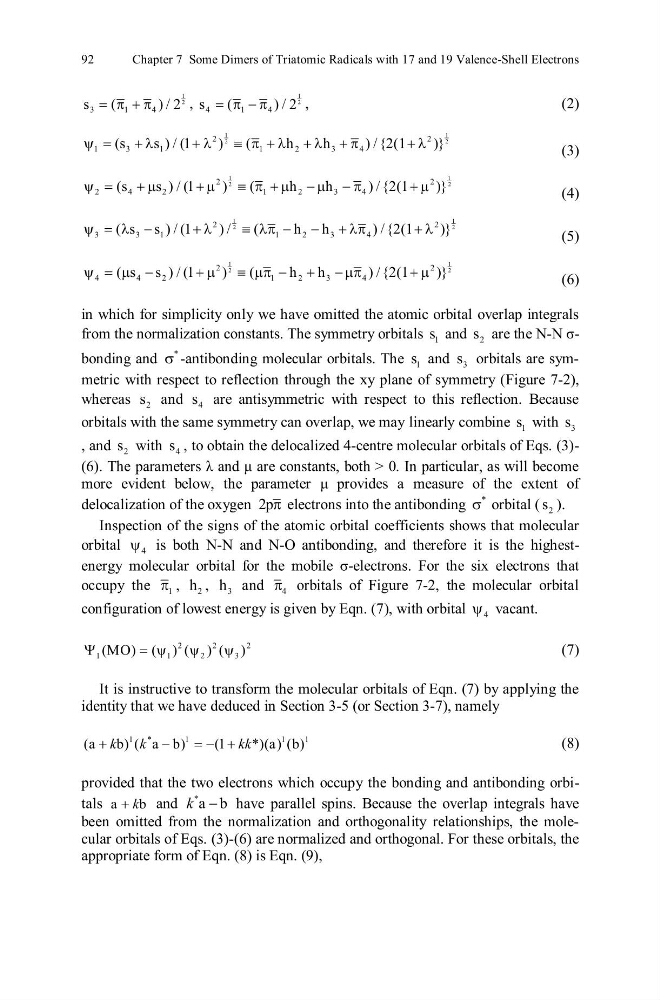
in which for simplicity only we have omitted the atomic orbital overlap integrals
from the normalization constants. The symmetry orbitals 1
s and 2
s are the N-N σbonding and
*
-antibonding molecular orbitals. The 1
s and 3
s orbitals are symmetric with respect to reflection through the xy plane of symmetry (Figure 7-2),
whereas 2
s and 4
s are antisymmetric with respect to this reflection. Because
orbitals with the same symmetry can overlap, we may linearly combine 1
s with 3
s
, and 2
s with 4
s , to obtain the delocalized 4-centre molecular orbitals of Eqs. (3)(6). The parameters λ and μ are constants, both > 0. In particular, as will become
more evident below, the parameter μ provides a measure of the extent of
delocalization of the oxygen 2p electrons into the antibonding
*
orbital ( 2
s ).
Inspection of the signs of the atomic orbital coefficients shows that molecular
orbital 4
is both N-N and N-O antibonding, and therefore it is the highestenergy molecular orbital for the mobile σ-electrons. For the six electrons that
occupy the 1
, 2
h , 3
h and 4
orbitals of Figure 7-2, the molecular orbital
configuration of lowest energy is given by Eqn. (7), with orbital 4
vacant.
2
2
2
1
1
2
3
(MO) ( ) ( ) ( )
(7)
It is instructive to transform the molecular orbitals of Eqn. (7) by applying the
identity that we have deduced in Section 3-5 (or Section 3-7), namely
1
*
1
1
1
(a b) ( a b)
(1
*)(a) (b)
k
k
kk
(8)
provided that the two electrons which occupy the bonding and antibonding orbitals a b
k
and
* a b
k have parallel spins. Because the overlap integrals have
been omitted from the normalization and orthogonality relationships, the molecular orbitals of Eqs. (3)-(6) are normalized and orthogonal. For these orbitals, the
appropriate form of Eqn. (8) is Eqn. (9),
Chapter 7 Some Dimers of Triatomic Radicals with 17 and 19 Valence-Shell Electrons
1
2
3
1
4
s
(
) / 2
,
1
2
4
1
4
s
(
) / 2
,
(2)
1
1
2
2
2
2
1
3
1
1
2
3
4
(s
s ) / (1
)
(
h
h
) / {2(1
)}
(3)
1
1
2
2
2
2
2
4
2
1
2
3
4
(s
s ) / (1
)
(
h
h
) / {2(1
)}
(4)
1
1
2
2
2
2
3
3
1
1
2
3
4
( s s ) / (1
) /
(
h h
) / {2(1
)}
(5)
1
1
2
2
2
2
4
4
2
1
2
3
4
( s s ) / (1
)
(
h h
) / {2(1
)}
(6)
in which for simplicity only we have omitted the atomic orbital overlap integrals
from the normalization constants. The symmetry orbitals 1
s and 2
s are the N-N σbonding and
*
-antibonding molecular orbitals. The 1
s and 3
s orbitals are symmetric with respect to reflection through the xy plane of symmetry (Figure 7-2),
whereas 2
s and 4
s are antisymmetric with respect to this reflection. Because
orbitals with the same symmetry can overlap, we may linearly combine 1
s with 3
s
, and 2
s with 4
s , to obtain the delocalized 4-centre molecular orbitals of Eqs. (3)(6). The parameters λ and μ are constants, both > 0. In particular, as will become
more evident below, the parameter μ provides a measure of the extent of
delocalization of the oxygen 2p electrons into the antibonding
*
orbital ( 2
s ).
Inspection of the signs of the atomic orbital coefficients shows that molecular
orbital 4
is both N-N and N-O antibonding, and therefore it is the highestenergy molecular orbital for the mobile σ-electrons. For the six electrons that
occupy the 1
, 2
h , 3
h and 4
orbitals of Figure 7-2, the molecular orbital
configuration of lowest energy is given by Eqn. (7), with orbital 4
vacant.
2
2
2
1
1
2
3
(MO) ( ) ( ) ( )
(7)
It is instructive to transform the molecular orbitals of Eqn. (7) by applying the
identity that we have deduced in Section 3-5 (or Section 3-7), namely
1
*
1
1
1
(a b) ( a b)
(1
*)(a) (b)
k
k
kk
(8)
provided that the two electrons which occupy the bonding and antibonding orbitals a b
k
and
* a b
k have parallel spins. Because the overlap integrals have
been omitted from the normalization and orthogonality relationships, the molecular orbitals of Eqs. (3)-(6) are normalized and orthogonal. For these orbitals, the
appropriate form of Eqn. (8) is Eqn. (9),