

7-6
The Geometries of P2F4 and S2O4
2–
99
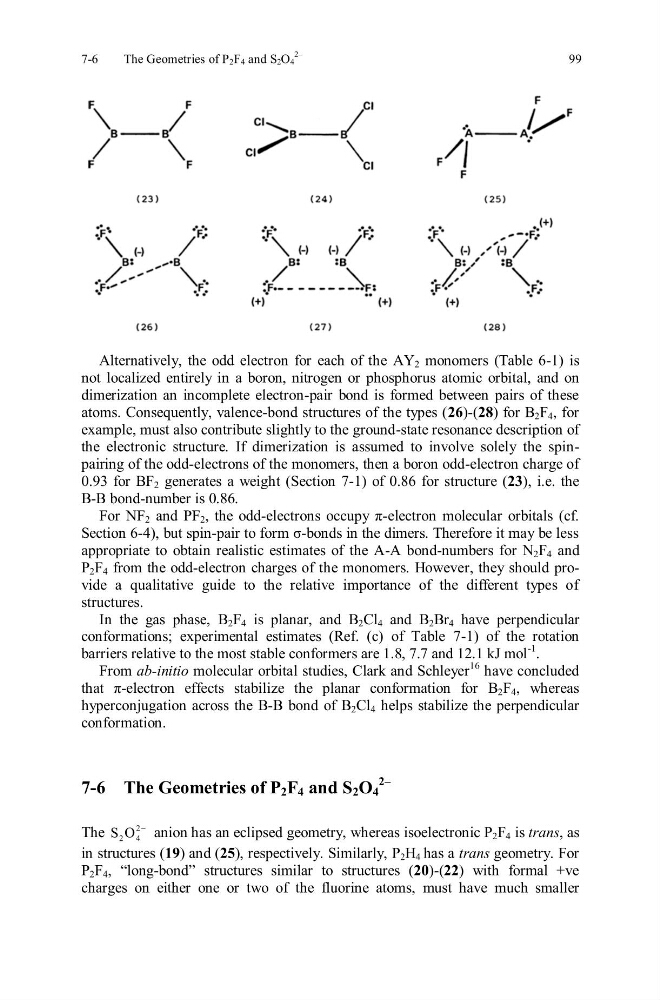
Alternatively, the odd electron for each of the AY 2 monomers (Table 6-1) is
not localized entirely in a boron, nitrogen or phosphorus atomic orbital, and on
dimerization an incomplete electron-pair bond is formed between pairs of these
atoms. Consequently, valence-bond structures of the types (26)-(28) for B 2 F 4 , for
example, must also contribute slightly to the ground-state resonance description of
the electronic structure. If dimerization is assumed to involve solely the spinpairing of the odd-electrons of the monomers, then a boron odd-electron charge of
0.93 for BF 2 generates a weight (Section 7-1) of 0.86 for structure (23), i.e. the
B-B bond-number is 0.86.
For NF 2 and PF 2 , the odd-electrons occupy π-electron molecular orbitals (cf.
Section 6-4), but spin-pair to form σ-bonds in the dimers. Therefore it may be less
appropriate to obtain realistic estimates of the A-A bond-numbers for N 2 F 4 and
P 2 F 4 from the odd-electron charges of the monomers. However, they should provide a qualitative guide to the relative importance of the different types of
structures.
In the gas phase, B 2 F 4 is planar, and B 2 Cl 4 and B 2 Br 4 have perpendicular
conformations; experimental estimates (Ref. (c) of Table 7-1) of the rotation
barriers relative to the most stable conformers are 1.8, 7.7 and 12.1 kJ mol
-1 .
From ab-initio molecular orbital studies, Clark and Schleyer
16 have concluded
that π-electron effects stabilize the planar conformation for B 2 F 4 , whereas
hyperconjugation across the B-B bond of B 2 Cl 4 helps stabilize the perpendicular
conformation.
7-6 The Geometries of P 2 F 4 and S 2 O 4
2–
The
2
2
4
S O
anion has an eclipsed geometry, whereas isoelectronic P 2 F 4 is trans, as
in structures (19) and (25), respectively. Similarly, P 2 H 4 has a trans geometry. For
P 2 F 4 , “long-bond” structures similar to structures (20)-(22) with formal +ve
charges on either one or two of the fluorine atoms, must have much smaller
The Geometries of P2F4 and S2O4
2–
99
Alternatively, the odd electron for each of the AY 2 monomers (Table 6-1) is
not localized entirely in a boron, nitrogen or phosphorus atomic orbital, and on
dimerization an incomplete electron-pair bond is formed between pairs of these
atoms. Consequently, valence-bond structures of the types (26)-(28) for B 2 F 4 , for
example, must also contribute slightly to the ground-state resonance description of
the electronic structure. If dimerization is assumed to involve solely the spinpairing of the odd-electrons of the monomers, then a boron odd-electron charge of
0.93 for BF 2 generates a weight (Section 7-1) of 0.86 for structure (23), i.e. the
B-B bond-number is 0.86.
For NF 2 and PF 2 , the odd-electrons occupy π-electron molecular orbitals (cf.
Section 6-4), but spin-pair to form σ-bonds in the dimers. Therefore it may be less
appropriate to obtain realistic estimates of the A-A bond-numbers for N 2 F 4 and
P 2 F 4 from the odd-electron charges of the monomers. However, they should provide a qualitative guide to the relative importance of the different types of
structures.
In the gas phase, B 2 F 4 is planar, and B 2 Cl 4 and B 2 Br 4 have perpendicular
conformations; experimental estimates (Ref. (c) of Table 7-1) of the rotation
barriers relative to the most stable conformers are 1.8, 7.7 and 12.1 kJ mol
-1 .
From ab-initio molecular orbital studies, Clark and Schleyer
16 have concluded
that π-electron effects stabilize the planar conformation for B 2 F 4 , whereas
hyperconjugation across the B-B bond of B 2 Cl 4 helps stabilize the perpendicular
conformation.
7-6 The Geometries of P 2 F 4 and S 2 O 4
2–
The
2
2
4
S O
anion has an eclipsed geometry, whereas isoelectronic P 2 F 4 is trans, as
in structures (19) and (25), respectively. Similarly, P 2 H 4 has a trans geometry. For
P 2 F 4 , “long-bond” structures similar to structures (20)-(22) with formal +ve
charges on either one or two of the fluorine atoms, must have much smaller