

distribution of the valence basins closely matches the non-bonding and bonding
domains of the VSEPR model [61].
Hierarchy of the ELF basins. The f localization domain (ELF(r) = f) is a
volume limited by one or more closed isosurfaces. Initially proposed for visualizing
the ELF basins, interestingly it provides a hierarchy of basins in relation with the
nature of the chemical bond [84]. The localization domain is called irreducible if it
surrounds one attractor or reducible if it contains several attractors. When
increasing the ELF(r) value, a reducible domain splits into several domains, each
containing fewer attractors than the parent domain. The first reduction provides
useful information on the nature of bonds because the reduction yields two composite domains corresponding to the interacting moieties. For example, the first
reduction in a molecule A–B splits usually for covalent bonds into core domains
and a single valence domain that contains all the valence attractors. In contrast, for
an ionic pair A
+ B
− , the first reduction yields domains corresponding to the cation
and to the anion fragments.
Integrated properties. As in the QTAIM theory, the ELF basin population is
calculated by integrating the electron density over the basin volume. The populations must be understood as arising from Lewis resonant structures and it is possible
to calculate some weights of formal Lewis structures [85]. Moreover, a statistical
analysis of the basin populations enables one, through the definitions of the variance and the covariance matrix, to obtain information about the electron delocalization between basins [86]. Indeed, the variance of a basin is interpreted as a
measure of the electron density fluctuation with all other basins. The covariance
matrix elements are measures of the correlation between populations of two given
basins. These statistical quantities are useful for characterizing some particular
bonding schemes, such as the charge-shift bonding that recently emerged in the
literature [87], for which a stabilizing contribution is the resonance energy caused
by the covalent-ionic mixing.
The combination of ELF and QTAIM topologies has led Raub and Jansen [88]
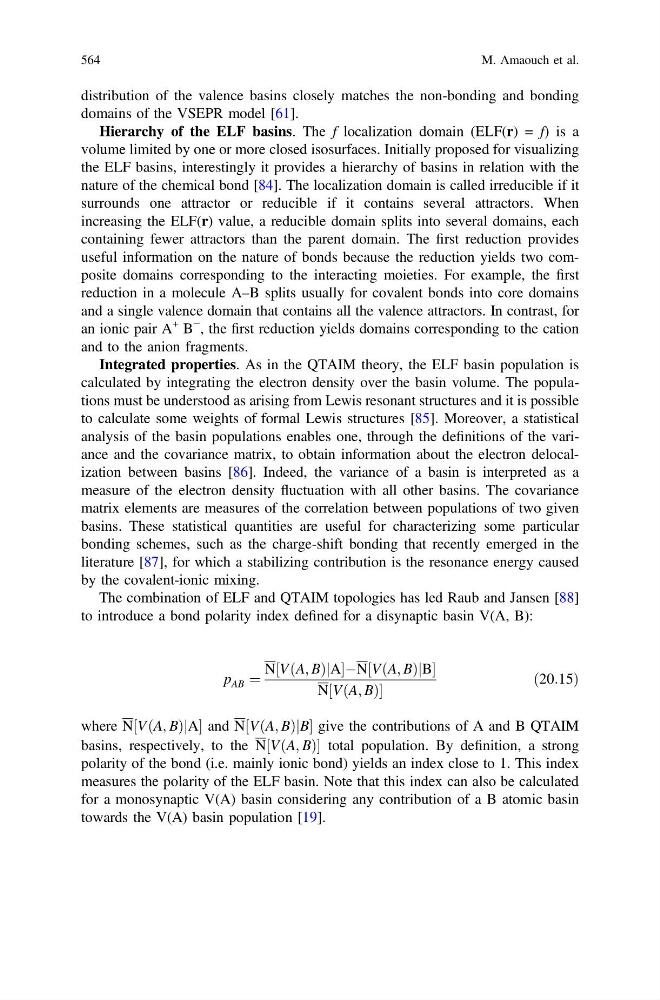
to introduce a bond polarity index defined for a disynaptic basin V(A, B):
p AB ¼
N V A; B
ð
ÞjA
½
À N V A; B
ð
ÞjB
½
N V A; B
ð
Þ
½
ð20:15Þ
where N V A; B
ð
ÞjA
½
and N V A; B
ð
ÞjB
½
give the contributions of A and B QTAIM
basins, respectively, to the N V A; B
ð
Þ
½
total population. By definition, a strong
polarity of the bond (i.e. mainly ionic bond) yields an index close to 1. This index
measures the polarity of the ELF basin. Note that this index can also be calculated
for a monosynaptic V(A) basin considering any contribution of a B atomic basin
towards the V(A) basin population [19].
564
M. Amaouch et al.
domains of the VSEPR model [61].
Hierarchy of the ELF basins. The f localization domain (ELF(r) = f) is a
volume limited by one or more closed isosurfaces. Initially proposed for visualizing
the ELF basins, interestingly it provides a hierarchy of basins in relation with the
nature of the chemical bond [84]. The localization domain is called irreducible if it
surrounds one attractor or reducible if it contains several attractors. When
increasing the ELF(r) value, a reducible domain splits into several domains, each
containing fewer attractors than the parent domain. The first reduction provides
useful information on the nature of bonds because the reduction yields two composite domains corresponding to the interacting moieties. For example, the first
reduction in a molecule A–B splits usually for covalent bonds into core domains
and a single valence domain that contains all the valence attractors. In contrast, for
an ionic pair A
+ B
− , the first reduction yields domains corresponding to the cation
and to the anion fragments.
Integrated properties. As in the QTAIM theory, the ELF basin population is
calculated by integrating the electron density over the basin volume. The populations must be understood as arising from Lewis resonant structures and it is possible
to calculate some weights of formal Lewis structures [85]. Moreover, a statistical
analysis of the basin populations enables one, through the definitions of the variance and the covariance matrix, to obtain information about the electron delocalization between basins [86]. Indeed, the variance of a basin is interpreted as a
measure of the electron density fluctuation with all other basins. The covariance
matrix elements are measures of the correlation between populations of two given
basins. These statistical quantities are useful for characterizing some particular
bonding schemes, such as the charge-shift bonding that recently emerged in the
literature [87], for which a stabilizing contribution is the resonance energy caused
by the covalent-ionic mixing.
The combination of ELF and QTAIM topologies has led Raub and Jansen [88]
to introduce a bond polarity index defined for a disynaptic basin V(A, B):
p AB ¼
N V A; B
ð
ÞjA
½
À N V A; B
ð
ÞjB
½
N V A; B
ð
Þ
½
ð20:15Þ
where N V A; B
ð
ÞjA
½
and N V A; B
ð
ÞjB
½
give the contributions of A and B QTAIM
basins, respectively, to the N V A; B
ð
Þ
½
total population. By definition, a strong
polarity of the bond (i.e. mainly ionic bond) yields an index close to 1. This index
measures the polarity of the ELF basin. Note that this index can also be calculated
for a monosynaptic V(A) basin considering any contribution of a B atomic basin
towards the V(A) basin population [19].
564
M. Amaouch et al.