

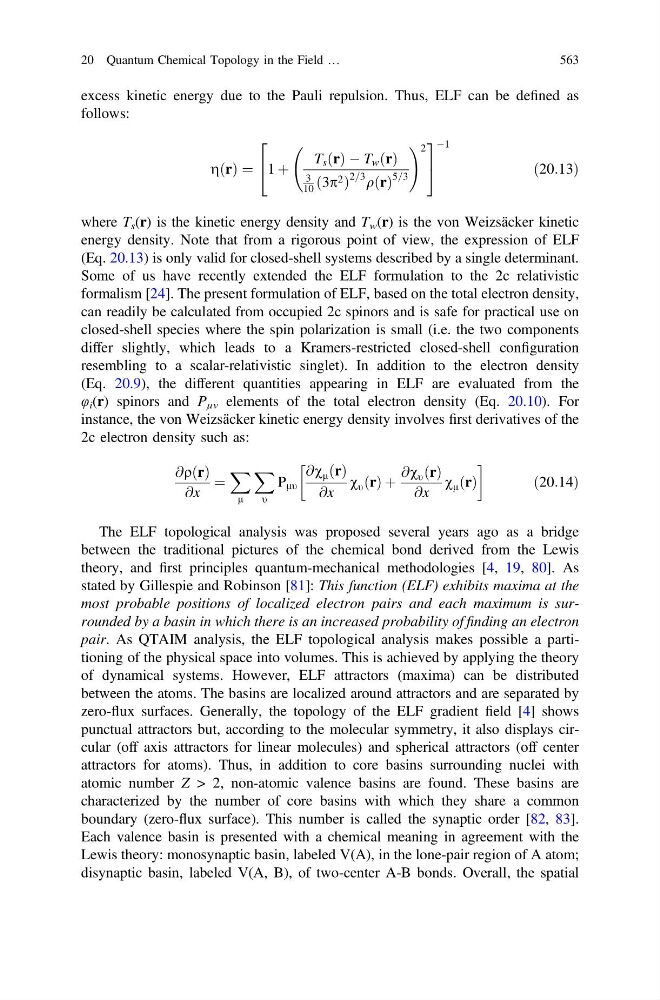
excess kinetic energy due to the Pauli repulsion. Thus, ELF can be defined as
follows:
gðrÞ ¼ 1 þ
T s r
ð Þ À T w r
ð Þ
3
10 ð3p 2 Þ
2=3 qðrÞ
5=3
! 2
2
4
3
5
À1
ð20:13Þ
where T s (r) is the kinetic energy density and T w (r) is the von Weizsäcker kinetic
energy density. Note that from a rigorous point of view, the expression of ELF
(Eq. 20.13) is only valid for closed-shell systems described by a single determinant.
Some of us have recently extended the ELF formulation to the 2c relativistic
formalism [24]. The present formulation of ELF, based on the total electron density,
can readily be calculated from occupied 2c spinors and is safe for practical use on
closed-shell species where the spin polarization is small (i.e. the two components
differ slightly, which leads to a Kramers-restricted closed-shell configuration
resembling to a scalar-relativistic singlet). In addition to the electron density
(Eq. 20.9), the different quantities appearing in ELF are evaluated from the
φ i (r) spinors and P µν elements of the total electron density (Eq. 20.10). For
instance, the von Weizsäcker kinetic energy density involves first derivatives of the
2c electron density such as:
@qðrÞ
@x
¼
X
l
X
t
P lt
@v l ðrÞ
@x
v t ðrÞ þ
@v t ðrÞ
@x
v l ðrÞ
ð20:14Þ
The ELF topological analysis was proposed several years ago as a bridge
between the traditional pictures of the chemical bond derived from the Lewis
theory, and first principles quantum-mechanical methodologies [4, 19, 80]. As
stated by Gillespie and Robinson [81]: This function (ELF) exhibits maxima at the
most probable positions of localized electron pairs and each maximum is surrounded by a basin in which there is an increased probability of finding an electron
pair. As QTAIM analysis, the ELF topological analysis makes possible a partitioning of the physical space into volumes. This is achieved by applying the theory
of dynamical systems. However, ELF attractors (maxima) can be distributed
between the atoms. The basins are localized around attractors and are separated by
zero-flux surfaces. Generally, the topology of the ELF gradient field [4] shows
punctual attractors but, according to the molecular symmetry, it also displays circular (off axis attractors for linear molecules) and spherical attractors (off center
attractors for atoms). Thus, in addition to core basins surrounding nuclei with
atomic number Z > 2, non-atomic valence basins are found. These basins are
characterized by the number of core basins with which they share a common
boundary (zero-flux surface). This number is called the synaptic order [82, 83].
Each valence basin is presented with a chemical meaning in agreement with the
Lewis theory: monosynaptic basin, labeled V(A), in the lone-pair region of A atom;
disynaptic basin, labeled V(A, B), of two-center A-B bonds. Overall, the spatial
20 Quantum Chemical Topology in the Field …
563
follows:
gðrÞ ¼ 1 þ
T s r
ð Þ À T w r
ð Þ
3
10 ð3p 2 Þ
2=3 qðrÞ
5=3
! 2
2
4
3
5
À1
ð20:13Þ
where T s (r) is the kinetic energy density and T w (r) is the von Weizsäcker kinetic
energy density. Note that from a rigorous point of view, the expression of ELF
(Eq. 20.13) is only valid for closed-shell systems described by a single determinant.
Some of us have recently extended the ELF formulation to the 2c relativistic
formalism [24]. The present formulation of ELF, based on the total electron density,
can readily be calculated from occupied 2c spinors and is safe for practical use on
closed-shell species where the spin polarization is small (i.e. the two components
differ slightly, which leads to a Kramers-restricted closed-shell configuration
resembling to a scalar-relativistic singlet). In addition to the electron density
(Eq. 20.9), the different quantities appearing in ELF are evaluated from the
φ i (r) spinors and P µν elements of the total electron density (Eq. 20.10). For
instance, the von Weizsäcker kinetic energy density involves first derivatives of the
2c electron density such as:
@qðrÞ
@x
¼
X
l
X
t
P lt
@v l ðrÞ
@x
v t ðrÞ þ
@v t ðrÞ
@x
v l ðrÞ
ð20:14Þ
The ELF topological analysis was proposed several years ago as a bridge
between the traditional pictures of the chemical bond derived from the Lewis
theory, and first principles quantum-mechanical methodologies [4, 19, 80]. As
stated by Gillespie and Robinson [81]: This function (ELF) exhibits maxima at the
most probable positions of localized electron pairs and each maximum is surrounded by a basin in which there is an increased probability of finding an electron
pair. As QTAIM analysis, the ELF topological analysis makes possible a partitioning of the physical space into volumes. This is achieved by applying the theory
of dynamical systems. However, ELF attractors (maxima) can be distributed
between the atoms. The basins are localized around attractors and are separated by
zero-flux surfaces. Generally, the topology of the ELF gradient field [4] shows
punctual attractors but, according to the molecular symmetry, it also displays circular (off axis attractors for linear molecules) and spherical attractors (off center
attractors for atoms). Thus, in addition to core basins surrounding nuclei with
atomic number Z > 2, non-atomic valence basins are found. These basins are
characterized by the number of core basins with which they share a common
boundary (zero-flux surface). This number is called the synaptic order [82, 83].
Each valence basin is presented with a chemical meaning in agreement with the
Lewis theory: monosynaptic basin, labeled V(A), in the lone-pair region of A atom;
disynaptic basin, labeled V(A, B), of two-center A-B bonds. Overall, the spatial
20 Quantum Chemical Topology in the Field …
563