

and the kinetic energy density (G b ) at the BCP. This ratio is larger than 1 when
∇
2
ρ b < 0, while it is smaller than 1 when ∇
2
ρ b > 0. Another energetic descriptor is
often used to differentiate two categories of closed-shell bonding: the |V b |/G b ratio
that reflects the covalency magnitude of the interaction [71–73]. If the latter ratio is
smaller than 1, the kinetic energy density is the leading term and electrons are
destabilized close to the BCP, no covalency is expected (for example pure ionic or
van der Waals bonding). The interactions are called pure closed-shell interactions
(pure CS). The second category of closed-shell bonding, with some sharing of
electrons (|V b |/G b > 1, i.e. the potential energy density is large and electrons are
stabilized at the BCP), is called after Nakanishi et al. regular closed-shell (regular
CS) [74]. Thus, the analysis of the ρ b , ∇
2
ρ b , V b and G b values provide information
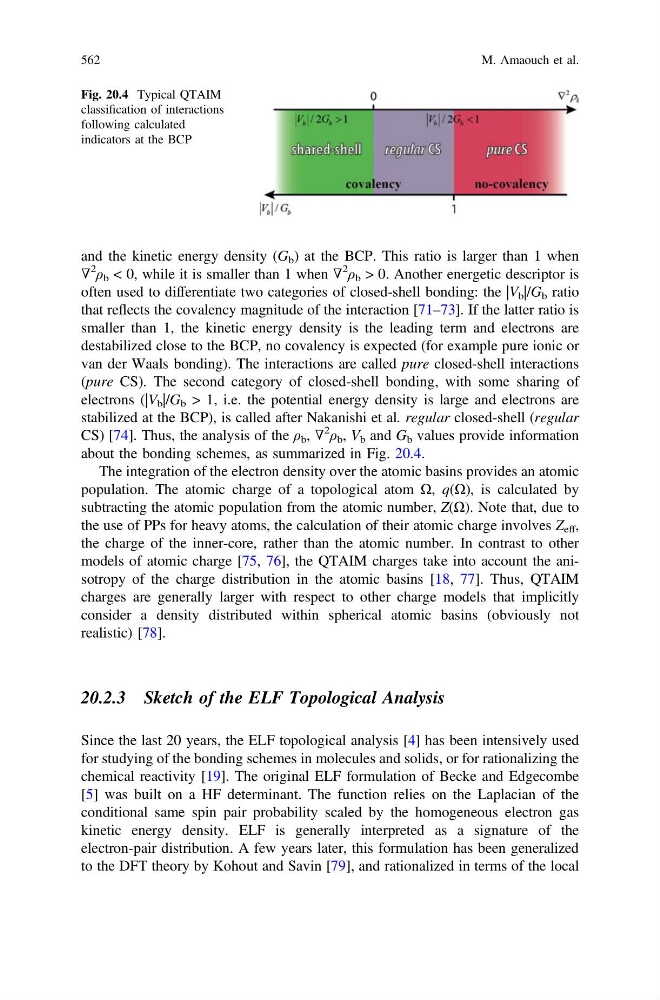
about the bonding schemes, as summarized in Fig. 20.4.
The integration of the electron density over the atomic basins provides an atomic
population. The atomic charge of a topological atom Ω, q(Ω), is calculated by
subtracting the atomic population from the atomic number, Z(Ω). Note that, due to
the use of PPs for heavy atoms, the calculation of their atomic charge involves Z eff ,
the charge of the inner-core, rather than the atomic number. In contrast to other
models of atomic charge [75, 76], the QTAIM charges take into account the anisotropy of the charge distribution in the atomic basins [18, 77]. Thus, QTAIM
charges are generally larger with respect to other charge models that implicitly
consider a density distributed within spherical atomic basins (obviously not
realistic) [78].
20.2.3 Sketch of the ELF Topological Analysis
Since the last 20 years, the ELF topological analysis [4] has been intensively used
for studying of the bonding schemes in molecules and solids, or for rationalizing the
chemical reactivity [19]. The original ELF formulation of Becke and Edgecombe
[5] was built on a HF determinant. The function relies on the Laplacian of the
conditional same spin pair probability scaled by the homogeneous electron gas
kinetic energy density. ELF is generally interpreted as a signature of the
electron-pair distribution. A few years later, this formulation has been generalized
to the DFT theory by Kohout and Savin [79], and rationalized in terms of the local
Fig. 20.4 Typical QTAIM
classification of interactions
following calculated
indicators at the BCP
562
M. Amaouch et al.
∇
2
ρ b < 0, while it is smaller than 1 when ∇
2
ρ b > 0. Another energetic descriptor is
often used to differentiate two categories of closed-shell bonding: the |V b |/G b ratio
that reflects the covalency magnitude of the interaction [71–73]. If the latter ratio is
smaller than 1, the kinetic energy density is the leading term and electrons are
destabilized close to the BCP, no covalency is expected (for example pure ionic or
van der Waals bonding). The interactions are called pure closed-shell interactions
(pure CS). The second category of closed-shell bonding, with some sharing of
electrons (|V b |/G b > 1, i.e. the potential energy density is large and electrons are
stabilized at the BCP), is called after Nakanishi et al. regular closed-shell (regular
CS) [74]. Thus, the analysis of the ρ b , ∇
2
ρ b , V b and G b values provide information
about the bonding schemes, as summarized in Fig. 20.4.
The integration of the electron density over the atomic basins provides an atomic
population. The atomic charge of a topological atom Ω, q(Ω), is calculated by
subtracting the atomic population from the atomic number, Z(Ω). Note that, due to
the use of PPs for heavy atoms, the calculation of their atomic charge involves Z eff ,
the charge of the inner-core, rather than the atomic number. In contrast to other
models of atomic charge [75, 76], the QTAIM charges take into account the anisotropy of the charge distribution in the atomic basins [18, 77]. Thus, QTAIM
charges are generally larger with respect to other charge models that implicitly
consider a density distributed within spherical atomic basins (obviously not
realistic) [78].
20.2.3 Sketch of the ELF Topological Analysis
Since the last 20 years, the ELF topological analysis [4] has been intensively used
for studying of the bonding schemes in molecules and solids, or for rationalizing the
chemical reactivity [19]. The original ELF formulation of Becke and Edgecombe
[5] was built on a HF determinant. The function relies on the Laplacian of the
conditional same spin pair probability scaled by the homogeneous electron gas
kinetic energy density. ELF is generally interpreted as a signature of the
electron-pair distribution. A few years later, this formulation has been generalized
to the DFT theory by Kohout and Savin [79], and rationalized in terms of the local
Fig. 20.4 Typical QTAIM
classification of interactions
following calculated
indicators at the BCP
562
M. Amaouch et al.