

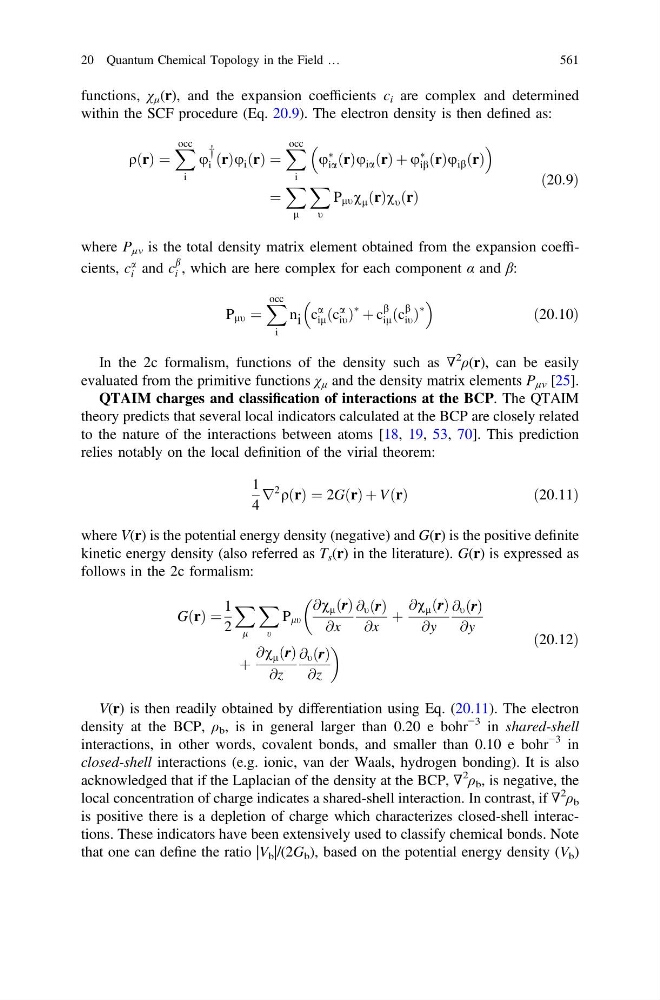
functions, χ µ (r), and the expansion coefficients c i are complex and determined
within the SCF procedure (Eq. 20.9). The electron density is then defined as:
q r
ð Þ ¼
X occ
i
u
y
i r
ð Þu i r
ð Þ ¼
X occ
i
u
Ã
ia r
ð Þu ia r
ð Þ þ u
Ã
ib r
ð Þu ib r
ð Þ
¼
X
l
X
t
P lt v l r
ð Þv t ðrÞ
ð20:9Þ
where P µν is the total density matrix element obtained from the expansion coefficients, c
a
i and c
b
i , which are here complex for each component α and β:
P lt ¼
X occ
i
n i c
a
il ðc
a
it Þ
à þ c
b
il ðc
b
it Þ
Ã
ð20:10Þ
In the 2c formalism, functions of the density such as ∇
2
ρ(r), can be easily
evaluated from the primitive functions χ µ and the density matrix elements P µν [25].
QTAIM charges and classification of interactions at the BCP. The QTAIM
theory predicts that several local indicators calculated at the BCP are closely related
to the nature of the interactions between atoms [18, 19, 53, 70]. This prediction
relies notably on the local definition of the virial theorem:
1
4
r
2
q r
ð Þ ¼ 2G r
ð Þ þ VðrÞ
ð 20:11Þ
where V(r) is the potential energy density (negative) and G(r) is the positive definite
kinetic energy density (also referred as T s (r) in the literature). G(r) is expressed as
follows in the 2c formalism:
G r
ð Þ ¼
1
2
X
l
X
t
P lt
@v l ðrÞ
@x
@ t ðrÞ
@x
þ
@v l ðrÞ
@y
@ t ðrÞ
@y
þ
@v l ðrÞ
@z
@ t ðrÞ
@z
ð20:12Þ
V(r) is then readily obtained by differentiation using Eq. (20.11). The electron
density at the BCP, ρ b , is in general larger than 0.20 e bohr
−3 in shared-shell
interactions, in other words, covalent bonds, and smaller than 0.10 e bohr
−3 in
closed-shell interactions (e.g. ionic, van der Waals, hydrogen bonding). It is also
acknowledged that if the Laplacian of the density at the BCP, ∇
2
ρ b , is negative, the
local concentration of charge indicates a shared-shell interaction. In contrast, if ∇
2
ρ b
is positive there is a depletion of charge which characterizes closed-shell interactions. These indicators have been extensively used to classify chemical bonds. Note
that one can define the ratio |V b |/(2G b ), based on the potential energy density (V b )
20 Quantum Chemical Topology in the Field …
561
within the SCF procedure (Eq. 20.9). The electron density is then defined as:
q r
ð Þ ¼
X occ
i
u
y
i r
ð Þu i r
ð Þ ¼
X occ
i
u
Ã
ia r
ð Þu ia r
ð Þ þ u
Ã
ib r
ð Þu ib r
ð Þ
¼
X
l
X
t
P lt v l r
ð Þv t ðrÞ
ð20:9Þ
where P µν is the total density matrix element obtained from the expansion coefficients, c
a
i and c
b
i , which are here complex for each component α and β:
P lt ¼
X occ
i
n i c
a
il ðc
a
it Þ
à þ c
b
il ðc
b
it Þ
Ã
ð20:10Þ
In the 2c formalism, functions of the density such as ∇
2
ρ(r), can be easily
evaluated from the primitive functions χ µ and the density matrix elements P µν [25].
QTAIM charges and classification of interactions at the BCP. The QTAIM
theory predicts that several local indicators calculated at the BCP are closely related
to the nature of the interactions between atoms [18, 19, 53, 70]. This prediction
relies notably on the local definition of the virial theorem:
1
4
r
2
q r
ð Þ ¼ 2G r
ð Þ þ VðrÞ
ð 20:11Þ
where V(r) is the potential energy density (negative) and G(r) is the positive definite
kinetic energy density (also referred as T s (r) in the literature). G(r) is expressed as
follows in the 2c formalism:
G r
ð Þ ¼
1
2
X
l
X
t
P lt
@v l ðrÞ
@x
@ t ðrÞ
@x
þ
@v l ðrÞ
@y
@ t ðrÞ
@y
þ
@v l ðrÞ
@z
@ t ðrÞ
@z
ð20:12Þ
V(r) is then readily obtained by differentiation using Eq. (20.11). The electron
density at the BCP, ρ b , is in general larger than 0.20 e bohr
−3 in shared-shell
interactions, in other words, covalent bonds, and smaller than 0.10 e bohr
−3 in
closed-shell interactions (e.g. ionic, van der Waals, hydrogen bonding). It is also
acknowledged that if the Laplacian of the density at the BCP, ∇
2
ρ b , is negative, the
local concentration of charge indicates a shared-shell interaction. In contrast, if ∇
2
ρ b
is positive there is a depletion of charge which characterizes closed-shell interactions. These indicators have been extensively used to classify chemical bonds. Note
that one can define the ratio |V b |/(2G b ), based on the potential energy density (V b )
20 Quantum Chemical Topology in the Field …
561