

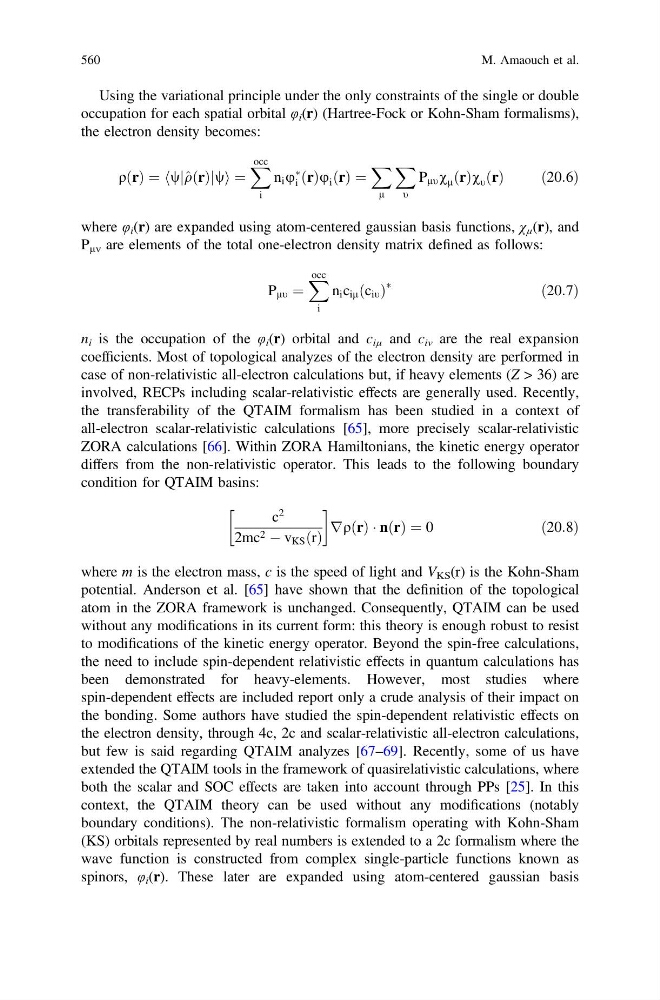
Using the variational principle under the only constraints of the single or double
occupation for each spatial orbital φ i (r) (Hartree-Fock or Kohn-Sham formalisms),
the electron density becomes:
q r
ð Þ ¼ wj^ qðrÞjw
h
i¼
X occ
i
n i u
Ã
i ðrÞu i ðrÞ ¼
X
l
X
t
P lt v l r
ð Þv t ðrÞ
ð20:6Þ
where φ i (r) are expanded using atom-centered gaussian basis functions, χ µ (r), and
P µν are elements of the total one-electron density matrix defined as follows:
P lt ¼
X occ
i
n i c il ðc it Þ
Ã
ð20:7Þ
n i is the occupation of the φ i (r) orbital and c iµ and c iν are the real expansion
coefficients. Most of topological analyzes of the electron density are performed in
case of non-relativistic all-electron calculations but, if heavy elements (Z > 36) are
involved, RECPs including scalar-relativistic effects are generally used. Recently,
the transferability of the QTAIM formalism has been studied in a context of
all-electron scalar-relativistic calculations [65], more precisely scalar-relativistic
ZORA calculations [66]. Within ZORA Hamiltonians, the kinetic energy operator
differs from the non-relativistic operator. This leads to the following boundary
condition for QTAIM basins:
c
2
2mc 2 À v KS r
ð Þ
rq r
ð Þ Á nðrÞ ¼ 0
ð20:8Þ
where m is the electron mass, c is the speed of light and V KS (r) is the Kohn-Sham
potential. Anderson et al. [65] have shown that the definition of the topological
atom in the ZORA framework is unchanged. Consequently, QTAIM can be used
without any modifications in its current form: this theory is enough robust to resist
to modifications of the kinetic energy operator. Beyond the spin-free calculations,
the need to include spin-dependent relativistic effects in quantum calculations has
been demonstrated for heavy-elements. However, most studies where
spin-dependent effects are included report only a crude analysis of their impact on
the bonding. Some authors have studied the spin-dependent relativistic effects on
the electron density, through 4c, 2c and scalar-relativistic all-electron calculations,
but few is said regarding QTAIM analyzes [67–69]. Recently, some of us have
extended the QTAIM tools in the framework of quasirelativistic calculations, where
both the scalar and SOC effects are taken into account through PPs [25]. In this
context, the QTAIM theory can be used without any modifications (notably
boundary conditions). The non-relativistic formalism operating with Kohn-Sham
(KS) orbitals represented by real numbers is extended to a 2c formalism where the
wave function is constructed from complex single-particle functions known as
spinors, φ i (r). These later are expanded using atom-centered gaussian basis
560
M. Amaouch et al.
occupation for each spatial orbital φ i (r) (Hartree-Fock or Kohn-Sham formalisms),
the electron density becomes:
q r
ð Þ ¼ wj^ qðrÞjw
h
i¼
X occ
i
n i u
Ã
i ðrÞu i ðrÞ ¼
X
l
X
t
P lt v l r
ð Þv t ðrÞ
ð20:6Þ
where φ i (r) are expanded using atom-centered gaussian basis functions, χ µ (r), and
P µν are elements of the total one-electron density matrix defined as follows:
P lt ¼
X occ
i
n i c il ðc it Þ
Ã
ð20:7Þ
n i is the occupation of the φ i (r) orbital and c iµ and c iν are the real expansion
coefficients. Most of topological analyzes of the electron density are performed in
case of non-relativistic all-electron calculations but, if heavy elements (Z > 36) are
involved, RECPs including scalar-relativistic effects are generally used. Recently,
the transferability of the QTAIM formalism has been studied in a context of
all-electron scalar-relativistic calculations [65], more precisely scalar-relativistic
ZORA calculations [66]. Within ZORA Hamiltonians, the kinetic energy operator
differs from the non-relativistic operator. This leads to the following boundary
condition for QTAIM basins:
c
2
2mc 2 À v KS r
ð Þ
rq r
ð Þ Á nðrÞ ¼ 0
ð20:8Þ
where m is the electron mass, c is the speed of light and V KS (r) is the Kohn-Sham
potential. Anderson et al. [65] have shown that the definition of the topological
atom in the ZORA framework is unchanged. Consequently, QTAIM can be used
without any modifications in its current form: this theory is enough robust to resist
to modifications of the kinetic energy operator. Beyond the spin-free calculations,
the need to include spin-dependent relativistic effects in quantum calculations has
been demonstrated for heavy-elements. However, most studies where
spin-dependent effects are included report only a crude analysis of their impact on
the bonding. Some authors have studied the spin-dependent relativistic effects on
the electron density, through 4c, 2c and scalar-relativistic all-electron calculations,
but few is said regarding QTAIM analyzes [67–69]. Recently, some of us have
extended the QTAIM tools in the framework of quasirelativistic calculations, where
both the scalar and SOC effects are taken into account through PPs [25]. In this
context, the QTAIM theory can be used without any modifications (notably
boundary conditions). The non-relativistic formalism operating with Kohn-Sham
(KS) orbitals represented by real numbers is extended to a 2c formalism where the
wave function is constructed from complex single-particle functions known as
spinors, φ i (r). These later are expanded using atom-centered gaussian basis
560
M. Amaouch et al.