

continuous symmetry group (C ∞v for instance). Among the saddle points, a bond
critical point (BCP) plays an essential role in QTAIM theory (see Fig. 20.2).
A BCP is only connected to two attractors by the trajectory of the gradient field
(bond path) and, at the BCP, the values of some descriptors are distinctly related to
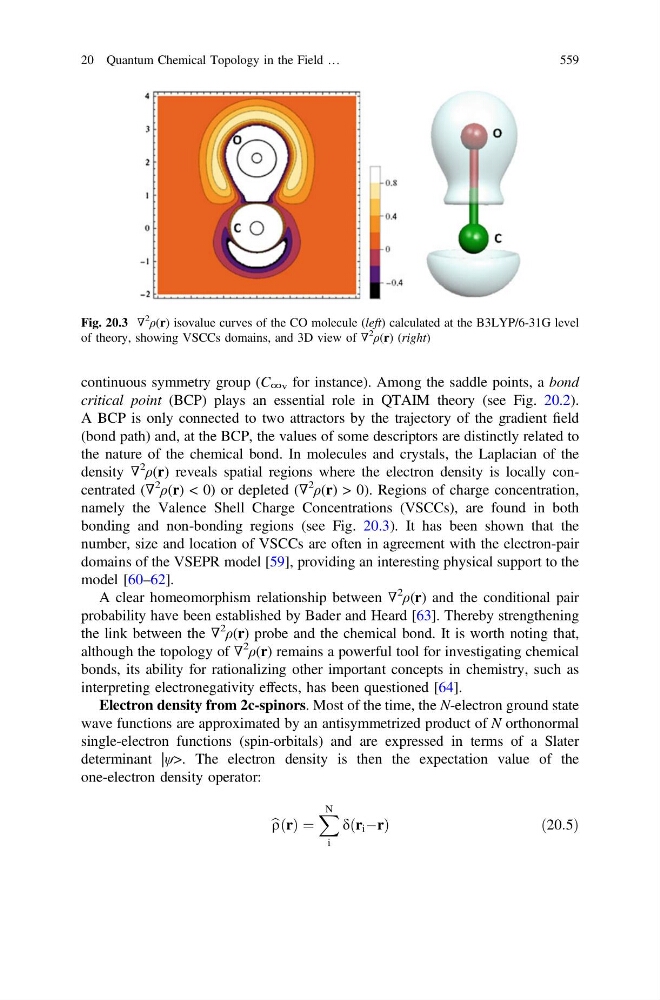
the nature of the chemical bond. In molecules and crystals, the Laplacian of the
density ∇
2
ρ(r) reveals spatial regions where the electron density is locally concentrated (∇
2
ρ(r) < 0) or depleted (∇
2
ρ(r) > 0). Regions of charge concentration,
namely the Valence Shell Charge Concentrations (VSCCs), are found in both
bonding and non-bonding regions (see Fig. 20.3). It has been shown that the
number, size and location of VSCCs are often in agreement with the electron-pair
domains of the VSEPR model [59], providing an interesting physical support to the
model [60–62].
A clear homeomorphism relationship between ∇
2
ρ(r) and the conditional pair
probability have been established by Bader and Heard [63]. Thereby strengthening
the link between the ∇
2
ρ(r) probe and the chemical bond. It is worth noting that,
although the topology of ∇
2
ρ(r) remains a powerful tool for investigating chemical
bonds, its ability for rationalizing other important concepts in chemistry, such as
interpreting electronegativity effects, has been questioned [64].
Electron density from 2c-spinors. Most of the time, the N-electron ground state
wave functions are approximated by an antisymmetrized product of N orthonormal
single-electron functions (spin-orbitals) and are expressed in terms of a Slater
determinant |ψ>. The electron density is then the expectation value of the
one-electron density operator:
b q r
ð Þ ¼
X N
i
dðr i ÀrÞ
ð 20:5Þ
Fig. 20.3 ∇
2 ρ(r) isovalue curves of the CO molecule (left) calculated at the B3LYP/6-31G level
of theory, showing VSCCs domains, and 3D view of ∇
2
ρ(r) (right)
20 Quantum Chemical Topology in the Field …
559
critical point (BCP) plays an essential role in QTAIM theory (see Fig. 20.2).
A BCP is only connected to two attractors by the trajectory of the gradient field
(bond path) and, at the BCP, the values of some descriptors are distinctly related to
the nature of the chemical bond. In molecules and crystals, the Laplacian of the
density ∇
2
ρ(r) reveals spatial regions where the electron density is locally concentrated (∇
2
ρ(r) < 0) or depleted (∇
2
ρ(r) > 0). Regions of charge concentration,
namely the Valence Shell Charge Concentrations (VSCCs), are found in both
bonding and non-bonding regions (see Fig. 20.3). It has been shown that the
number, size and location of VSCCs are often in agreement with the electron-pair
domains of the VSEPR model [59], providing an interesting physical support to the
model [60–62].
A clear homeomorphism relationship between ∇
2
ρ(r) and the conditional pair
probability have been established by Bader and Heard [63]. Thereby strengthening
the link between the ∇
2
ρ(r) probe and the chemical bond. It is worth noting that,
although the topology of ∇
2
ρ(r) remains a powerful tool for investigating chemical
bonds, its ability for rationalizing other important concepts in chemistry, such as
interpreting electronegativity effects, has been questioned [64].
Electron density from 2c-spinors. Most of the time, the N-electron ground state
wave functions are approximated by an antisymmetrized product of N orthonormal
single-electron functions (spin-orbitals) and are expressed in terms of a Slater
determinant |ψ>. The electron density is then the expectation value of the
one-electron density operator:
b q r
ð Þ ¼
X N
i
dðr i ÀrÞ
ð 20:5Þ
Fig. 20.3 ∇
2 ρ(r) isovalue curves of the CO molecule (left) calculated at the B3LYP/6-31G level
of theory, showing VSCCs domains, and 3D view of ∇
2
ρ(r) (right)
20 Quantum Chemical Topology in the Field …
559