

20.2.4 Computer Implementation in a 2c Context
The QTAIM and ELF topological analyzes, extended for the treatment of 2c wave
functions from the NWChem software, have been implemented in a modified
version of the TopMod program package [24, 89]. The program, written in Fortran
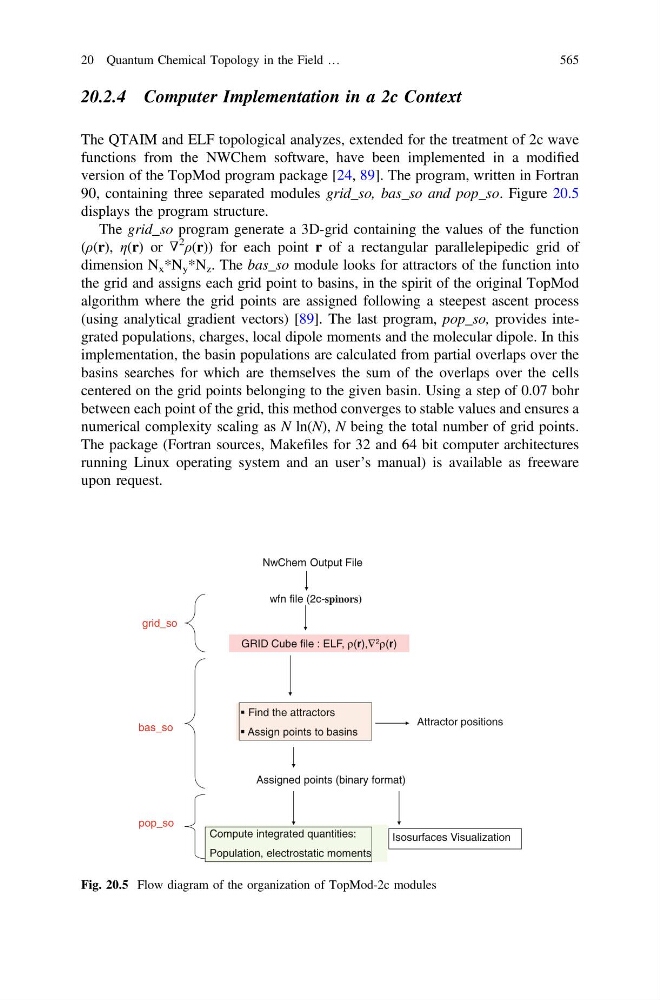
90, containing three separated modules grid_so, bas_so and pop_so. Figure 20.5
displays the program structure.
The grid_so program generate a 3D-grid containing the values of the function
(ρ(r), η(r) or ∇
2
ρ(r)) for each point r of a rectangular parallelepipedic grid of
dimension N x *N y *N z . The bas_so module looks for attractors of the function into
the grid and assigns each grid point to basins, in the spirit of the original TopMod
algorithm where the grid points are assigned following a steepest ascent process
(using analytical gradient vectors) [89]. The last program, pop_so, provides integrated populations, charges, local dipole moments and the molecular dipole. In this
implementation, the basin populations are calculated from partial overlaps over the
basins searches for which are themselves the sum of the overlaps over the cells
centered on the grid points belonging to the given basin. Using a step of 0.07 bohr
between each point of the grid, this method converges to stable values and ensures a
numerical complexity scaling as N ln(N), N being the total number of grid points.
The package (Fortran sources, Makefiles for 32 and 64 bit computer architectures
running Linux operating system and an user’s manual) is available as freeware
upon request.
Find the attractors
Assign points to basins
Assigned points (binary format)
Compute integrated quantities:
Population, electrostatic moments
Isosurfaces Visualization
GRID Cube file : ELF, ρ(r),∇ 2 ρ(r)
Attractor positions
grid_so
NwChem Output File
bas_so
pop_so
wfn file (2c-spinors)
Fig. 20.5 Flow diagram of the organization of TopMod-2c modules
20 Quantum Chemical Topology in the Field …
565
The QTAIM and ELF topological analyzes, extended for the treatment of 2c wave
functions from the NWChem software, have been implemented in a modified
version of the TopMod program package [24, 89]. The program, written in Fortran
90, containing three separated modules grid_so, bas_so and pop_so. Figure 20.5
displays the program structure.
The grid_so program generate a 3D-grid containing the values of the function
(ρ(r), η(r) or ∇
2
ρ(r)) for each point r of a rectangular parallelepipedic grid of
dimension N x *N y *N z . The bas_so module looks for attractors of the function into
the grid and assigns each grid point to basins, in the spirit of the original TopMod
algorithm where the grid points are assigned following a steepest ascent process
(using analytical gradient vectors) [89]. The last program, pop_so, provides integrated populations, charges, local dipole moments and the molecular dipole. In this
implementation, the basin populations are calculated from partial overlaps over the
basins searches for which are themselves the sum of the overlaps over the cells
centered on the grid points belonging to the given basin. Using a step of 0.07 bohr
between each point of the grid, this method converges to stable values and ensures a
numerical complexity scaling as N ln(N), N being the total number of grid points.
The package (Fortran sources, Makefiles for 32 and 64 bit computer architectures
running Linux operating system and an user’s manual) is available as freeware
upon request.
Find the attractors
Assign points to basins
Assigned points (binary format)
Compute integrated quantities:
Population, electrostatic moments
Isosurfaces Visualization
GRID Cube file : ELF, ρ(r),∇ 2 ρ(r)
Attractor positions
grid_so
NwChem Output File
bas_so
pop_so
wfn file (2c-spinors)
Fig. 20.5 Flow diagram of the organization of TopMod-2c modules
20 Quantum Chemical Topology in the Field …
565