

short-range radial potentials which are different for different orbital
angular-momentum quantum numbers l and, for a given l, for the two total
one-electron angular-momentum quantum numbers j = l ± 1/2 ( b
P lj is the 2c projector onto the complete space of functions with angular symmetry l, j around the
core under study). The parameters B
k
lj and b
k
lj are adjusted so that b
V PP in 2c
valence-only atomic calculations reproduces, as closely as possible, a set of
all-electron 4c multiconfiguration Dirac-Hartree-Fock (MCDHF) energies. Note
that a transcription of such kind of PP into a scalar-relativistic spin-averaged part
(averaged relativistic potential b
V AREP ) and an effective one-electron spin-orbit
operator ( b
V SO ) is easily possible [43, 44]. The omission of b
V SO in the calculation
leads to one-component (1c) scalar-relativistic approach (in a non-relativistic formalism). Hence, SOC effects can readily be quantified via the difference between
calculations with and without b
V SO included in PPs. The action of b
V SO generates a
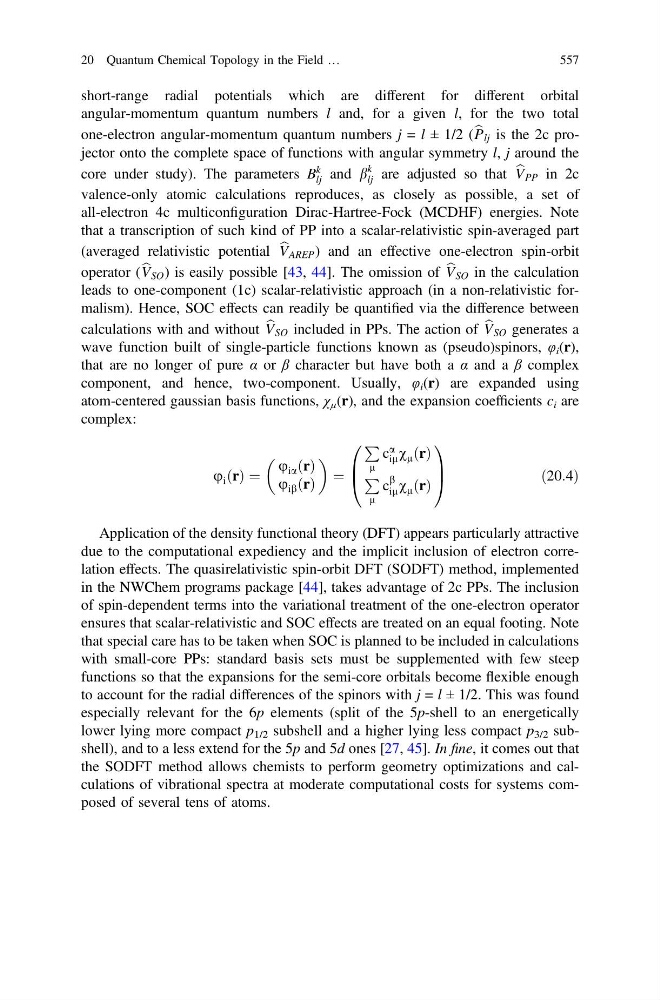
wave function built of single-particle functions known as (pseudo)spinors, φ i (r),
that are no longer of pure α or β character but have both a α and a β complex
component, and hence, two-component. Usually, φ i (r) are expanded using
atom-centered gaussian basis functions, χ µ (r), and the expansion coefficients c i are
complex:
u i r
ð Þ ¼
u ia r
ð Þ
u ib r
ð Þ
¼
P
l
c
a
il v l ðrÞ
P
l
c
b
il v l ðrÞ
0
B
@
1
C
A
ð20:4Þ
Application of the density functional theory (DFT) appears particularly attractive
due to the computational expediency and the implicit inclusion of electron correlation effects. The quasirelativistic spin-orbit DFT (SODFT) method, implemented
in the NWChem programs package [44], takes advantage of 2c PPs. The inclusion
of spin-dependent terms into the variational treatment of the one-electron operator
ensures that scalar-relativistic and SOC effects are treated on an equal footing. Note
that special care has to be taken when SOC is planned to be included in calculations
with small-core PPs: standard basis sets must be supplemented with few steep
functions so that the expansions for the semi-core orbitals become flexible enough
to account for the radial differences of the spinors with j = l ± 1/2. This was found
especially relevant for the 6p elements (split of the 5p-shell to an energetically
lower lying more compact p 1/2 subshell and a higher lying less compact p 3/2 subshell), and to a less extend for the 5p and 5d ones [27, 45]. In fine, it comes out that
the SODFT method allows chemists to perform geometry optimizations and calculations of vibrational spectra at moderate computational costs for systems composed of several tens of atoms.
20 Quantum Chemical Topology in the Field …
557
angular-momentum quantum numbers l and, for a given l, for the two total
one-electron angular-momentum quantum numbers j = l ± 1/2 ( b
P lj is the 2c projector onto the complete space of functions with angular symmetry l, j around the
core under study). The parameters B
k
lj and b
k
lj are adjusted so that b
V PP in 2c
valence-only atomic calculations reproduces, as closely as possible, a set of
all-electron 4c multiconfiguration Dirac-Hartree-Fock (MCDHF) energies. Note
that a transcription of such kind of PP into a scalar-relativistic spin-averaged part
(averaged relativistic potential b
V AREP ) and an effective one-electron spin-orbit
operator ( b
V SO ) is easily possible [43, 44]. The omission of b
V SO in the calculation
leads to one-component (1c) scalar-relativistic approach (in a non-relativistic formalism). Hence, SOC effects can readily be quantified via the difference between
calculations with and without b
V SO included in PPs. The action of b
V SO generates a
wave function built of single-particle functions known as (pseudo)spinors, φ i (r),
that are no longer of pure α or β character but have both a α and a β complex
component, and hence, two-component. Usually, φ i (r) are expanded using
atom-centered gaussian basis functions, χ µ (r), and the expansion coefficients c i are
complex:
u i r
ð Þ ¼
u ia r
ð Þ
u ib r
ð Þ
¼
P
l
c
a
il v l ðrÞ
P
l
c
b
il v l ðrÞ
0
B
@
1
C
A
ð20:4Þ
Application of the density functional theory (DFT) appears particularly attractive
due to the computational expediency and the implicit inclusion of electron correlation effects. The quasirelativistic spin-orbit DFT (SODFT) method, implemented
in the NWChem programs package [44], takes advantage of 2c PPs. The inclusion
of spin-dependent terms into the variational treatment of the one-electron operator
ensures that scalar-relativistic and SOC effects are treated on an equal footing. Note
that special care has to be taken when SOC is planned to be included in calculations
with small-core PPs: standard basis sets must be supplemented with few steep
functions so that the expansions for the semi-core orbitals become flexible enough
to account for the radial differences of the spinors with j = l ± 1/2. This was found
especially relevant for the 6p elements (split of the 5p-shell to an energetically
lower lying more compact p 1/2 subshell and a higher lying less compact p 3/2 subshell), and to a less extend for the 5p and 5d ones [27, 45]. In fine, it comes out that
the SODFT method allows chemists to perform geometry optimizations and calculations of vibrational spectra at moderate computational costs for systems composed of several tens of atoms.
20 Quantum Chemical Topology in the Field …
557