

20.2 The Theoretical Frame
20.2.1 Computational Strategy
The proper treatment of molecular systems containing heavy atoms needs to perform four-component (4c) relativistic calculations based on the exact Hamiltonian.
The most straightforward way to construct the relativistic many-electron
Hamiltonian is to augment the one-electron Dirac operator with the Coulomb or
Breit operator as a two-electron term [38]. However, the applicability of this
approach is limited to rather small systems owing to unaffordable computational
costs [39]. Either founded on an exact or an approximate formalism, several
quasirelativistic approaches are often employed as efficient alternatives [40, 41].
Accurate descriptions of relativistic effects could be obtained with the exact
two-component (X2C) Hamiltonians, the familiar Douglas-Kroll (DKn) approach,
or using the nth order regular approximation (ZORA, FORA) of the exact relativistic Hamiltonian. The relativistic effective core potential (RECP), and in particular pseudopotential (PP), as an approximate quasirelativistic method has gained
popularity as it makes possible to study systems of increasing size while preserving
a high degree of reliability comparable to the all-electron calculations [42]. Good
efficiency is ensured by replacing inner-core electrons, which leads to significant
reductions in the number of basis functions, and the simpler forms of the
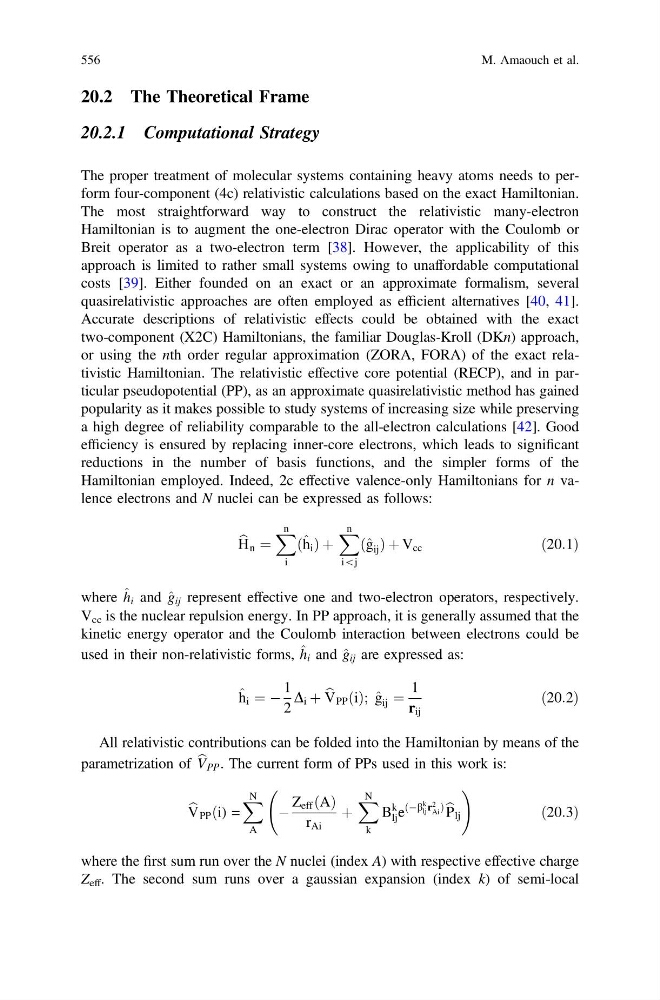
Hamiltonian employed. Indeed, 2c effective valence-only Hamiltonians for n valence electrons and N nuclei can be expressed as follows:
b
H n ¼
X n
i
ð ^ h i Þ þ
X n
i\j
ð^ g ij Þ þ V cc
ð20:1Þ
where ^ h i and ^ g ij represent effective one and two-electron operators, respectively.
V cc is the nuclear repulsion energy. In PP approach, it is generally assumed that the
kinetic energy operator and the Coulomb interaction between electrons could be
used in their non-relativistic forms, ^ h i and ^ g ij are expressed as:
^ h i ¼ À
1
2
D i þ b
V PP i
ð Þ; ^ g ij ¼
1
r ij
ð20:2Þ
All relativistic contributions can be folded into the Hamiltonian by means of the
parametrization of b
V PP . The current form of PPs used in this work is:
b
V PP ði) =
X N
A
À
Z eff A
ð Þ
r Ai
þ
X N
k
B
k
lj e
ðÀb
k
lj r
2
Ai Þ b P lj
!
ð20:3Þ
where the first sum run over the N nuclei (index A) with respective effective charge
Z eff . The second sum runs over a gaussian expansion (index k) of semi-local
556
M. Amaouch et al.
20.2.1 Computational Strategy
The proper treatment of molecular systems containing heavy atoms needs to perform four-component (4c) relativistic calculations based on the exact Hamiltonian.
The most straightforward way to construct the relativistic many-electron
Hamiltonian is to augment the one-electron Dirac operator with the Coulomb or
Breit operator as a two-electron term [38]. However, the applicability of this
approach is limited to rather small systems owing to unaffordable computational
costs [39]. Either founded on an exact or an approximate formalism, several
quasirelativistic approaches are often employed as efficient alternatives [40, 41].
Accurate descriptions of relativistic effects could be obtained with the exact
two-component (X2C) Hamiltonians, the familiar Douglas-Kroll (DKn) approach,
or using the nth order regular approximation (ZORA, FORA) of the exact relativistic Hamiltonian. The relativistic effective core potential (RECP), and in particular pseudopotential (PP), as an approximate quasirelativistic method has gained
popularity as it makes possible to study systems of increasing size while preserving
a high degree of reliability comparable to the all-electron calculations [42]. Good
efficiency is ensured by replacing inner-core electrons, which leads to significant
reductions in the number of basis functions, and the simpler forms of the
Hamiltonian employed. Indeed, 2c effective valence-only Hamiltonians for n valence electrons and N nuclei can be expressed as follows:
b
H n ¼
X n
i
ð ^ h i Þ þ
X n
i\j
ð^ g ij Þ þ V cc
ð20:1Þ
where ^ h i and ^ g ij represent effective one and two-electron operators, respectively.
V cc is the nuclear repulsion energy. In PP approach, it is generally assumed that the
kinetic energy operator and the Coulomb interaction between electrons could be
used in their non-relativistic forms, ^ h i and ^ g ij are expressed as:
^ h i ¼ À
1
2
D i þ b
V PP i
ð Þ; ^ g ij ¼
1
r ij
ð20:2Þ
All relativistic contributions can be folded into the Hamiltonian by means of the
parametrization of b
V PP . The current form of PPs used in this work is:
b
V PP ði) =
X N
A
À
Z eff A
ð Þ
r Ai
þ
X N
k
B
k
lj e
ðÀb
k
lj r
2
Ai Þ b P lj
!
ð20:3Þ
where the first sum run over the N nuclei (index A) with respective effective charge
Z eff . The second sum runs over a gaussian expansion (index k) of semi-local
556
M. Amaouch et al.