

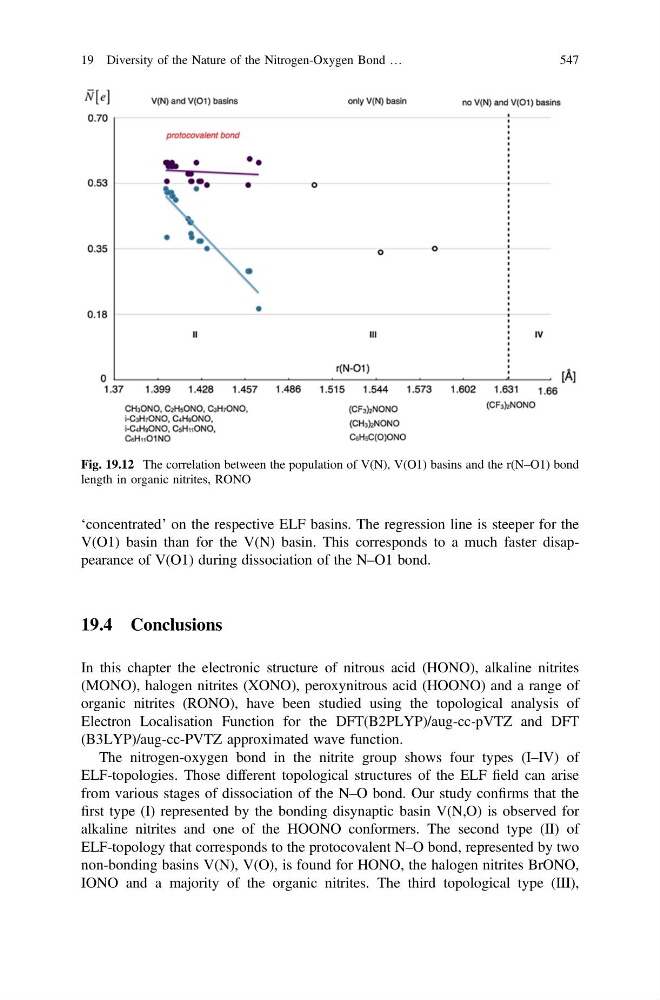
‘concentrated’ on the respective ELF basins. The regression line is steeper for the
V(O1) basin than for the V(N) basin. This corresponds to a much faster disappearance of V(O1) during dissociation of the N–O1 bond.
19.4 Conclusions
In this chapter the electronic structure of nitrous acid (HONO), alkaline nitrites
(MONO), halogen nitrites (XONO), peroxynitrous acid (HOONO) and a range of
organic nitrites (RONO), have been studied using the topological analysis of
Electron Localisation Function for the DFT(B2PLYP)/aug-cc-pVTZ and DFT
(B3LYP)/aug-cc-PVTZ approximated wave function.
The nitrogen-oxygen bond in the nitrite group shows four types (I–IV) of
ELF-topologies. Those different topological structures of the ELF field can arise
from various stages of dissociation of the N–O bond. Our study confirms that the
first type (I) represented by the bonding disynaptic basin V(N,O) is observed for
alkaline nitrites and one of the HOONO conformers. The second type (II) of
ELF-topology that corresponds to the protocovalent N–O bond, represented by two
non-bonding basins V(N), V(O), is found for HONO, the halogen nitrites BrONO,
IONO and a majority of the organic nitrites. The third topological type (III),
Fig. 19.12 The correlation between the population of V(N), V(O1) basins and the r(N–O1) bond
length in organic nitrites, RONO
19 Diversity of the Nature of the Nitrogen-Oxygen Bond …
547
V(O1) basin than for the V(N) basin. This corresponds to a much faster disappearance of V(O1) during dissociation of the N–O1 bond.
19.4 Conclusions
In this chapter the electronic structure of nitrous acid (HONO), alkaline nitrites
(MONO), halogen nitrites (XONO), peroxynitrous acid (HOONO) and a range of
organic nitrites (RONO), have been studied using the topological analysis of
Electron Localisation Function for the DFT(B2PLYP)/aug-cc-pVTZ and DFT
(B3LYP)/aug-cc-PVTZ approximated wave function.
The nitrogen-oxygen bond in the nitrite group shows four types (I–IV) of
ELF-topologies. Those different topological structures of the ELF field can arise
from various stages of dissociation of the N–O bond. Our study confirms that the
first type (I) represented by the bonding disynaptic basin V(N,O) is observed for
alkaline nitrites and one of the HOONO conformers. The second type (II) of
ELF-topology that corresponds to the protocovalent N–O bond, represented by two
non-bonding basins V(N), V(O), is found for HONO, the halogen nitrites BrONO,
IONO and a majority of the organic nitrites. The third topological type (III),
Fig. 19.12 The correlation between the population of V(N), V(O1) basins and the r(N–O1) bond
length in organic nitrites, RONO
19 Diversity of the Nature of the Nitrogen-Oxygen Bond …
547