

characterised by single nonbonding basin V(N) is observed for the halogen nitrites
FONO, ClONO, HOONO, (CH 3 ) 2 NONO and benzoyl nitrite. Finally, for the very
long N–O bond, found in the (CF 3 ) 2 NO–NO molecule, the fourth type (IV) of
ELF-topology is observed. This type is characterised by an absence of local
maxima of the ELF field.
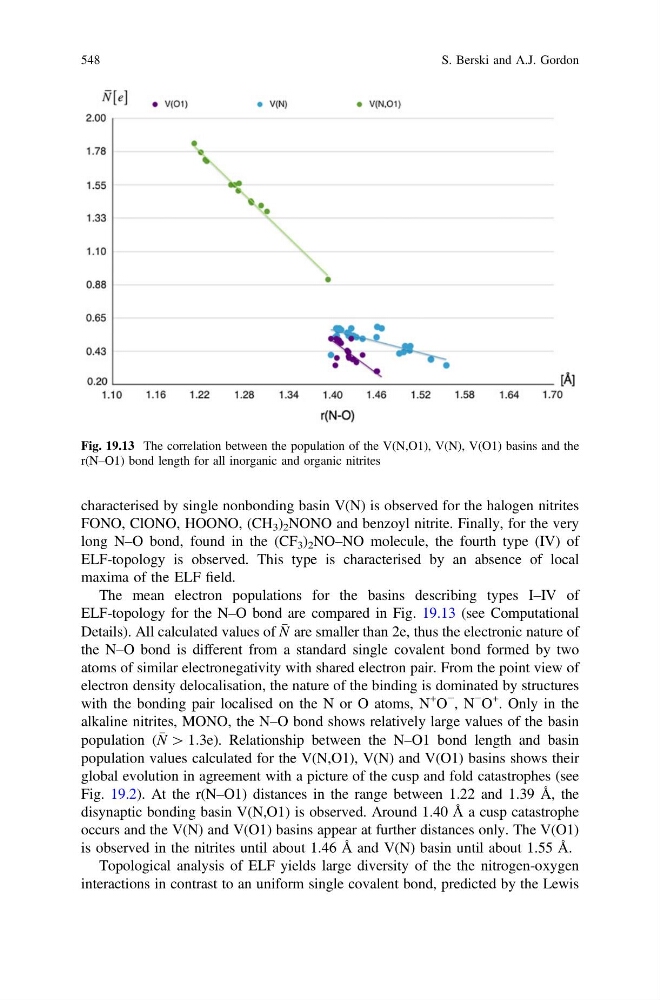
The mean electron populations for the basins describing types I–IV of
ELF-topology for the N–O bond are compared in Fig. 19.13 (see Computational
Details). All calculated values of
N are smaller than 2e, thus the electronic nature of
the N–O bond is different from a standard single covalent bond formed by two
atoms of similar electronegativity with shared electron pair. From the point view of
electron density delocalisation, the nature of the binding is dominated by structures
with the bonding pair localised on the N or O atoms, N
+
O
−
, N
− O
+ . Only in the
alkaline nitrites, MONO, the N–O bond shows relatively large values of the basin
population (
N [ 1:3e). Relationship between the N–O1 bond length and basin
population values calculated for the V(N,O1), V(N) and V(O1) basins shows their
global evolution in agreement with a picture of the cusp and fold catastrophes (see
Fig. 19.2). At the r(N–O1) distances in the range between 1.22 and 1.39 Å, the
disynaptic bonding basin V(N,O1) is observed. Around 1.40 Å a cusp catastrophe
occurs and the V(N) and V(O1) basins appear at further distances only. The V(O1)
is observed in the nitrites until about 1.46 Å and V(N) basin until about 1.55 Å.
Topological analysis of ELF yields large diversity of the the nitrogen-oxygen
interactions in contrast to an uniform single covalent bond, predicted by the Lewis
Fig. 19.13 The correlation between the population of the V(N,O1), V(N), V(O1) basins and the
r(N–O1) bond length for all inorganic and organic nitrites
548
S. Berski and A.J. Gordon
FONO, ClONO, HOONO, (CH 3 ) 2 NONO and benzoyl nitrite. Finally, for the very
long N–O bond, found in the (CF 3 ) 2 NO–NO molecule, the fourth type (IV) of
ELF-topology is observed. This type is characterised by an absence of local
maxima of the ELF field.
The mean electron populations for the basins describing types I–IV of
ELF-topology for the N–O bond are compared in Fig. 19.13 (see Computational
Details). All calculated values of
N are smaller than 2e, thus the electronic nature of
the N–O bond is different from a standard single covalent bond formed by two
atoms of similar electronegativity with shared electron pair. From the point view of
electron density delocalisation, the nature of the binding is dominated by structures
with the bonding pair localised on the N or O atoms, N
+
O
−
, N
− O
+ . Only in the
alkaline nitrites, MONO, the N–O bond shows relatively large values of the basin
population (
N [ 1:3e). Relationship between the N–O1 bond length and basin
population values calculated for the V(N,O1), V(N) and V(O1) basins shows their
global evolution in agreement with a picture of the cusp and fold catastrophes (see
Fig. 19.2). At the r(N–O1) distances in the range between 1.22 and 1.39 Å, the
disynaptic bonding basin V(N,O1) is observed. Around 1.40 Å a cusp catastrophe
occurs and the V(N) and V(O1) basins appear at further distances only. The V(O1)
is observed in the nitrites until about 1.46 Å and V(N) basin until about 1.55 Å.
Topological analysis of ELF yields large diversity of the the nitrogen-oxygen
interactions in contrast to an uniform single covalent bond, predicted by the Lewis
Fig. 19.13 The correlation between the population of the V(N,O1), V(N), V(O1) basins and the
r(N–O1) bond length for all inorganic and organic nitrites
548
S. Berski and A.J. Gordon