

spikes appearing for Pd at ca. q ¼ 0:1 a.u., along with the peaks appearing for the
iodine compounds in Sect. 18.7.1, are an artifact from the pseudopotential, and as
such, should be disregarded.
18.8 Reactivity
Understanding and predicting chemical reactivity are some of the achievements of
quantum chemistry. In this regard, the Woodward-Hoffmann rules [21] for pericyclic reactions have become a classical reference. By definition, pericyclic reactions evolve via a cyclic aromatic transition state of delocalized electrons where
bond making and bond breaking occur simultaneously in a cyclic array. Using the
orbital symmetry conservation, Woodward-Hoffmann proposed a list of rules of
thumb able to predict the mechanism and, hence the stereoselectivity of pericyclic
reactions. Examples include cycloadditions, electrocyclizations, sigmatropic rearrangements, and chelotropic reactions. Much work has been devoted to show that
electron circulation on the pericyclic transition states may be smartly characterized
by the topology of the electron localization function (ELF) [92]. Recently, it was
shown how the combined analysis of the NCI method and ELF may be employed as
a visual tool to understand the electron reorganization along an intrinsic reaction
path (IRC) [93]. Contrary to ELF, the reduced density gradient does no suffer from
catastrophes (sudden creation and/or destruction of critical points), being possible
to preclude the bonding formation from the first stages of the reaction.
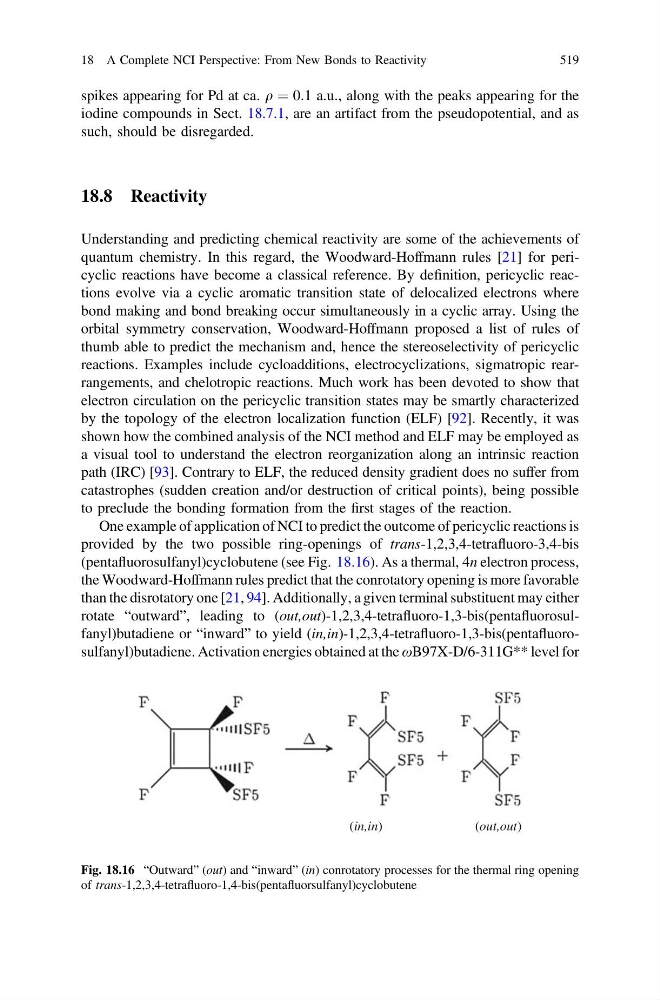
One example of application of NCI to predict the outcome of pericyclic reactions is
provided by the two possible ring-openings of trans-1,2,3,4-tetrafluoro-3,4-bis
(pentafluorosulfanyl)cyclobutene (see Fig. 18.16). As a thermal, 4n electron process,
the Woodward-Hoffmann rules predict that the conrotatory opening is more favorable
than the disrotatory one [21, 94]. Additionally, a given terminal substituent may either
rotate “outward”, leading to (out,out)-1,2,3,4-tetrafluoro-1,3-bis(pentafluorosulfanyl)butadiene or “inward” to yield (in,in)-1,2,3,4-tetrafluoro-1,3-bis(pentafluorosulfanyl)butadiene. Activation energies obtained at the ωB97X-D/6-311G** level for
(in,in)
( out,out)
Fig. 18.16 “Outward” (out) and “inward” (in) conrotatory processes for the thermal ring opening
of trans-1,2,3,4-tetrafluoro-1,4-bis(pentafluorsulfanyl)cyclobutene
18 A Complete NCI Perspective: From New Bonds to Reactivity
519
iodine compounds in Sect. 18.7.1, are an artifact from the pseudopotential, and as
such, should be disregarded.
18.8 Reactivity
Understanding and predicting chemical reactivity are some of the achievements of
quantum chemistry. In this regard, the Woodward-Hoffmann rules [21] for pericyclic reactions have become a classical reference. By definition, pericyclic reactions evolve via a cyclic aromatic transition state of delocalized electrons where
bond making and bond breaking occur simultaneously in a cyclic array. Using the
orbital symmetry conservation, Woodward-Hoffmann proposed a list of rules of
thumb able to predict the mechanism and, hence the stereoselectivity of pericyclic
reactions. Examples include cycloadditions, electrocyclizations, sigmatropic rearrangements, and chelotropic reactions. Much work has been devoted to show that
electron circulation on the pericyclic transition states may be smartly characterized
by the topology of the electron localization function (ELF) [92]. Recently, it was
shown how the combined analysis of the NCI method and ELF may be employed as
a visual tool to understand the electron reorganization along an intrinsic reaction
path (IRC) [93]. Contrary to ELF, the reduced density gradient does no suffer from
catastrophes (sudden creation and/or destruction of critical points), being possible
to preclude the bonding formation from the first stages of the reaction.
One example of application of NCI to predict the outcome of pericyclic reactions is
provided by the two possible ring-openings of trans-1,2,3,4-tetrafluoro-3,4-bis
(pentafluorosulfanyl)cyclobutene (see Fig. 18.16). As a thermal, 4n electron process,
the Woodward-Hoffmann rules predict that the conrotatory opening is more favorable
than the disrotatory one [21, 94]. Additionally, a given terminal substituent may either
rotate “outward”, leading to (out,out)-1,2,3,4-tetrafluoro-1,3-bis(pentafluorosulfanyl)butadiene or “inward” to yield (in,in)-1,2,3,4-tetrafluoro-1,3-bis(pentafluorosulfanyl)butadiene. Activation energies obtained at the ωB97X-D/6-311G** level for
(in,in)
( out,out)
Fig. 18.16 “Outward” (out) and “inward” (in) conrotatory processes for the thermal ring opening
of trans-1,2,3,4-tetrafluoro-1,4-bis(pentafluorsulfanyl)cyclobutene
18 A Complete NCI Perspective: From New Bonds to Reactivity
519