

(out,out) and (in,in) transition states are 41.55 kcal/mol and 21.12 kcal/mol,
respectively. Because this kind of stereoselectivity is related to the direction of the
twist, it was named torquoselectivity by Houk and co-workers [95].
Rondan and Houk proposed in 1984 a widely accepted orbital model able to
explain torquoselectivity [96, 97]. In a nutshell, this model states that electron donor
substituents at C 3 and C 4 preferentially rotate outward in order to maximize the
stabilizing interaction with the HOMO of the breaking C 3 –C 4 bond and to minimize
the repulsive interaction with the LUMO of the same bond. Electron acceptor
substituents undergo the opposite effect, and, consequently, inward rotation is
preferred. Since only certain orbitals are included in the model, a wrong selection of
the interacting orbitals leads to wrong predictions. This disadvantage is common for
all theories based on a selected group of orbitals, such as the frontier orbital theory
[98]. To avoid this flaw, Ponec decided to reinvestigate the problem in terms of an
electron density based indicator, such as the molecular similarity approach [99]. He
showed that the origin of the torquoselectivity comes from the low electron reorganization required to convert reactants into products.
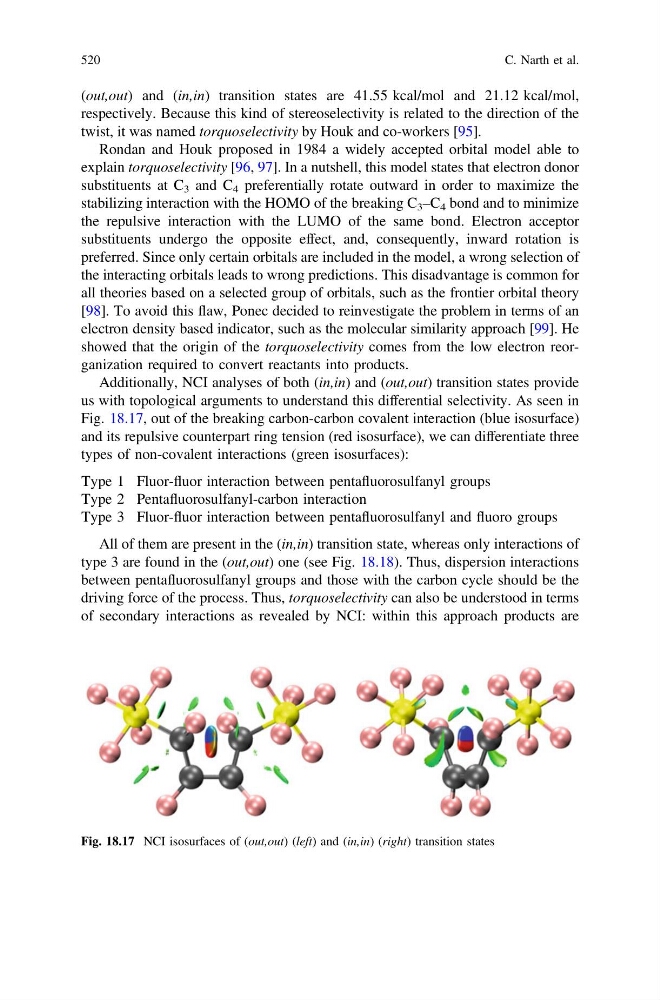
Additionally, NCI analyses of both (in,in) and (out,out) transition states provide
us with topological arguments to understand this differential selectivity. As seen in
Fig. 18.17, out of the breaking carbon-carbon covalent interaction (blue isosurface)
and its repulsive counterpart ring tension (red isosurface), we can differentiate three
types of non-covalent interactions (green isosurfaces):
Type 1 Fluor-fluor interaction between pentafluorosulfanyl groups
Type 2 Pentafluorosulfanyl-carbon interaction
Type 3 Fluor-fluor interaction between pentafluorosulfanyl and fluoro groups
All of them are present in the (in,in) transition state, whereas only interactions of
type 3 are found in the (out,out) one (see Fig. 18.18). Thus, dispersion interactions
between pentafluorosulfanyl groups and those with the carbon cycle should be the
driving force of the process. Thus, torquoselectivity can also be understood in terms
of secondary interactions as revealed by NCI: within this approach products are
Fig. 18.17 NCI isosurfaces of (out,out) (left) and (in,in) (right) transition states
520
C. Narth et al.
respectively. Because this kind of stereoselectivity is related to the direction of the
twist, it was named torquoselectivity by Houk and co-workers [95].
Rondan and Houk proposed in 1984 a widely accepted orbital model able to
explain torquoselectivity [96, 97]. In a nutshell, this model states that electron donor
substituents at C 3 and C 4 preferentially rotate outward in order to maximize the
stabilizing interaction with the HOMO of the breaking C 3 –C 4 bond and to minimize
the repulsive interaction with the LUMO of the same bond. Electron acceptor
substituents undergo the opposite effect, and, consequently, inward rotation is
preferred. Since only certain orbitals are included in the model, a wrong selection of
the interacting orbitals leads to wrong predictions. This disadvantage is common for
all theories based on a selected group of orbitals, such as the frontier orbital theory
[98]. To avoid this flaw, Ponec decided to reinvestigate the problem in terms of an
electron density based indicator, such as the molecular similarity approach [99]. He
showed that the origin of the torquoselectivity comes from the low electron reorganization required to convert reactants into products.
Additionally, NCI analyses of both (in,in) and (out,out) transition states provide
us with topological arguments to understand this differential selectivity. As seen in
Fig. 18.17, out of the breaking carbon-carbon covalent interaction (blue isosurface)
and its repulsive counterpart ring tension (red isosurface), we can differentiate three
types of non-covalent interactions (green isosurfaces):
Type 1 Fluor-fluor interaction between pentafluorosulfanyl groups
Type 2 Pentafluorosulfanyl-carbon interaction
Type 3 Fluor-fluor interaction between pentafluorosulfanyl and fluoro groups
All of them are present in the (in,in) transition state, whereas only interactions of
type 3 are found in the (out,out) one (see Fig. 18.18). Thus, dispersion interactions
between pentafluorosulfanyl groups and those with the carbon cycle should be the
driving force of the process. Thus, torquoselectivity can also be understood in terms
of secondary interactions as revealed by NCI: within this approach products are
Fig. 18.17 NCI isosurfaces of (out,out) (left) and (in,in) (right) transition states
520
C. Narth et al.