

bond in the BH 3 NH 3 complex. It should be noted that this agrees with the fact that
di-hydrogen bonds have been attributed very variable strengths. Crabtree et al. [91]
have placed the NH Á Á Á HB contact at the upper end of the energy range quoted for
hydrogen bonds. Popelier instead, has found it to be in the range of normal HB
strengths [86] and Morrison and Siddick [87] assigned it towards the lower end of
the hydrogen bond strength spectrum. Our results show that the range of energies
covered go (at least) from the strong to the medium HB-type of strength.
18.7.5 Metal Driven Interactions
Although NCI is usually used for weak interactions, its basis does not limit the tool
to only weak interactions. Indeed, it can be used for covalent and ionic interactions,
as well (see S.I. in Refs. [50] and [61]). Most commonly, it is also used within
metallorganic frameworks to detect interactions with metals. We will analyze several
model examples relevant to solvation and protein structure. It should be noted that in
these cases the default cutoff value of the density needs to be increased.
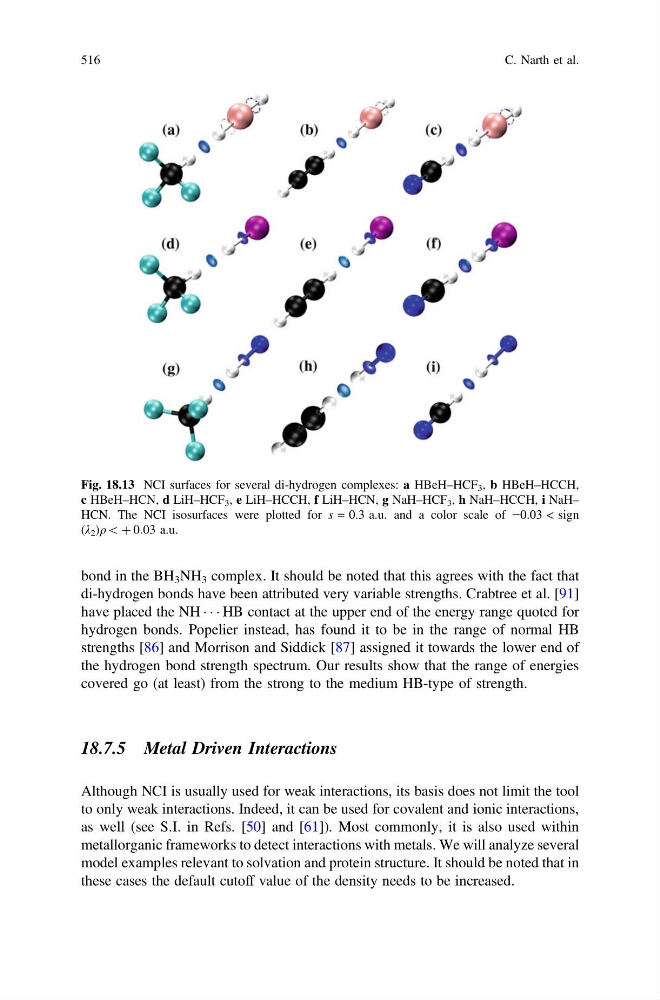
Fig. 18.13 NCI surfaces for several di-hydrogen complexes: a HBeH–HCF 3 , b HBeH–HCCH,
c HBeH–HCN, d LiH–HCF 3 , e LiH–HCCH, f LiH–HCN, g NaH–HCF 3 , h NaH–HCCH, i NaH–
HCN. The NCI isosurfaces were plotted for s = 0.3 a.u. and a color scale of −0.03 < sign
(λ 2 )q\ þ 0:03 a.u.
516
C. Narth et al.
di-hydrogen bonds have been attributed very variable strengths. Crabtree et al. [91]
have placed the NH Á Á Á HB contact at the upper end of the energy range quoted for
hydrogen bonds. Popelier instead, has found it to be in the range of normal HB
strengths [86] and Morrison and Siddick [87] assigned it towards the lower end of
the hydrogen bond strength spectrum. Our results show that the range of energies
covered go (at least) from the strong to the medium HB-type of strength.
18.7.5 Metal Driven Interactions
Although NCI is usually used for weak interactions, its basis does not limit the tool
to only weak interactions. Indeed, it can be used for covalent and ionic interactions,
as well (see S.I. in Refs. [50] and [61]). Most commonly, it is also used within
metallorganic frameworks to detect interactions with metals. We will analyze several
model examples relevant to solvation and protein structure. It should be noted that in
these cases the default cutoff value of the density needs to be increased.
Fig. 18.13 NCI surfaces for several di-hydrogen complexes: a HBeH–HCF 3 , b HBeH–HCCH,
c HBeH–HCN, d LiH–HCF 3 , e LiH–HCCH, f LiH–HCN, g NaH–HCF 3 , h NaH–HCCH, i NaH–
HCN. The NCI isosurfaces were plotted for s = 0.3 a.u. and a color scale of −0.03 < sign
(λ 2 )q\ þ 0:03 a.u.
516
C. Narth et al.