

18.7.4 The Di-hydrogen Bond
The term di-hydrogen bond was coined to describe an interaction of the type D–
H···H–E, where D is a typical hydrogen donor such as N or O. The interesting thing
about this type of bond, is that the acceptor atom is also a hydrogen.
Thus, the accepting hydrogen atom must be hydride-like and E has to be an atom
capable of accommodating a hydridic hydrogen. Transition metals and boron are
some known examples of atoms occurring at position E. Within di-hydrogen
bonded complexes, BH 3 NH 3 is perhaps the most widely studied [86–88]. We have
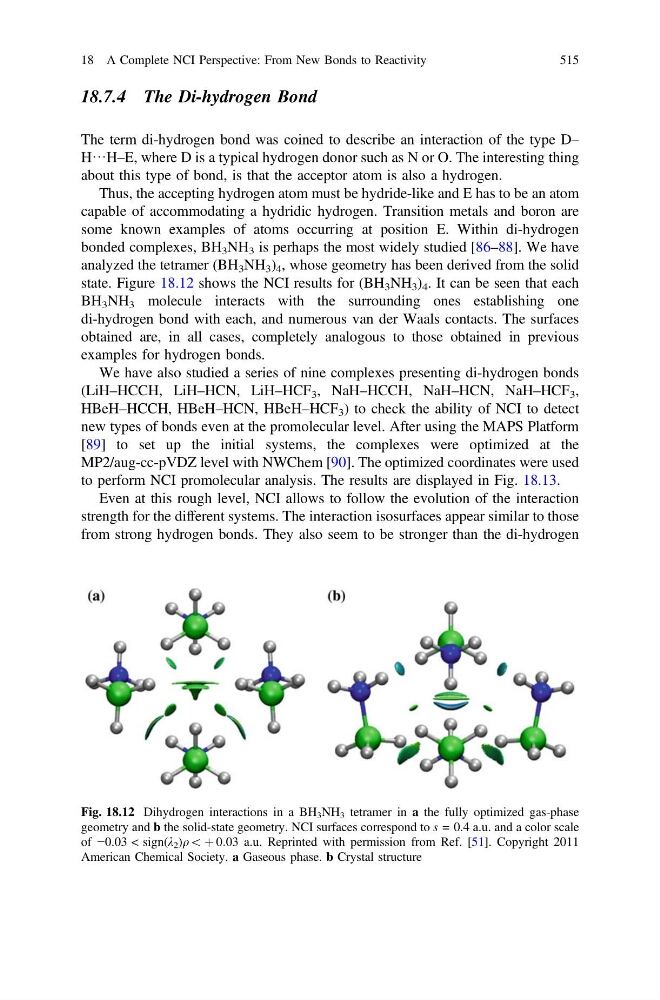
analyzed the tetramer (BH 3 NH 3 ) 4 , whose geometry has been derived from the solid
state. Figure 18.12 shows the NCI results for (BH 3 NH 3 ) 4 . It can be seen that each
BH 3 NH 3 molecule interacts with the surrounding ones establishing one
di-hydrogen bond with each, and numerous van der Waals contacts. The surfaces
obtained are, in all cases, completely analogous to those obtained in previous
examples for hydrogen bonds.
We have also studied a series of nine complexes presenting di-hydrogen bonds
(LiH–HCCH, LiH–HCN, LiH–HCF 3 , NaH–HCCH, NaH–HCN, NaH–HCF 3 ,
HBeH–HCCH, HBeH–HCN, HBeH–HCF 3 ) to check the ability of NCI to detect
new types of bonds even at the promolecular level. After using the MAPS Platform
[89] to set up the initial systems, the complexes were optimized at the
MP2/aug-cc-pVDZ level with NWChem [90]. The optimized coordinates were used
to perform NCI promolecular analysis. The results are displayed in Fig. 18.13.
Even at this rough level, NCI allows to follow the evolution of the interaction
strength for the different systems. The interaction isosurfaces appear similar to those
from strong hydrogen bonds. They also seem to be stronger than the di-hydrogen
Fig. 18.12 Dihydrogen interactions in a BH 3 NH 3 tetramer in a the fully optimized gas-phase
geometry and b the solid-state geometry. NCI surfaces correspond to s = 0.4 a.u. and a color scale
of −0.03 < sign(λ 2 )q\ þ 0:03 a.u. Reprinted with permission from Ref. [51]. Copyright 2011
American Chemical Society. a Gaseous phase. b Crystal structure
18 A Complete NCI Perspective: From New Bonds to Reactivity
515
The term di-hydrogen bond was coined to describe an interaction of the type D–
H···H–E, where D is a typical hydrogen donor such as N or O. The interesting thing
about this type of bond, is that the acceptor atom is also a hydrogen.
Thus, the accepting hydrogen atom must be hydride-like and E has to be an atom
capable of accommodating a hydridic hydrogen. Transition metals and boron are
some known examples of atoms occurring at position E. Within di-hydrogen
bonded complexes, BH 3 NH 3 is perhaps the most widely studied [86–88]. We have
analyzed the tetramer (BH 3 NH 3 ) 4 , whose geometry has been derived from the solid
state. Figure 18.12 shows the NCI results for (BH 3 NH 3 ) 4 . It can be seen that each
BH 3 NH 3 molecule interacts with the surrounding ones establishing one
di-hydrogen bond with each, and numerous van der Waals contacts. The surfaces
obtained are, in all cases, completely analogous to those obtained in previous
examples for hydrogen bonds.
We have also studied a series of nine complexes presenting di-hydrogen bonds
(LiH–HCCH, LiH–HCN, LiH–HCF 3 , NaH–HCCH, NaH–HCN, NaH–HCF 3 ,
HBeH–HCCH, HBeH–HCN, HBeH–HCF 3 ) to check the ability of NCI to detect
new types of bonds even at the promolecular level. After using the MAPS Platform
[89] to set up the initial systems, the complexes were optimized at the
MP2/aug-cc-pVDZ level with NWChem [90]. The optimized coordinates were used
to perform NCI promolecular analysis. The results are displayed in Fig. 18.13.
Even at this rough level, NCI allows to follow the evolution of the interaction
strength for the different systems. The interaction isosurfaces appear similar to those
from strong hydrogen bonds. They also seem to be stronger than the di-hydrogen
Fig. 18.12 Dihydrogen interactions in a BH 3 NH 3 tetramer in a the fully optimized gas-phase
geometry and b the solid-state geometry. NCI surfaces correspond to s = 0.4 a.u. and a color scale
of −0.03 < sign(λ 2 )q\ þ 0:03 a.u. Reprinted with permission from Ref. [51]. Copyright 2011
American Chemical Society. a Gaseous phase. b Crystal structure
18 A Complete NCI Perspective: From New Bonds to Reactivity
515