

more than twice the one donated by NCH. In order to study which is the effect of
the beryllium bond on the halogen bonding features, we have also reported in
Fig. 17.14 the CD functions associated to the formation of the halogen bond in the
structure obtained by removing the BeF 2 fragment from the ternary complex (black,
blue and red dotted lines for NCH, NHCH 2 and NH 3 , respectively). As one might
expect, the difference between a solid and a dotted line of the same color shows
smaller variations along the series if compared with the Be···F case. At the interfragment boundary, these differences are +0.044, +0.072 and +0.061 e, for NCH,
NHCH 2 and NH 3 , respectively. These smaller variations are expected on the basis
we are not changing the nature of the beryllium fragment and this results in a
systematic enhancement of the Cl ← N charge flow.
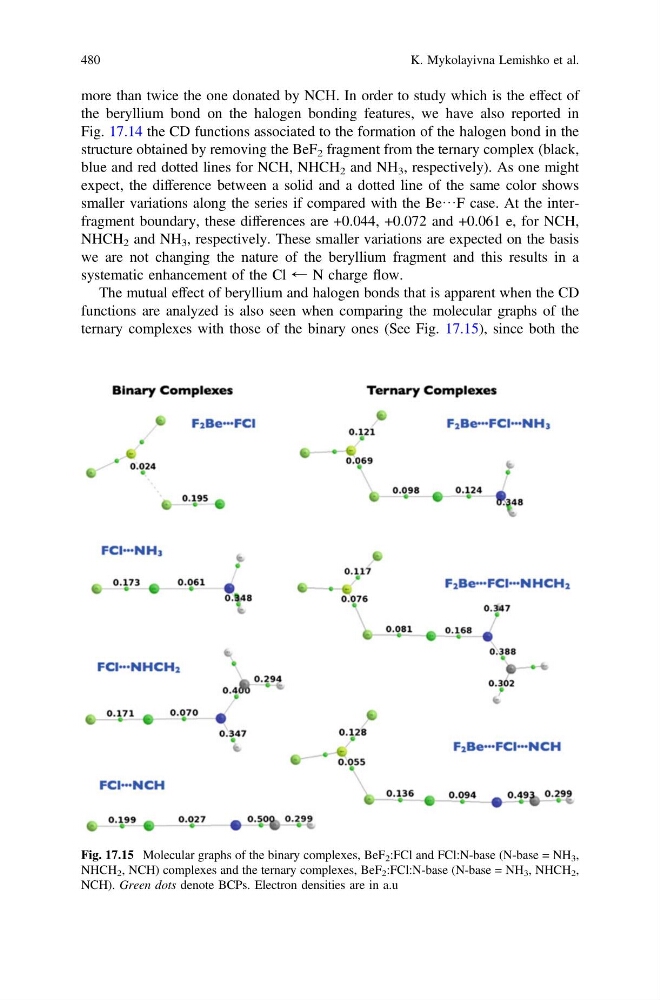
The mutual effect of beryllium and halogen bonds that is apparent when the CD
functions are analyzed is also seen when comparing the molecular graphs of the
ternary complexes with those of the binary ones (See Fig. 17.15), since both the
Fig. 17.15 Molecular graphs of the binary complexes, BeF 2 :FCl and FCl:N-base (N-base = NH 3 ,
NHCH 2 , NCH) complexes and the ternary complexes, BeF 2 :FCl:N-base (N-base = NH 3 , NHCH 2 ,
NCH). Green dots denote BCPs. Electron densities are in a.u
480
K. Mykolayivna Lemishko et al.
the beryllium bond on the halogen bonding features, we have also reported in
Fig. 17.14 the CD functions associated to the formation of the halogen bond in the
structure obtained by removing the BeF 2 fragment from the ternary complex (black,
blue and red dotted lines for NCH, NHCH 2 and NH 3 , respectively). As one might
expect, the difference between a solid and a dotted line of the same color shows
smaller variations along the series if compared with the Be···F case. At the interfragment boundary, these differences are +0.044, +0.072 and +0.061 e, for NCH,
NHCH 2 and NH 3 , respectively. These smaller variations are expected on the basis
we are not changing the nature of the beryllium fragment and this results in a
systematic enhancement of the Cl ← N charge flow.
The mutual effect of beryllium and halogen bonds that is apparent when the CD
functions are analyzed is also seen when comparing the molecular graphs of the
ternary complexes with those of the binary ones (See Fig. 17.15), since both the
Fig. 17.15 Molecular graphs of the binary complexes, BeF 2 :FCl and FCl:N-base (N-base = NH 3 ,
NHCH 2 , NCH) complexes and the ternary complexes, BeF 2 :FCl:N-base (N-base = NH 3 , NHCH 2 ,
NCH). Green dots denote BCPs. Electron densities are in a.u
480
K. Mykolayivna Lemishko et al.