

beryllium and the halogen bonds exhibit a significantly larger electron density in the
ternary complexes.
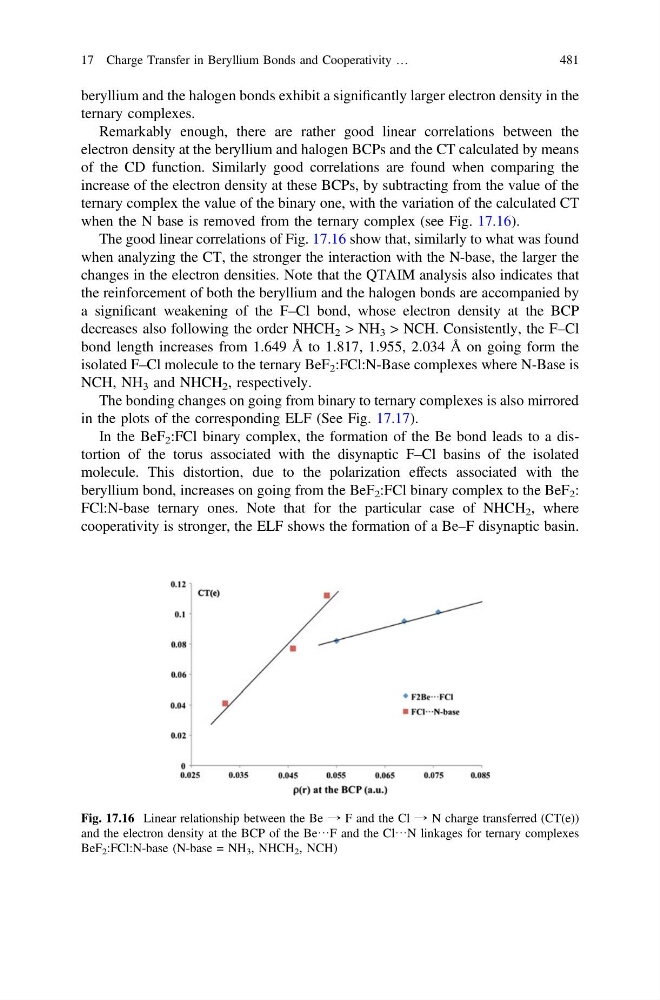
Remarkably enough, there are rather good linear correlations between the
electron density at the beryllium and halogen BCPs and the CT calculated by means
of the CD function. Similarly good correlations are found when comparing the
increase of the electron density at these BCPs, by subtracting from the value of the
ternary complex the value of the binary one, with the variation of the calculated CT
when the N base is removed from the ternary complex (see Fig. 17.16).
The good linear correlations of Fig. 17.16 show that, similarly to what was found
when analyzing the CT, the stronger the interaction with the N-base, the larger the
changes in the electron densities. Note that the QTAIM analysis also indicates that
the reinforcement of both the beryllium and the halogen bonds are accompanied by
a significant weakening of the F–Cl bond, whose electron density at the BCP
decreases also following the order NHCH 2 > NH 3 > NCH. Consistently, the F–Cl
bond length increases from 1.649 Å to 1.817, 1.955, 2.034 Å on going form the
isolated F–Cl molecule to the ternary BeF 2 :FCl:N-Base complexes where N-Base is
NCH, NH 3 and NHCH 2 , respectively.
The bonding changes on going from binary to ternary complexes is also mirrored
in the plots of the corresponding ELF (See Fig. 17.17).
In the BeF 2 :FCl binary complex, the formation of the Be bond leads to a distortion of the torus associated with the disynaptic F–Cl basins of the isolated
molecule. This distortion, due to the polarization effects associated with the
beryllium bond, increases on going from the BeF 2 :FCl binary complex to the BeF 2 :
FCl:N-base ternary ones. Note that for the particular case of NHCH 2 , where
cooperativity is stronger, the ELF shows the formation of a Be–F disynaptic basin.
Fig. 17.16 Linear relationship between the Be → F and the Cl → N charge transferred (CT(e))
and the electron density at the BCP of the Be···F and the Cl···N linkages for ternary complexes
BeF 2 :FCl:N-base (N-base = NH 3 , NHCH 2 , NCH)
17 Charge Transfer in Beryllium Bonds and Cooperativity …
481
ternary complexes.
Remarkably enough, there are rather good linear correlations between the
electron density at the beryllium and halogen BCPs and the CT calculated by means
of the CD function. Similarly good correlations are found when comparing the
increase of the electron density at these BCPs, by subtracting from the value of the
ternary complex the value of the binary one, with the variation of the calculated CT
when the N base is removed from the ternary complex (see Fig. 17.16).
The good linear correlations of Fig. 17.16 show that, similarly to what was found
when analyzing the CT, the stronger the interaction with the N-base, the larger the
changes in the electron densities. Note that the QTAIM analysis also indicates that
the reinforcement of both the beryllium and the halogen bonds are accompanied by
a significant weakening of the F–Cl bond, whose electron density at the BCP
decreases also following the order NHCH 2 > NH 3 > NCH. Consistently, the F–Cl
bond length increases from 1.649 Å to 1.817, 1.955, 2.034 Å on going form the
isolated F–Cl molecule to the ternary BeF 2 :FCl:N-Base complexes where N-Base is
NCH, NH 3 and NHCH 2 , respectively.
The bonding changes on going from binary to ternary complexes is also mirrored
in the plots of the corresponding ELF (See Fig. 17.17).
In the BeF 2 :FCl binary complex, the formation of the Be bond leads to a distortion of the torus associated with the disynaptic F–Cl basins of the isolated
molecule. This distortion, due to the polarization effects associated with the
beryllium bond, increases on going from the BeF 2 :FCl binary complex to the BeF 2 :
FCl:N-base ternary ones. Note that for the particular case of NHCH 2 , where
cooperativity is stronger, the ELF shows the formation of a Be–F disynaptic basin.
Fig. 17.16 Linear relationship between the Be → F and the Cl → N charge transferred (CT(e))
and the electron density at the BCP of the Be···F and the Cl···N linkages for ternary complexes
BeF 2 :FCl:N-base (N-base = NH 3 , NHCH 2 , NCH)
17 Charge Transfer in Beryllium Bonds and Cooperativity …
481