

that at the Be···F BCP, the corresponding difference in the CT component is much
bigger. This points to the fact that the electron densities at the BCP do not depend
only by the amount of charge transferred but also on the physical volume in which
it is accommodated.
17.5 Effect of the Nature of the Basic Site
on Cooperativity. Comparison of F 2 Be:FCl:Nbase
(N-Base = NCH, NHCH 2 , NH 3 ) Ternary Complexes
In this section we extend our study by including different ternary complexes. In
particular, we study complexes of formula F 2 Be:FCl:N-base, where the N-base are
the sp, sp
2 and sp
3 hybridized bases NCH, NHCH 2 and NH 3 , respectively. We
focused here on the comparison between the beryllium/halogen bonds in the ternary
complex and in the binary ones frozen at the same positions they occupy in the
ternary complex.
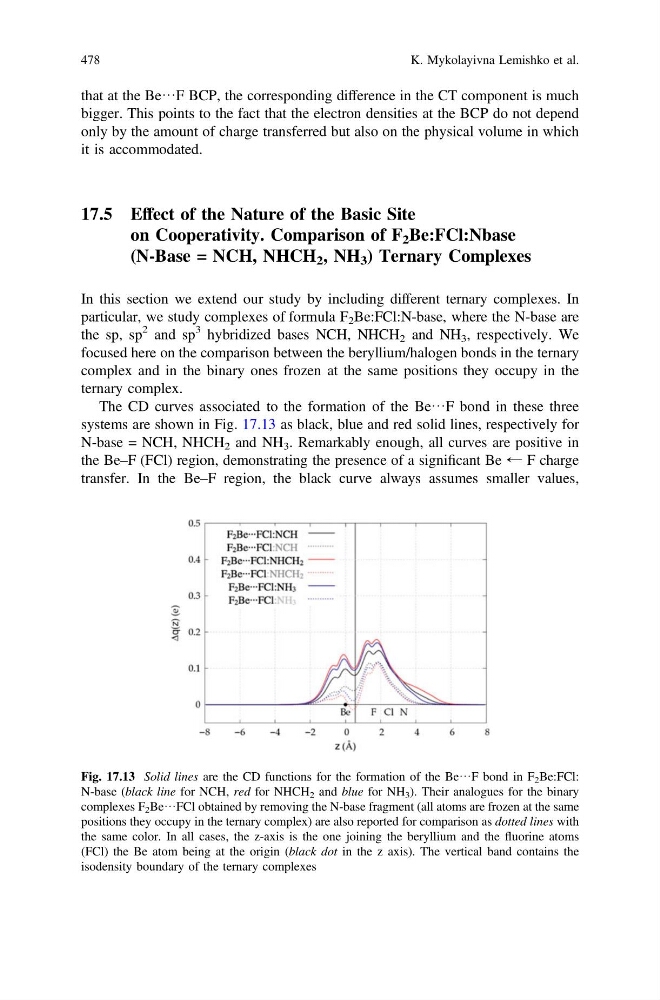
The CD curves associated to the formation of the Be···F bond in these three
systems are shown in Fig. 17.13 as black, blue and red solid lines, respectively for
N-base = NCH, NHCH 2 and NH 3 . Remarkably enough, all curves are positive in
the Be–F (FCl) region, demonstrating the presence of a significant Be ← F charge
transfer. In the Be–F region, the black curve always assumes smaller values,
Fig. 17.13 Solid lines are the CD functions for the formation of the Be···F bond in F 2 Be:FCl:
N-base (black line for NCH, red for NHCH 2 and blue for NH 3 ). Their analogues for the binary
complexes F 2 Be···FCl obtained by removing the N-base fragment (all atoms are frozen at the same
positions they occupy in the ternary complex) are also reported for comparison as dotted lines with
the same color. In all cases, the z-axis is the one joining the beryllium and the fluorine atoms
(FCl) the Be atom being at the origin (black dot in the z axis). The vertical band contains the
isodensity boundary of the ternary complexes
478
K. Mykolayivna Lemishko et al.
bigger. This points to the fact that the electron densities at the BCP do not depend
only by the amount of charge transferred but also on the physical volume in which
it is accommodated.
17.5 Effect of the Nature of the Basic Site
on Cooperativity. Comparison of F 2 Be:FCl:Nbase
(N-Base = NCH, NHCH 2 , NH 3 ) Ternary Complexes
In this section we extend our study by including different ternary complexes. In
particular, we study complexes of formula F 2 Be:FCl:N-base, where the N-base are
the sp, sp
2 and sp
3 hybridized bases NCH, NHCH 2 and NH 3 , respectively. We
focused here on the comparison between the beryllium/halogen bonds in the ternary
complex and in the binary ones frozen at the same positions they occupy in the
ternary complex.
The CD curves associated to the formation of the Be···F bond in these three
systems are shown in Fig. 17.13 as black, blue and red solid lines, respectively for
N-base = NCH, NHCH 2 and NH 3 . Remarkably enough, all curves are positive in
the Be–F (FCl) region, demonstrating the presence of a significant Be ← F charge
transfer. In the Be–F region, the black curve always assumes smaller values,
Fig. 17.13 Solid lines are the CD functions for the formation of the Be···F bond in F 2 Be:FCl:
N-base (black line for NCH, red for NHCH 2 and blue for NH 3 ). Their analogues for the binary
complexes F 2 Be···FCl obtained by removing the N-base fragment (all atoms are frozen at the same
positions they occupy in the ternary complex) are also reported for comparison as dotted lines with
the same color. In all cases, the z-axis is the one joining the beryllium and the fluorine atoms
(FCl) the Be atom being at the origin (black dot in the z axis). The vertical band contains the
isodensity boundary of the ternary complexes
478
K. Mykolayivna Lemishko et al.