

The significant differences in the bonding distances between the binary and
ternary complexes led us to study the beryllium and the halogen bonds in the
geometry obtained by freezing the binary complex atoms at the position they
occupy in the ternary complex. By comparing the bonding features of these systems
with the ones of the ternary complex, we want to estimate the net electronic effect
due to cooperativity, leaving out effects due to the geometry relaxation.
Before discussing cooperativity, it is necessary to compare the Be···F and Cl···N
bonds when binary complexes are on their minimum configuration with the ones of
the “frozen” binary complexes. The CD curve for the Be···F bond in the geometry
obtained by removing the NCH atoms from the ternary complex structure while
keeping the remaining atoms frozen at the same position is the black dotted line of
Fig. 17.10. In this case, we observed a CT of 0.039 e, only 0.003 e larger than the
one of the relaxed binary complex, despite the significant shortening of the Be···F
bond. Conversely, the CD associated with the formation of the Cl···N bond in the
structure obtained by removing the BeF 2 molecule from the ternary complex (black
dotted line of Fig. 17.13) shows the presence of net charge transfer between the
fragments of 0.127 e, significantly higher than the 0.038 e transferred when the
binary complex is on its relaxed configuration. This behavior is consistent with the
shortening observed in the presence of a single, σ component of the interaction.
It is remarkable that, if we use the frozen binary complex as reference, the Cl ← N
charge transfer increases in the ternary complex (F 2 Be:FCl:NCH) by 0.044 e, that is
similar to the increment of 0.041 e observed in the case of the Be ← F charge transfer
upon inclusion of the NCH group.
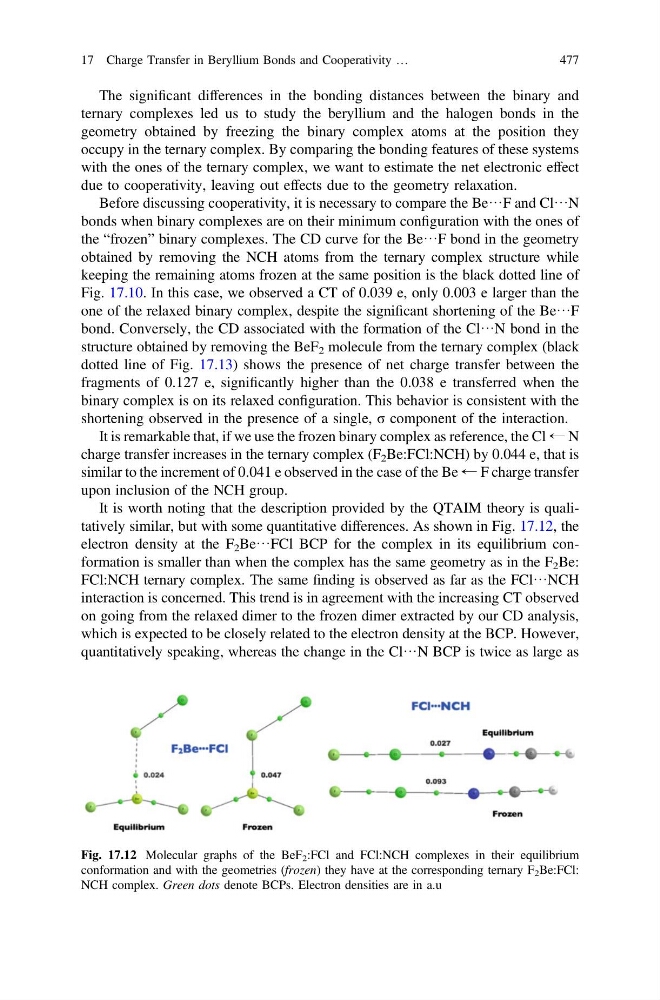
It is worth noting that the description provided by the QTAIM theory is qualitatively similar, but with some quantitative differences. As shown in Fig. 17.12, the
electron density at the F 2 Be···FCl BCP for the complex in its equilibrium conformation is smaller than when the complex has the same geometry as in the F 2 Be:
FCl:NCH ternary complex. The same finding is observed as far as the FCl···NCH
interaction is concerned. This trend is in agreement with the increasing CT observed
on going from the relaxed dimer to the frozen dimer extracted by our CD analysis,
which is expected to be closely related to the electron density at the BCP. However,
quantitatively speaking, whereas the change in the Cl···N BCP is twice as large as
Fig. 17.12 Molecular graphs of the BeF 2 :FCl and FCl:NCH complexes in their equilibrium
conformation and with the geometries (frozen) they have at the corresponding ternary F 2 Be:FCl:
NCH complex. Green dots denote BCPs. Electron densities are in a.u
17 Charge Transfer in Beryllium Bonds and Cooperativity …
477
ternary complexes led us to study the beryllium and the halogen bonds in the
geometry obtained by freezing the binary complex atoms at the position they
occupy in the ternary complex. By comparing the bonding features of these systems
with the ones of the ternary complex, we want to estimate the net electronic effect
due to cooperativity, leaving out effects due to the geometry relaxation.
Before discussing cooperativity, it is necessary to compare the Be···F and Cl···N
bonds when binary complexes are on their minimum configuration with the ones of
the “frozen” binary complexes. The CD curve for the Be···F bond in the geometry
obtained by removing the NCH atoms from the ternary complex structure while
keeping the remaining atoms frozen at the same position is the black dotted line of
Fig. 17.10. In this case, we observed a CT of 0.039 e, only 0.003 e larger than the
one of the relaxed binary complex, despite the significant shortening of the Be···F
bond. Conversely, the CD associated with the formation of the Cl···N bond in the
structure obtained by removing the BeF 2 molecule from the ternary complex (black
dotted line of Fig. 17.13) shows the presence of net charge transfer between the
fragments of 0.127 e, significantly higher than the 0.038 e transferred when the
binary complex is on its relaxed configuration. This behavior is consistent with the
shortening observed in the presence of a single, σ component of the interaction.
It is remarkable that, if we use the frozen binary complex as reference, the Cl ← N
charge transfer increases in the ternary complex (F 2 Be:FCl:NCH) by 0.044 e, that is
similar to the increment of 0.041 e observed in the case of the Be ← F charge transfer
upon inclusion of the NCH group.
It is worth noting that the description provided by the QTAIM theory is qualitatively similar, but with some quantitative differences. As shown in Fig. 17.12, the
electron density at the F 2 Be···FCl BCP for the complex in its equilibrium conformation is smaller than when the complex has the same geometry as in the F 2 Be:
FCl:NCH ternary complex. The same finding is observed as far as the FCl···NCH
interaction is concerned. This trend is in agreement with the increasing CT observed
on going from the relaxed dimer to the frozen dimer extracted by our CD analysis,
which is expected to be closely related to the electron density at the BCP. However,
quantitatively speaking, whereas the change in the Cl···N BCP is twice as large as
Fig. 17.12 Molecular graphs of the BeF 2 :FCl and FCl:NCH complexes in their equilibrium
conformation and with the geometries (frozen) they have at the corresponding ternary F 2 Be:FCl:
NCH complex. Green dots denote BCPs. Electron densities are in a.u
17 Charge Transfer in Beryllium Bonds and Cooperativity …
477