

orientation and Lewis bases, beryllium bond may present a certain amount of CT in
direction going from the beryllium moiety to the base (i.e. non-negligible backdonation), as typically occurs for transition metals in coordination bonding.
17.4 Cooperativity Between Beryllium Bonds and Halogen
Bonds. The F 2 Be:FCl:NCH Complex
In this section we study the cooperativity of halogen and beryllium bonds by
comparing the electronic structure of F 2 Be:FCl and FCl:NCH with the one of the
corresponding ternary complex, namely F 2 Be:FCl:NCH. Our aim is to quantify the
effect of the base on the Be···F bonding features and, at the same time, to understand how the Cl···N bond is affected by the presence of the BeF 2 moiety.
We start comparing the Be···F (FCl) bonding features between F 2 Be:FCl and
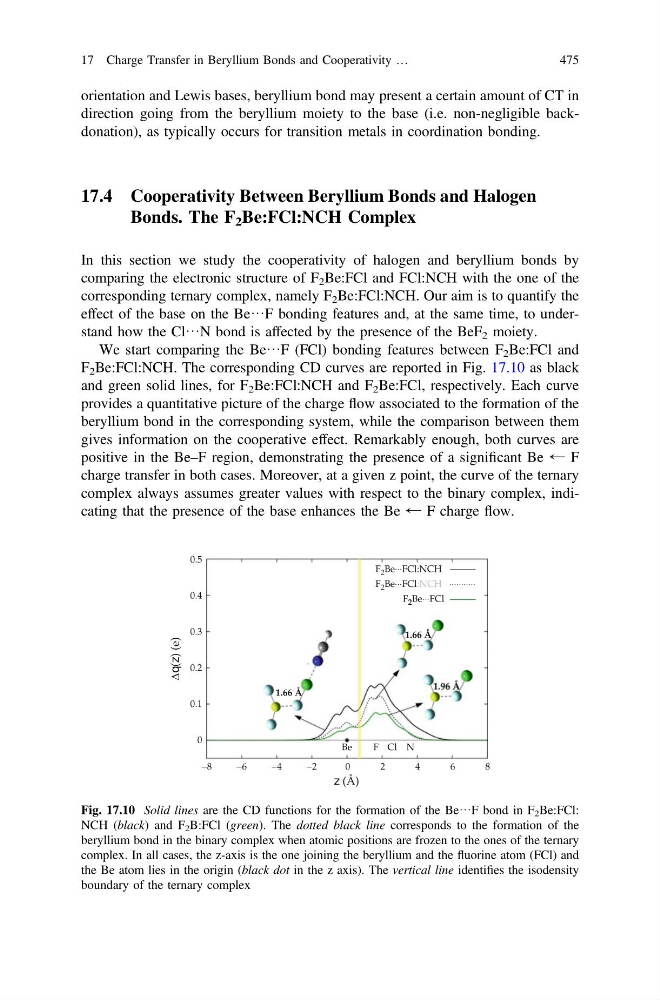
F 2 Be:FCl:NCH. The corresponding CD curves are reported in Fig. 17.10 as black
and green solid lines, for F 2 Be:FCl:NCH and F 2 Be:FCl, respectively. Each curve
provides a quantitative picture of the charge flow associated to the formation of the
beryllium bond in the corresponding system, while the comparison between them
gives information on the cooperative effect. Remarkably enough, both curves are
positive in the Be–F region, demonstrating the presence of a significant Be ← F
charge transfer in both cases. Moreover, at a given z point, the curve of the ternary
complex always assumes greater values with respect to the binary complex, indicating that the presence of the base enhances the Be ← F charge flow.
Fig. 17.10 Solid lines are the CD functions for the formation of the Be···F bond in F 2 Be:FCl:
NCH (black) and F 2 B:FCl (green). The dotted black line corresponds to the formation of the
beryllium bond in the binary complex when atomic positions are frozen to the ones of the ternary
complex. In all cases, the z-axis is the one joining the beryllium and the fluorine atom (FCl) and
the Be atom lies in the origin (black dot in the z axis). The vertical line identifies the isodensity
boundary of the ternary complex
17 Charge Transfer in Beryllium Bonds and Cooperativity …
475
direction going from the beryllium moiety to the base (i.e. non-negligible backdonation), as typically occurs for transition metals in coordination bonding.
17.4 Cooperativity Between Beryllium Bonds and Halogen
Bonds. The F 2 Be:FCl:NCH Complex
In this section we study the cooperativity of halogen and beryllium bonds by
comparing the electronic structure of F 2 Be:FCl and FCl:NCH with the one of the
corresponding ternary complex, namely F 2 Be:FCl:NCH. Our aim is to quantify the
effect of the base on the Be···F bonding features and, at the same time, to understand how the Cl···N bond is affected by the presence of the BeF 2 moiety.
We start comparing the Be···F (FCl) bonding features between F 2 Be:FCl and
F 2 Be:FCl:NCH. The corresponding CD curves are reported in Fig. 17.10 as black
and green solid lines, for F 2 Be:FCl:NCH and F 2 Be:FCl, respectively. Each curve
provides a quantitative picture of the charge flow associated to the formation of the
beryllium bond in the corresponding system, while the comparison between them
gives information on the cooperative effect. Remarkably enough, both curves are
positive in the Be–F region, demonstrating the presence of a significant Be ← F
charge transfer in both cases. Moreover, at a given z point, the curve of the ternary
complex always assumes greater values with respect to the binary complex, indicating that the presence of the base enhances the Be ← F charge flow.
Fig. 17.10 Solid lines are the CD functions for the formation of the Be···F bond in F 2 Be:FCl:
NCH (black) and F 2 B:FCl (green). The dotted black line corresponds to the formation of the
beryllium bond in the binary complex when atomic positions are frozen to the ones of the ternary
complex. In all cases, the z-axis is the one joining the beryllium and the fluorine atom (FCl) and
the Be atom lies in the origin (black dot in the z axis). The vertical line identifies the isodensity
boundary of the ternary complex
17 Charge Transfer in Beryllium Bonds and Cooperativity …
475