

evidenced by the shape and position of basins around S atom in ELF pics of these
complexes in Fig. 17.7.
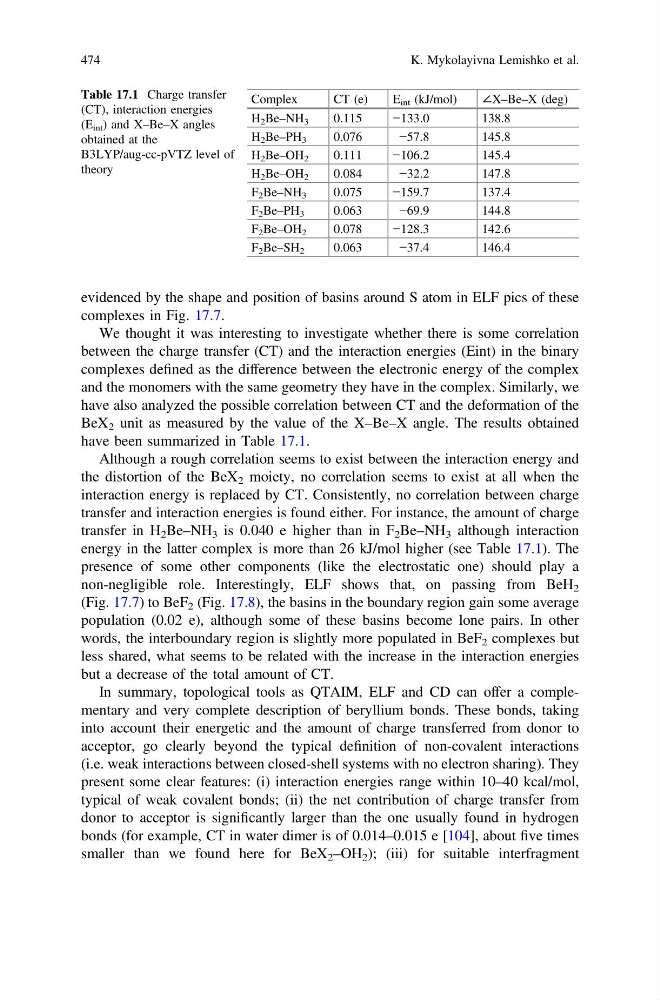
We thought it was interesting to investigate whether there is some correlation
between the charge transfer (CT) and the interaction energies (Eint) in the binary
complexes defined as the difference between the electronic energy of the complex
and the monomers with the same geometry they have in the complex. Similarly, we
have also analyzed the possible correlation between CT and the deformation of the
BeX 2 unit as measured by the value of the X–Be–X angle. The results obtained
have been summarized in Table 17.1.
Although a rough correlation seems to exist between the interaction energy and
the distortion of the BeX 2 moiety, no correlation seems to exist at all when the
interaction energy is replaced by CT. Consistently, no correlation between charge
transfer and interaction energies is found either. For instance, the amount of charge
transfer in H 2 Be–NH 3 is 0.040 e higher than in F 2 Be–NH 3 although interaction
energy in the latter complex is more than 26 kJ/mol higher (see Table 17.1). The
presence of some other components (like the electrostatic one) should play a
non-negligible role. Interestingly, ELF shows that, on passing from BeH 2
(Fig. 17.7) to BeF 2 (Fig. 17.8), the basins in the boundary region gain some average
population (0.02 e), although some of these basins become lone pairs. In other
words, the interboundary region is slightly more populated in BeF 2 complexes but
less shared, what seems to be related with the increase in the interaction energies
but a decrease of the total amount of CT.
In summary, topological tools as QTAIM, ELF and CD can offer a complementary and very complete description of beryllium bonds. These bonds, taking
into account their energetic and the amount of charge transferred from donor to
acceptor, go clearly beyond the typical definition of non-covalent interactions
(i.e. weak interactions between closed-shell systems with no electron sharing). They
present some clear features: (i) interaction energies range within 10–40 kcal/mol,
typical of weak covalent bonds; (ii) the net contribution of charge transfer from
donor to acceptor is significantly larger than the one usually found in hydrogen
bonds (for example, CT in water dimer is of 0.014–0.015 e [104], about five times
smaller than we found here for BeX 2 –OH 2 ); (iii) for suitable interfragment
Table 17.1 Charge transfer
(CT), interaction energies
(E int ) and X–Be–X angles
obtained at the
B3LYP/aug-cc-pVTZ level of
theory
Complex
CT (e)
E int (kJ/mol)
∠X–Be–X (deg)
H 2 Be–NH 3
0.115
−133.0
138.8
H 2 Be–PH 3
0.076
−57.8
145.8
H 2 Be–OH 2
0.111
−106.2
145.4
H 2 Be–OH 2
0.084
−32.2
147.8
F 2 Be–NH 3
0.075
−159.7
137.4
F 2 Be–PH 3
0.063
−69.9
144.8
F 2 Be–OH 2
0.078
−128.3
142.6
F 2 Be–SH 2
0.063
−37.4
146.4
474
K. Mykolayivna Lemishko et al.
complexes in Fig. 17.7.
We thought it was interesting to investigate whether there is some correlation
between the charge transfer (CT) and the interaction energies (Eint) in the binary
complexes defined as the difference between the electronic energy of the complex
and the monomers with the same geometry they have in the complex. Similarly, we
have also analyzed the possible correlation between CT and the deformation of the
BeX 2 unit as measured by the value of the X–Be–X angle. The results obtained
have been summarized in Table 17.1.
Although a rough correlation seems to exist between the interaction energy and
the distortion of the BeX 2 moiety, no correlation seems to exist at all when the
interaction energy is replaced by CT. Consistently, no correlation between charge
transfer and interaction energies is found either. For instance, the amount of charge
transfer in H 2 Be–NH 3 is 0.040 e higher than in F 2 Be–NH 3 although interaction
energy in the latter complex is more than 26 kJ/mol higher (see Table 17.1). The
presence of some other components (like the electrostatic one) should play a
non-negligible role. Interestingly, ELF shows that, on passing from BeH 2
(Fig. 17.7) to BeF 2 (Fig. 17.8), the basins in the boundary region gain some average
population (0.02 e), although some of these basins become lone pairs. In other
words, the interboundary region is slightly more populated in BeF 2 complexes but
less shared, what seems to be related with the increase in the interaction energies
but a decrease of the total amount of CT.
In summary, topological tools as QTAIM, ELF and CD can offer a complementary and very complete description of beryllium bonds. These bonds, taking
into account their energetic and the amount of charge transferred from donor to
acceptor, go clearly beyond the typical definition of non-covalent interactions
(i.e. weak interactions between closed-shell systems with no electron sharing). They
present some clear features: (i) interaction energies range within 10–40 kcal/mol,
typical of weak covalent bonds; (ii) the net contribution of charge transfer from
donor to acceptor is significantly larger than the one usually found in hydrogen
bonds (for example, CT in water dimer is of 0.014–0.015 e [104], about five times
smaller than we found here for BeX 2 –OH 2 ); (iii) for suitable interfragment
Table 17.1 Charge transfer
(CT), interaction energies
(E int ) and X–Be–X angles
obtained at the
B3LYP/aug-cc-pVTZ level of
theory
Complex
CT (e)
E int (kJ/mol)
∠X–Be–X (deg)
H 2 Be–NH 3
0.115
−133.0
138.8
H 2 Be–PH 3
0.076
−57.8
145.8
H 2 Be–OH 2
0.111
−106.2
145.4
H 2 Be–OH 2
0.084
−32.2
147.8
F 2 Be–NH 3
0.075
−159.7
137.4
F 2 Be–PH 3
0.063
−69.9
144.8
F 2 Be–OH 2
0.078
−128.3
142.6
F 2 Be–SH 2
0.063
−37.4
146.4
474
K. Mykolayivna Lemishko et al.