

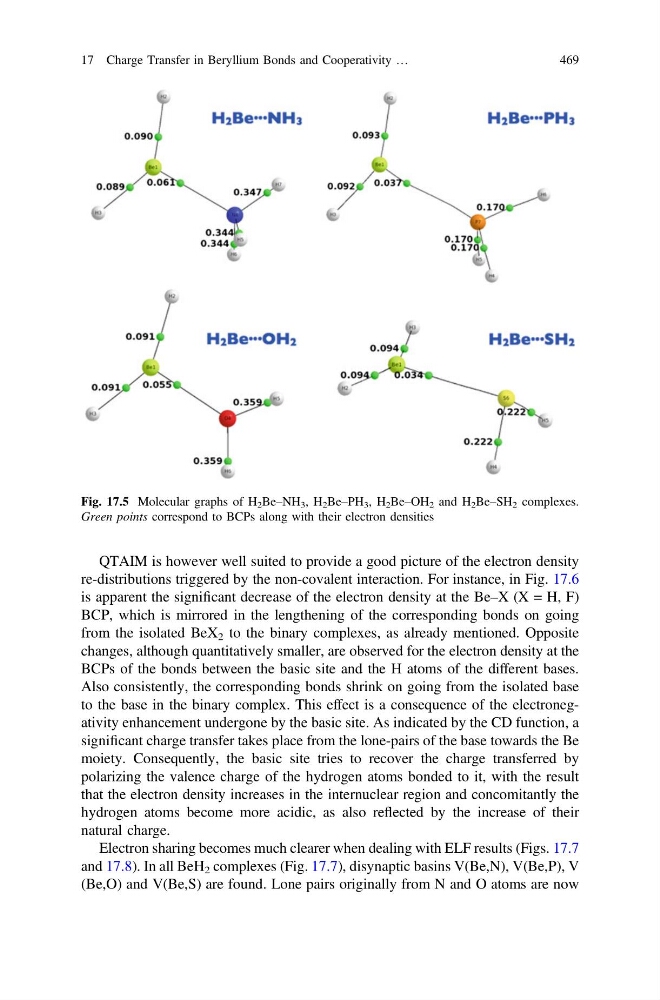
QTAIM is however well suited to provide a good picture of the electron density
re-distributions triggered by the non-covalent interaction. For instance, in Fig. 17.6
is apparent the significant decrease of the electron density at the Be–X (X = H, F)
BCP, which is mirrored in the lengthening of the corresponding bonds on going
from the isolated BeX 2 to the binary complexes, as already mentioned. Opposite
changes, although quantitatively smaller, are observed for the electron density at the
BCPs of the bonds between the basic site and the H atoms of the different bases.
Also consistently, the corresponding bonds shrink on going from the isolated base
to the base in the binary complex. This effect is a consequence of the electronegativity enhancement undergone by the basic site. As indicated by the CD function, a
significant charge transfer takes place from the lone-pairs of the base towards the Be
moiety. Consequently, the basic site tries to recover the charge transferred by
polarizing the valence charge of the hydrogen atoms bonded to it, with the result
that the electron density increases in the internuclear region and concomitantly the
hydrogen atoms become more acidic, as also reflected by the increase of their
natural charge.
Electron sharing becomes much clearer when dealing with ELF results (Figs. 17.7
and 17.8). In all BeH 2 complexes (Fig. 17.7), disynaptic basins V(Be,N), V(Be,P), V
(Be,O) and V(Be,S) are found. Lone pairs originally from N and O atoms are now
Fig. 17.5 Molecular graphs of H 2 Be–NH 3 , H 2 Be–PH 3 , H 2 Be–OH 2 and H 2 Be–SH 2 complexes.
Green points correspond to BCPs along with their electron densities
17 Charge Transfer in Beryllium Bonds and Cooperativity …
469
re-distributions triggered by the non-covalent interaction. For instance, in Fig. 17.6
is apparent the significant decrease of the electron density at the Be–X (X = H, F)
BCP, which is mirrored in the lengthening of the corresponding bonds on going
from the isolated BeX 2 to the binary complexes, as already mentioned. Opposite
changes, although quantitatively smaller, are observed for the electron density at the
BCPs of the bonds between the basic site and the H atoms of the different bases.
Also consistently, the corresponding bonds shrink on going from the isolated base
to the base in the binary complex. This effect is a consequence of the electronegativity enhancement undergone by the basic site. As indicated by the CD function, a
significant charge transfer takes place from the lone-pairs of the base towards the Be
moiety. Consequently, the basic site tries to recover the charge transferred by
polarizing the valence charge of the hydrogen atoms bonded to it, with the result
that the electron density increases in the internuclear region and concomitantly the
hydrogen atoms become more acidic, as also reflected by the increase of their
natural charge.
Electron sharing becomes much clearer when dealing with ELF results (Figs. 17.7
and 17.8). In all BeH 2 complexes (Fig. 17.7), disynaptic basins V(Be,N), V(Be,P), V
(Be,O) and V(Be,S) are found. Lone pairs originally from N and O atoms are now
Fig. 17.5 Molecular graphs of H 2 Be–NH 3 , H 2 Be–PH 3 , H 2 Be–OH 2 and H 2 Be–SH 2 complexes.
Green points correspond to BCPs along with their electron densities
17 Charge Transfer in Beryllium Bonds and Cooperativity …
469