

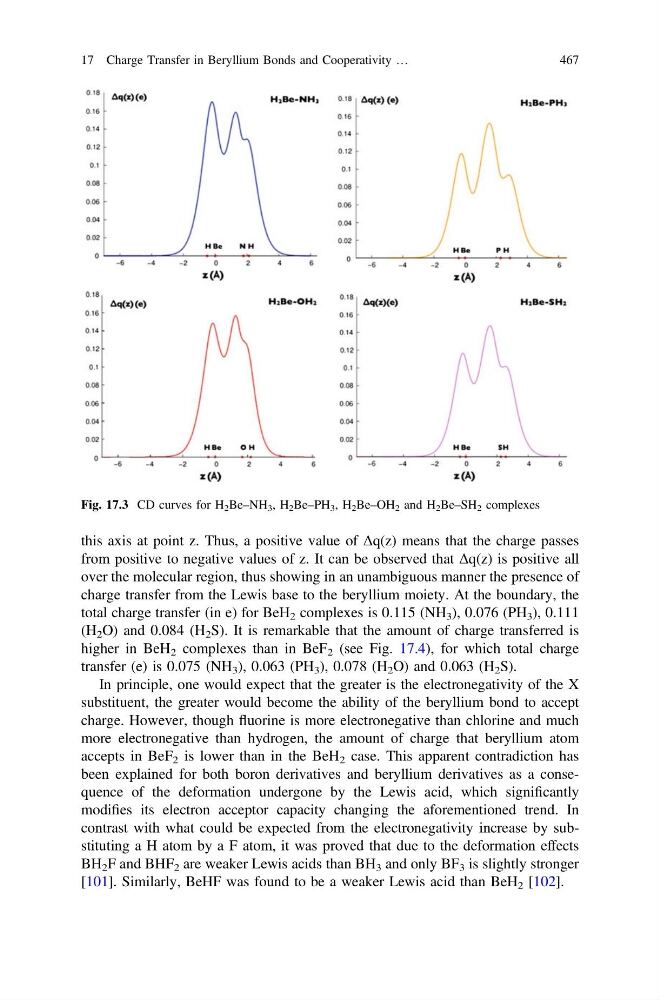
this axis at point z. Thus, a positive value of Δq(z) means that the charge passes
from positive to negative values of z. It can be observed that Δq(z) is positive all
over the molecular region, thus showing in an unambiguous manner the presence of
charge transfer from the Lewis base to the beryllium moiety. At the boundary, the
total charge transfer (in e) for BeH 2 complexes is 0.115 (NH 3 ), 0.076 (PH 3 ), 0.111
(H 2 O) and 0.084 (H 2 S). It is remarkable that the amount of charge transferred is
higher in BeH 2 complexes than in BeF 2 (see Fig. 17.4), for which total charge
transfer (e) is 0.075 (NH 3 ), 0.063 (PH 3 ), 0.078 (H 2 O) and 0.063 (H 2 S).
In principle, one would expect that the greater is the electronegativity of the X
substituent, the greater would become the ability of the beryllium bond to accept
charge. However, though fluorine is more electronegative than chlorine and much
more electronegative than hydrogen, the amount of charge that beryllium atom
accepts in BeF 2 is lower than in the BeH 2 case. This apparent contradiction has
been explained for both boron derivatives and beryllium derivatives as a consequence of the deformation undergone by the Lewis acid, which significantly
modifies its electron acceptor capacity changing the aforementioned trend. In
contrast with what could be expected from the electronegativity increase by substituting a H atom by a F atom, it was proved that due to the deformation effects
BH 2 F and BHF 2 are weaker Lewis acids than BH 3 and only BF 3 is slightly stronger
[101]. Similarly, BeHF was found to be a weaker Lewis acid than BeH 2 [102].
Fig. 17.3 CD curves for H 2 Be–NH 3 , H 2 Be–PH 3 , H 2 Be–OH 2 and H 2 Be–SH 2 complexes
17 Charge Transfer in Beryllium Bonds and Cooperativity …
467
from positive to negative values of z. It can be observed that Δq(z) is positive all
over the molecular region, thus showing in an unambiguous manner the presence of
charge transfer from the Lewis base to the beryllium moiety. At the boundary, the
total charge transfer (in e) for BeH 2 complexes is 0.115 (NH 3 ), 0.076 (PH 3 ), 0.111
(H 2 O) and 0.084 (H 2 S). It is remarkable that the amount of charge transferred is
higher in BeH 2 complexes than in BeF 2 (see Fig. 17.4), for which total charge
transfer (e) is 0.075 (NH 3 ), 0.063 (PH 3 ), 0.078 (H 2 O) and 0.063 (H 2 S).
In principle, one would expect that the greater is the electronegativity of the X
substituent, the greater would become the ability of the beryllium bond to accept
charge. However, though fluorine is more electronegative than chlorine and much
more electronegative than hydrogen, the amount of charge that beryllium atom
accepts in BeF 2 is lower than in the BeH 2 case. This apparent contradiction has
been explained for both boron derivatives and beryllium derivatives as a consequence of the deformation undergone by the Lewis acid, which significantly
modifies its electron acceptor capacity changing the aforementioned trend. In
contrast with what could be expected from the electronegativity increase by substituting a H atom by a F atom, it was proved that due to the deformation effects
BH 2 F and BHF 2 are weaker Lewis acids than BH 3 and only BF 3 is slightly stronger
[101]. Similarly, BeHF was found to be a weaker Lewis acid than BeH 2 [102].
Fig. 17.3 CD curves for H 2 Be–NH 3 , H 2 Be–PH 3 , H 2 Be–OH 2 and H 2 Be–SH 2 complexes
17 Charge Transfer in Beryllium Bonds and Cooperativity …
467