

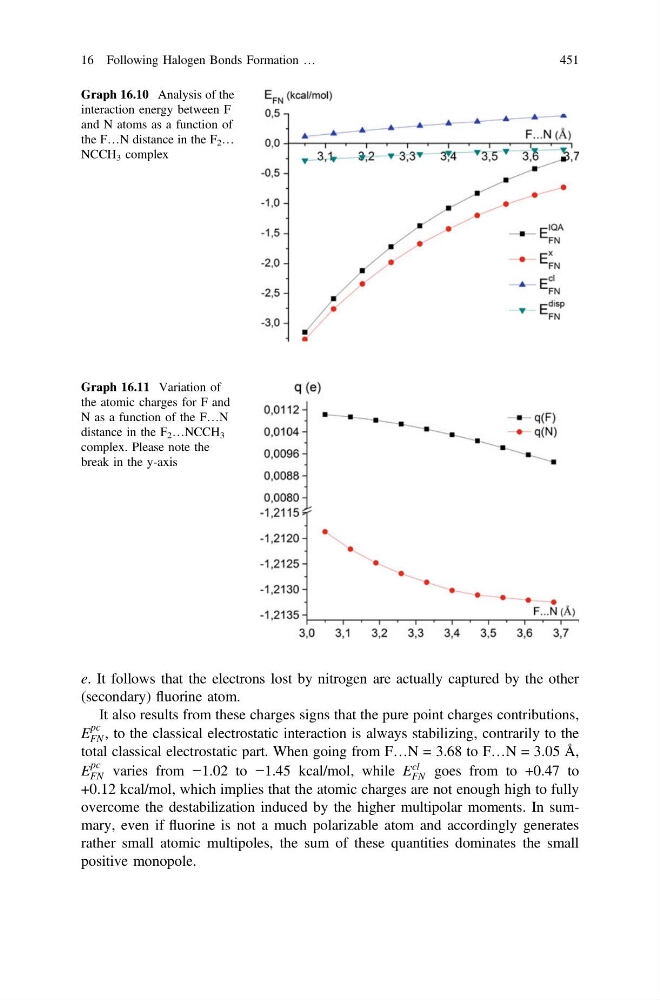
e. It follows that the electrons lost by nitrogen are actually captured by the other
(secondary) fluorine atom.
It also results from these charges signs that the pure point charges contributions,
E
pc
FN , to the classical electrostatic interaction is always stabilizing, contrarily to the
total classical electrostatic part. When going from F…N = 3.68 to F…N = 3.05 Å,
E
pc
FN varies from −1.02 to −1.45 kcal/mol, while E
cl
FN goes from to +0.47 to
+0.12 kcal/mol, which implies that the atomic charges are not enough high to fully
overcome the destabilization induced by the higher multipolar moments. In summary, even if fluorine is not a much polarizable atom and accordingly generates
rather small atomic multipoles, the sum of these quantities dominates the small
positive monopole.
Graph 16.10 Analysis of the
interaction energy between F
and N atoms as a function of
the F…N distance in the F 2 …
NCCH 3 complex
Graph 16.11 Variation of
the atomic charges for F and
N as a function of the F…N
distance in the F 2 …NCCH 3
complex. Please note the
break in the y-axis
16 Following Halogen Bonds Formation …
451
(secondary) fluorine atom.
It also results from these charges signs that the pure point charges contributions,
E
pc
FN , to the classical electrostatic interaction is always stabilizing, contrarily to the
total classical electrostatic part. When going from F…N = 3.68 to F…N = 3.05 Å,
E
pc
FN varies from −1.02 to −1.45 kcal/mol, while E
cl
FN goes from to +0.47 to
+0.12 kcal/mol, which implies that the atomic charges are not enough high to fully
overcome the destabilization induced by the higher multipolar moments. In summary, even if fluorine is not a much polarizable atom and accordingly generates
rather small atomic multipoles, the sum of these quantities dominates the small
positive monopole.
Graph 16.10 Analysis of the
interaction energy between F
and N atoms as a function of
the F…N distance in the F 2 …
NCCH 3 complex
Graph 16.11 Variation of
the atomic charges for F and
N as a function of the F…N
distance in the F 2 …NCCH 3
complex. Please note the
break in the y-axis
16 Following Halogen Bonds Formation …
451