

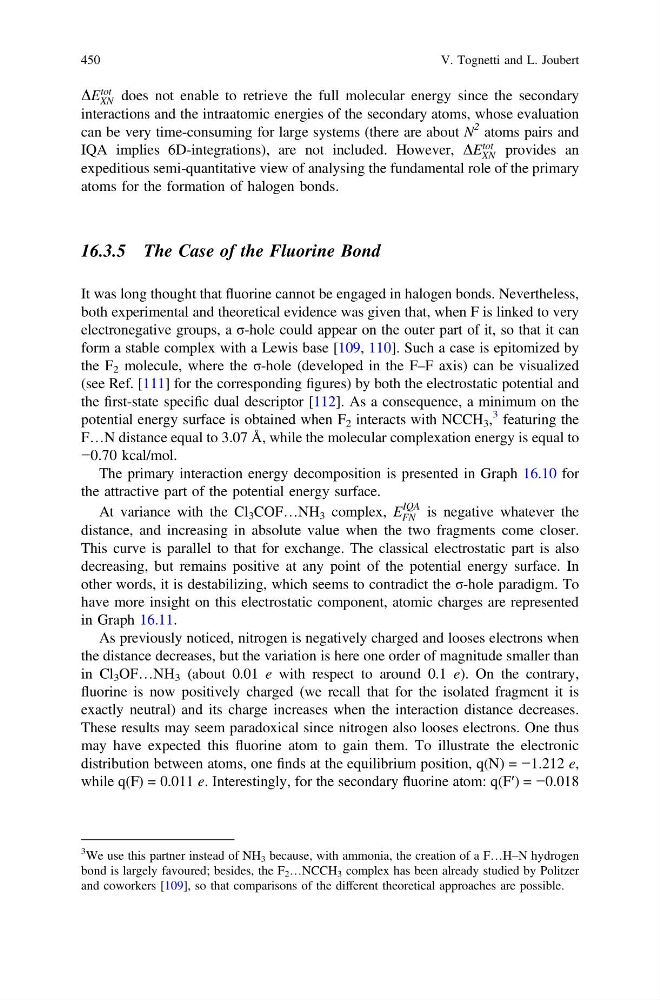
DE
tot
XN does not enable to retrieve the full molecular energy since the secondary
interactions and the intraatomic energies of the secondary atoms, whose evaluation
can be very time-consuming for large systems (there are about N
2 atoms pairs and
IQA implies 6D-integrations), are not included. However, DE
tot
XN provides an
expeditious semi-quantitative view of analysing the fundamental role of the primary
atoms for the formation of halogen bonds.
16.3.5 The Case of the Fluorine Bond
It was long thought that fluorine cannot be engaged in halogen bonds. Nevertheless,
both experimental and theoretical evidence was given that, when F is linked to very
electronegative groups, a σ-hole could appear on the outer part of it, so that it can
form a stable complex with a Lewis base [109, 110]. Such a case is epitomized by
the F 2 molecule, where the σ-hole (developed in the F–F axis) can be visualized
(see Ref. [111] for the corresponding figures) by both the electrostatic potential and
the first-state specific dual descriptor [112]. As a consequence, a minimum on the
potential energy surface is obtained when F 2 interacts with NCCH 3 ,
3 featuring the
F…N distance equal to 3.07 Å, while the molecular complexation energy is equal to
−0.70 kcal/mol.
The primary interaction energy decomposition is presented in Graph 16.10 for
the attractive part of the potential energy surface.
At variance with the Cl 3 COF…NH 3 complex, E
IQA
FN is negative whatever the
distance, and increasing in absolute value when the two fragments come closer.
This curve is parallel to that for exchange. The classical electrostatic part is also
decreasing, but remains positive at any point of the potential energy surface. In
other words, it is destabilizing, which seems to contradict the σ-hole paradigm. To
have more insight on this electrostatic component, atomic charges are represented
in Graph 16.11.
As previously noticed, nitrogen is negatively charged and looses electrons when
the distance decreases, but the variation is here one order of magnitude smaller than
in Cl 3 OF…NH 3 (about 0.01 e with respect to around 0.1 e). On the contrary,
fluorine is now positively charged (we recall that for the isolated fragment it is
exactly neutral) and its charge increases when the interaction distance decreases.
These results may seem paradoxical since nitrogen also looses electrons. One thus
may have expected this fluorine atom to gain them. To illustrate the electronic
distribution between atoms, one finds at the equilibrium position, q(N) = −1.212 e,
while q(F) = 0.011 e. Interestingly, for the secondary fluorine atom: q(Fʹ) = −0.018
3
We use this partner instead of NH 3 because, with ammonia, the creation of a F…H–N hydrogen
bond is largely favoured; besides, the F 2 …NCCH 3 complex has been already studied by Politzer
and coworkers [109], so that comparisons of the different theoretical approaches are possible.
450
V. Tognetti and L. Joubert
tot
XN does not enable to retrieve the full molecular energy since the secondary
interactions and the intraatomic energies of the secondary atoms, whose evaluation
can be very time-consuming for large systems (there are about N
2 atoms pairs and
IQA implies 6D-integrations), are not included. However, DE
tot
XN provides an
expeditious semi-quantitative view of analysing the fundamental role of the primary
atoms for the formation of halogen bonds.
16.3.5 The Case of the Fluorine Bond
It was long thought that fluorine cannot be engaged in halogen bonds. Nevertheless,
both experimental and theoretical evidence was given that, when F is linked to very
electronegative groups, a σ-hole could appear on the outer part of it, so that it can
form a stable complex with a Lewis base [109, 110]. Such a case is epitomized by
the F 2 molecule, where the σ-hole (developed in the F–F axis) can be visualized
(see Ref. [111] for the corresponding figures) by both the electrostatic potential and
the first-state specific dual descriptor [112]. As a consequence, a minimum on the
potential energy surface is obtained when F 2 interacts with NCCH 3 ,
3 featuring the
F…N distance equal to 3.07 Å, while the molecular complexation energy is equal to
−0.70 kcal/mol.
The primary interaction energy decomposition is presented in Graph 16.10 for
the attractive part of the potential energy surface.
At variance with the Cl 3 COF…NH 3 complex, E
IQA
FN is negative whatever the
distance, and increasing in absolute value when the two fragments come closer.
This curve is parallel to that for exchange. The classical electrostatic part is also
decreasing, but remains positive at any point of the potential energy surface. In
other words, it is destabilizing, which seems to contradict the σ-hole paradigm. To
have more insight on this electrostatic component, atomic charges are represented
in Graph 16.11.
As previously noticed, nitrogen is negatively charged and looses electrons when
the distance decreases, but the variation is here one order of magnitude smaller than
in Cl 3 OF…NH 3 (about 0.01 e with respect to around 0.1 e). On the contrary,
fluorine is now positively charged (we recall that for the isolated fragment it is
exactly neutral) and its charge increases when the interaction distance decreases.
These results may seem paradoxical since nitrogen also looses electrons. One thus
may have expected this fluorine atom to gain them. To illustrate the electronic
distribution between atoms, one finds at the equilibrium position, q(N) = −1.212 e,
while q(F) = 0.011 e. Interestingly, for the secondary fluorine atom: q(Fʹ) = −0.018
3
We use this partner instead of NH 3 because, with ammonia, the creation of a F…H–N hydrogen
bond is largely favoured; besides, the F 2 …NCCH 3 complex has been already studied by Politzer
and coworkers [109], so that comparisons of the different theoretical approaches are possible.
450
V. Tognetti and L. Joubert