

It is found negative at any distance for Cl and Br (more stabilizing in that case),
being larger and larger as the distance decreases. On the contrary, it is noteworthy
that the F…N interaction, which is destabilizing at long range, becomes slightly
negative in energy when the distance is lower than about 2.3 Å (but not enough to
overcome the other factors of destabilization, which will be discussed later).
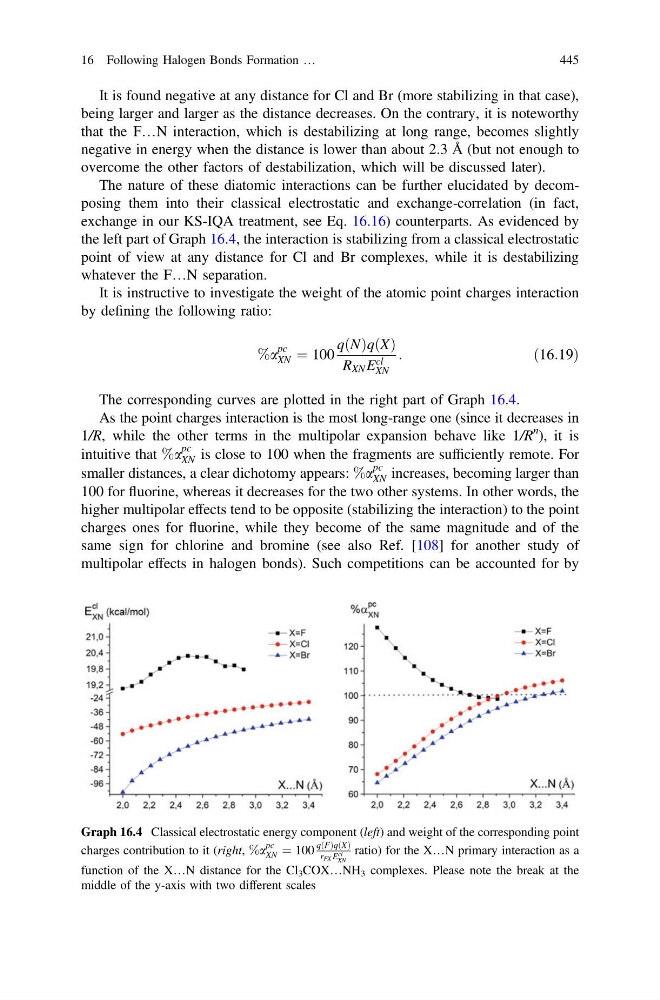
The nature of these diatomic interactions can be further elucidated by decomposing them into their classical electrostatic and exchange-correlation (in fact,
exchange in our KS-IQA treatment, see Eq. 16.16) counterparts. As evidenced by
the left part of Graph 16.4, the interaction is stabilizing from a classical electrostatic
point of view at any distance for Cl and Br complexes, while it is destabilizing
whatever the F…N separation.
It is instructive to investigate the weight of the atomic point charges interaction
by defining the following ratio:
%a
pc
XN ¼ 100
qðNÞqðXÞ
R XN E
cl
XN
:
ð16:19Þ
The corresponding curves are plotted in the right part of Graph 16.4.
As the point charges interaction is the most long-range one (since it decreases in
1/R, while the other terms in the multipolar expansion behave like 1/R
n ), it is
intuitive that %a
pc
XN is close to 100 when the fragments are sufficiently remote. For
smaller distances, a clear dichotomy appears: %a
pc
XN increases, becoming larger than
100 for fluorine, whereas it decreases for the two other systems. In other words, the
higher multipolar effects tend to be opposite (stabilizing the interaction) to the point
charges ones for fluorine, while they become of the same magnitude and of the
same sign for chlorine and bromine (see also Ref. [108] for another study of
multipolar effects in halogen bonds). Such competitions can be accounted for by
Graph 16.4 Classical electrostatic energy component (left) and weight of the corresponding point
charges contribution to it (right, %a
pc
XN ¼ 100
qðFÞqðXÞ
rFX E cl
XN
ratio) for the X…N primary interaction as a
function of the X…N distance for the Cl 3 COX…NH 3 complexes. Please note the break at the
middle of the y-axis with two different scales
16 Following Halogen Bonds Formation …
445
being larger and larger as the distance decreases. On the contrary, it is noteworthy
that the F…N interaction, which is destabilizing at long range, becomes slightly
negative in energy when the distance is lower than about 2.3 Å (but not enough to
overcome the other factors of destabilization, which will be discussed later).
The nature of these diatomic interactions can be further elucidated by decomposing them into their classical electrostatic and exchange-correlation (in fact,
exchange in our KS-IQA treatment, see Eq. 16.16) counterparts. As evidenced by
the left part of Graph 16.4, the interaction is stabilizing from a classical electrostatic
point of view at any distance for Cl and Br complexes, while it is destabilizing
whatever the F…N separation.
It is instructive to investigate the weight of the atomic point charges interaction
by defining the following ratio:
%a
pc
XN ¼ 100
qðNÞqðXÞ
R XN E
cl
XN
:
ð16:19Þ
The corresponding curves are plotted in the right part of Graph 16.4.
As the point charges interaction is the most long-range one (since it decreases in
1/R, while the other terms in the multipolar expansion behave like 1/R
n ), it is
intuitive that %a
pc
XN is close to 100 when the fragments are sufficiently remote. For
smaller distances, a clear dichotomy appears: %a
pc
XN increases, becoming larger than
100 for fluorine, whereas it decreases for the two other systems. In other words, the
higher multipolar effects tend to be opposite (stabilizing the interaction) to the point
charges ones for fluorine, while they become of the same magnitude and of the
same sign for chlorine and bromine (see also Ref. [108] for another study of
multipolar effects in halogen bonds). Such competitions can be accounted for by
Graph 16.4 Classical electrostatic energy component (left) and weight of the corresponding point
charges contribution to it (right, %a
pc
XN ¼ 100
qðFÞqðXÞ
rFX E cl
XN
ratio) for the X…N primary interaction as a
function of the X…N distance for the Cl 3 COX…NH 3 complexes. Please note the break at the
middle of the y-axis with two different scales
16 Following Halogen Bonds Formation …
445