

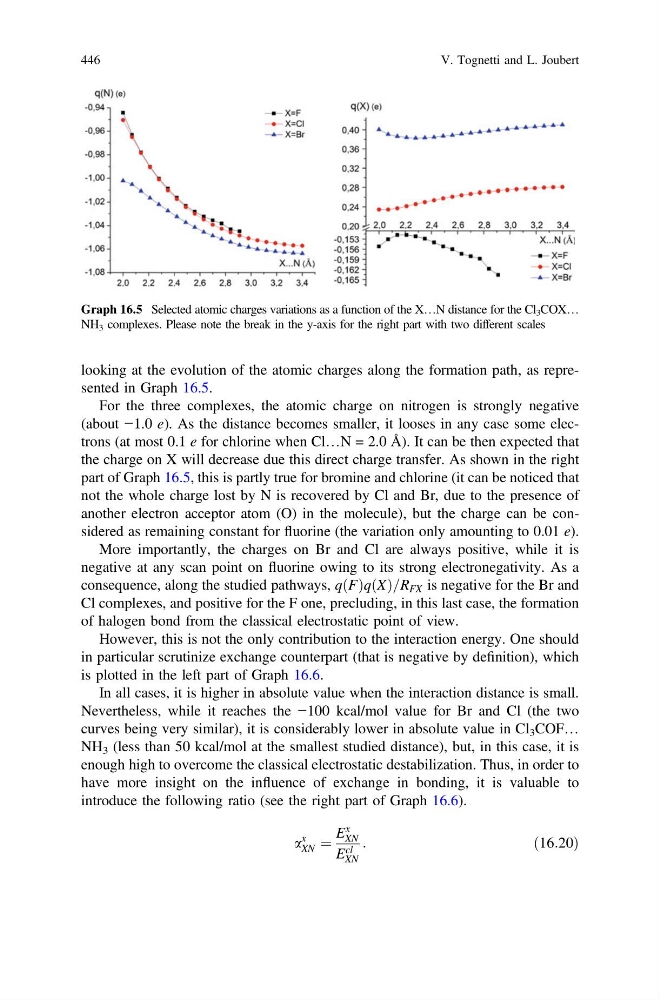
looking at the evolution of the atomic charges along the formation path, as represented in Graph 16.5.
For the three complexes, the atomic charge on nitrogen is strongly negative
(about −1.0 e). As the distance becomes smaller, it looses in any case some electrons (at most 0.1 e for chlorine when Cl…N = 2.0 Å). It can be then expected that
the charge on X will decrease due this direct charge transfer. As shown in the right
part of Graph 16.5, this is partly true for bromine and chlorine (it can be noticed that
not the whole charge lost by N is recovered by Cl and Br, due to the presence of
another electron acceptor atom (O) in the molecule), but the charge can be considered as remaining constant for fluorine (the variation only amounting to 0.01 e).
More importantly, the charges on Br and Cl are always positive, while it is
negative at any scan point on fluorine owing to its strong electronegativity. As a
consequence, along the studied pathways, qðFÞqðXÞ=R FX is negative for the Br and
Cl complexes, and positive for the F one, precluding, in this last case, the formation
of halogen bond from the classical electrostatic point of view.
However, this is not the only contribution to the interaction energy. One should
in particular scrutinize exchange counterpart (that is negative by definition), which
is plotted in the left part of Graph 16.6.
In all cases, it is higher in absolute value when the interaction distance is small.
Nevertheless, while it reaches the −100 kcal/mol value for Br and Cl (the two
curves being very similar), it is considerably lower in absolute value in Cl 3 COF…
NH 3 (less than 50 kcal/mol at the smallest studied distance), but, in this case, it is
enough high to overcome the classical electrostatic destabilization. Thus, in order to
have more insight on the influence of exchange in bonding, it is valuable to
introduce the following ratio (see the right part of Graph 16.6).
a
x
XN ¼
E
x
XN
E
cl
XN
:
ð16:20Þ
Graph 16.5 Selected atomic charges variations as a function of the X…N distance for the Cl 3 COX…
NH 3 complexes. Please note the break in the y-axis for the right part with two different scales
446
V. Tognetti and L. Joubert
For the three complexes, the atomic charge on nitrogen is strongly negative
(about −1.0 e). As the distance becomes smaller, it looses in any case some electrons (at most 0.1 e for chlorine when Cl…N = 2.0 Å). It can be then expected that
the charge on X will decrease due this direct charge transfer. As shown in the right
part of Graph 16.5, this is partly true for bromine and chlorine (it can be noticed that
not the whole charge lost by N is recovered by Cl and Br, due to the presence of
another electron acceptor atom (O) in the molecule), but the charge can be considered as remaining constant for fluorine (the variation only amounting to 0.01 e).
More importantly, the charges on Br and Cl are always positive, while it is
negative at any scan point on fluorine owing to its strong electronegativity. As a
consequence, along the studied pathways, qðFÞqðXÞ=R FX is negative for the Br and
Cl complexes, and positive for the F one, precluding, in this last case, the formation
of halogen bond from the classical electrostatic point of view.
However, this is not the only contribution to the interaction energy. One should
in particular scrutinize exchange counterpart (that is negative by definition), which
is plotted in the left part of Graph 16.6.
In all cases, it is higher in absolute value when the interaction distance is small.
Nevertheless, while it reaches the −100 kcal/mol value for Br and Cl (the two
curves being very similar), it is considerably lower in absolute value in Cl 3 COF…
NH 3 (less than 50 kcal/mol at the smallest studied distance), but, in this case, it is
enough high to overcome the classical electrostatic destabilization. Thus, in order to
have more insight on the influence of exchange in bonding, it is valuable to
introduce the following ratio (see the right part of Graph 16.6).
a
x
XN ¼
E
x
XN
E
cl
XN
:
ð16:20Þ
Graph 16.5 Selected atomic charges variations as a function of the X…N distance for the Cl 3 COX…
NH 3 complexes. Please note the break in the y-axis for the right part with two different scales
446
V. Tognetti and L. Joubert