

their promolecular essence in the complex since they still fulfil the PH equality
given by Eq. 16.18. Thus, in order that the total complex also respects PH at the
molecular level, at least one (3, −1) or one (3, −3) must be created, a pure mathematical effect, independent of the nature of the interactions between the moieties
(as also discussed in Ref. [65]). Graph 16.2 shows the variations of the electron
density and laplacian values at this (3, −1) CP.
The curves are all similar in the attractive part of the potential energy surface: the
electron density and laplacian values increase, but q ð3;À1Þ remains small (consistently
with the assumed non-covalent nature of the interactions), and r
2
q ð3;À1Þ is still
positive (in accordance with their expected noncovalent character). However, these
(3, −1) CP properties do not enable to discriminate between stable and unstable
complexes (that is between X = Br, Cl on one hand, and X = F on the other hand).
It can be added that neither do some other local real space approaches like the
noncovalent interactions index (NCI) [106], which will predict attraction in all
cases due to the presence of this (3, −1) CP, as also revealed for similar systems by
Cormanich et al. [107]. Such local approaches should thus be complemented by
integrated ones. To this aim, the IQA scheme is certainly particularly appealing.
16.3.3 Energy Decomposition of the Primary X…N
Interaction
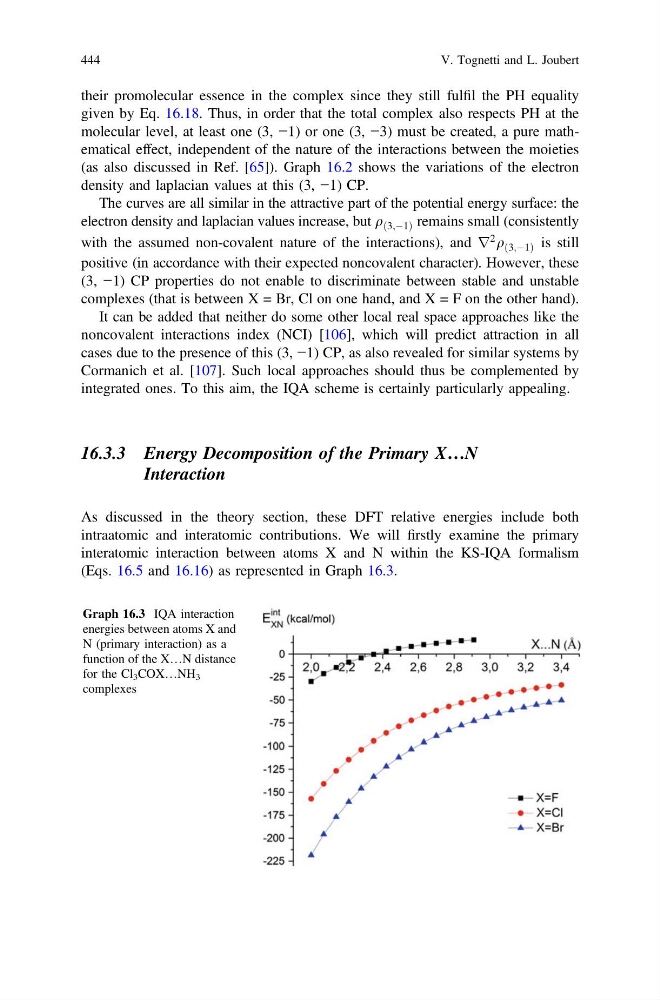
As discussed in the theory section, these DFT relative energies include both
intraatomic and interatomic contributions. We will firstly examine the primary
interatomic interaction between atoms X and N within the KS-IQA formalism
(Eqs. 16.5 and 16.16) as represented in Graph 16.3.
Graph 16.3 IQA interaction
energies between atoms X and
N (primary interaction) as a
function of the X…N distance
for the Cl 3 COX…NH 3
complexes
444
V. Tognetti and L. Joubert
given by Eq. 16.18. Thus, in order that the total complex also respects PH at the
molecular level, at least one (3, −1) or one (3, −3) must be created, a pure mathematical effect, independent of the nature of the interactions between the moieties
(as also discussed in Ref. [65]). Graph 16.2 shows the variations of the electron
density and laplacian values at this (3, −1) CP.
The curves are all similar in the attractive part of the potential energy surface: the
electron density and laplacian values increase, but q ð3;À1Þ remains small (consistently
with the assumed non-covalent nature of the interactions), and r
2
q ð3;À1Þ is still
positive (in accordance with their expected noncovalent character). However, these
(3, −1) CP properties do not enable to discriminate between stable and unstable
complexes (that is between X = Br, Cl on one hand, and X = F on the other hand).
It can be added that neither do some other local real space approaches like the
noncovalent interactions index (NCI) [106], which will predict attraction in all
cases due to the presence of this (3, −1) CP, as also revealed for similar systems by
Cormanich et al. [107]. Such local approaches should thus be complemented by
integrated ones. To this aim, the IQA scheme is certainly particularly appealing.
16.3.3 Energy Decomposition of the Primary X…N
Interaction
As discussed in the theory section, these DFT relative energies include both
intraatomic and interatomic contributions. We will firstly examine the primary
interatomic interaction between atoms X and N within the KS-IQA formalism
(Eqs. 16.5 and 16.16) as represented in Graph 16.3.
Graph 16.3 IQA interaction
energies between atoms X and
N (primary interaction) as a
function of the X…N distance
for the Cl 3 COX…NH 3
complexes
444
V. Tognetti and L. Joubert